


Fig. 5. miR-1290- and miR-1246-activated astrocytes secrete CNTF to promote breast cancer stem cells.
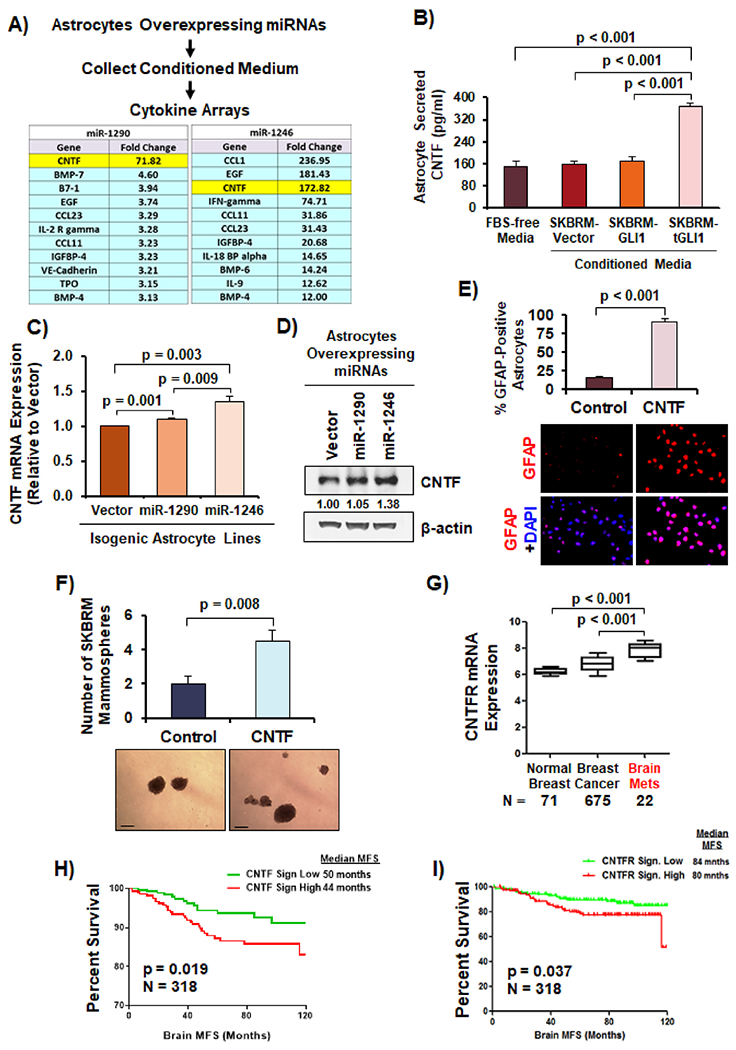
(A) Schematic of cytokine array assay. Table of top secreted cytokines and growth factors from astrocytes overexpressing miR-1290 and -1246 compared to control astrocytes. (B) Astrocytes secreted more CNTF in the presence of CM from SKBRM-tGLI1 cells as indicated by CNTF ELISA. (C) CNTF mRNA expression in astrocytes overexpressing vector, miR-1290, and miR-1246 using RT-qPCR. (D) CNTF protein expression in astrocytes overexpressing vector, miR-1290, and miR-1246 as indicated by Western blot analysis with quantification. (E) CNTF activated astrocytes as indicated by GFAP immunofluorescence. Human astrocytes were stimulated with or without 100 ng/mL of CNTF. 10× magnification. (F) CNTF increased mammosphere formation of SKBRM cells. 5× magnification. Scale bar indicates 100 μm. (G) Expression of CNTFR-α in normal breast tissue, breast cancer, and BCBM. (H–I) Kaplan-Meier plot of brain MFS using with CNTF and CNTFR gene signatures in breast cancer GEO datasets (GSE3740/40267/68373/73002/86278/158309). Log-Rank (Mantle-Cox) test was used in Panels H–I. Student’s t-test was used in Panels B–G to compute p-values. N = 3 experimental replicates.