


Fig. 3. Polyploid giant cancer cells (PGCCs) are capable of differentiation into morphologically different benign lineages.
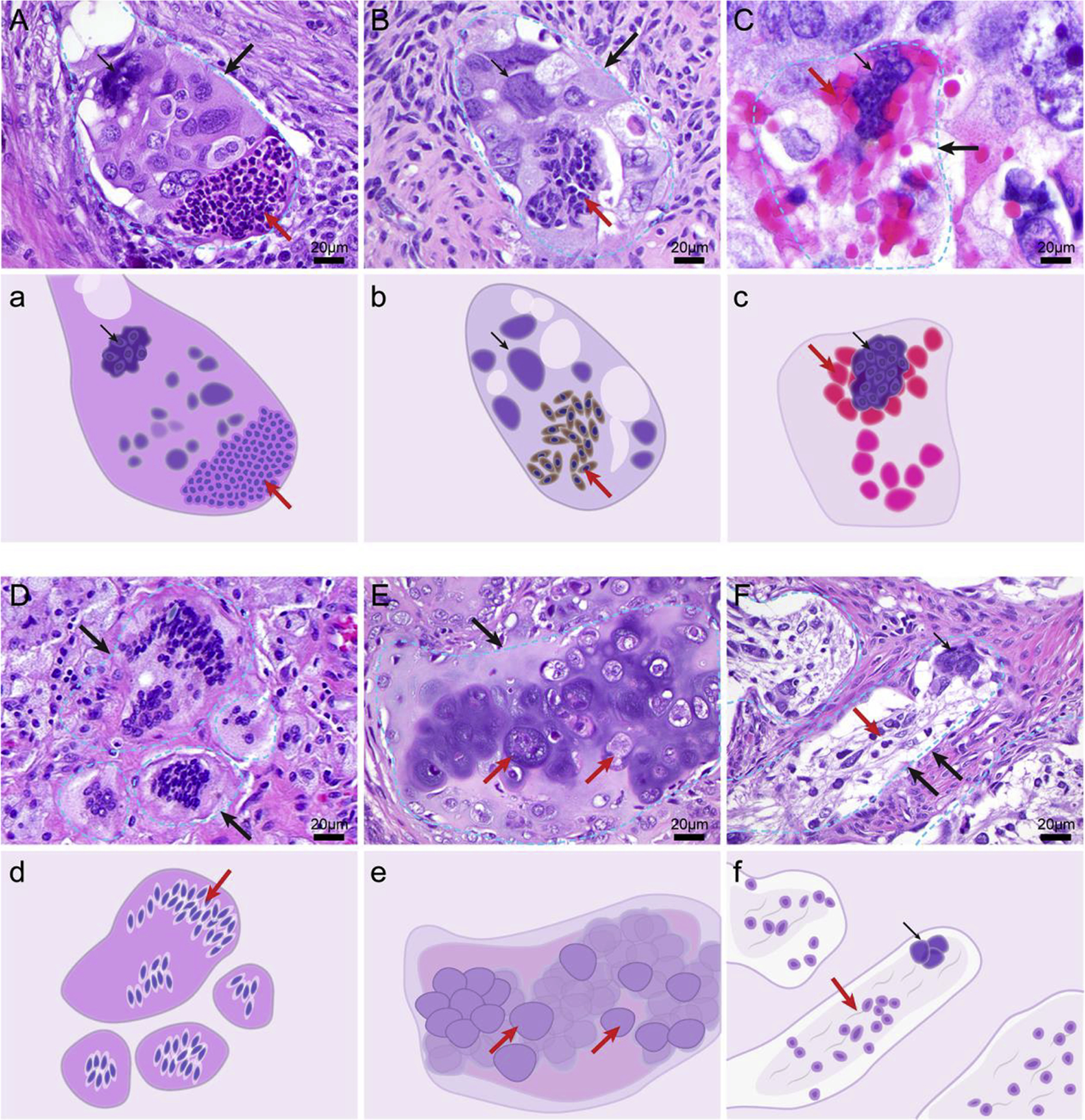
A. A PGCC with half nuclei differentiating into neutrophil-like cells. B. A PGCC differentiating into fibroblasts. C. A PGCC generating hemoglobin-forming erythroid cells. D. A PGCC differentiating into multinucleated foamy histiocytes. E. A PGCC forming chondrocytes. F. A PGCC differentiating into neuronal cells. Large black arrows indicate the outline of a PGCC; small black arrows, the giant nucleus of a PGCC; red arrows, the differentiated benign lineage. The slides were stained with hematoxylin and eosin. a-f. The schematic that highlights key morphologic feature of individual PGCC corresponding to A through F.