


FIGURE 5.
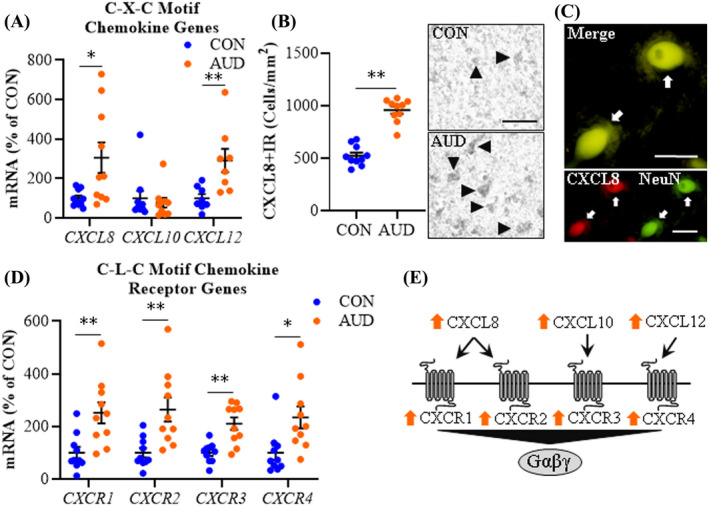
Expression of C‐X‐C motif chemokine and receptors in age‐matched moderate drinking control (CON) and alcohol use disorder (AUD) postmortem human orbitofrontal cortex (OFC). (A) Reverse transcription PCR (RT‐PCR) analysis revealed AUD increased expression of CXCL8 (3‐fold) and CXCL12 (2.9‐fold) relative to CONs. (B) Modified unbiased stereological assessment revealed an approximate 1.8‐fold increase of CXCL8+IR in the AUD OFC relative to CONs. Representative photomicrographs of CXCL8+IR in the OFC of a CON and AUD sample. Black arrowheads indicate CXCL8+IR cells. Scale bar = 50 μm. (C) Immunofluorescent co‐labeling revealed a high degree of CXCL8 (red) colocalization with the neuronal marker NeuN (green) in the postmortem human OFC. White arrows indicate CXCL8+IR cells that colocalize with NeuN (top; yellow). Scale bar = 20 μm. (D) RT‐PCR analysis revealed AUD increased expression of CXCR1 (2.5‐fold), CXCR2 (2.6‐fold), CXCR3 (2.1‐fold), and CXCR4 (2.4‐fold) relative to CONs. (E) Simplified schematic depicting C‐X‐C motif chemokines interacting with C‐X‐C motif chemokine receptors. RT‐PCR analyses were run in triplicate. Data are presented as mean ±SEM. * p ≤ 0.05, ** p < 0.01