


Fig. 8.
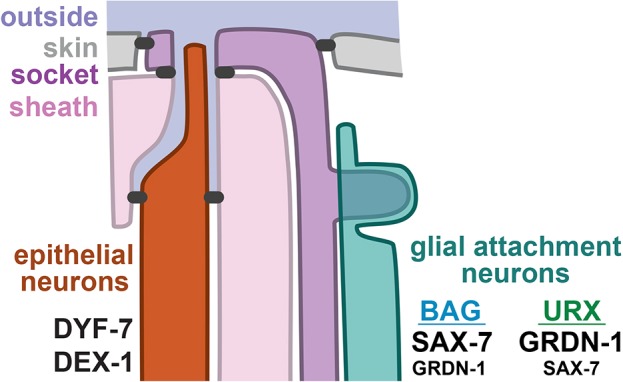
Distinct molecular mechanisms of retrograde extension. Different classes of head sensory neurons undergo retrograde extension using distinct cellular and molecular mechanisms. Epithelial neurons (24 amphid, 12 IL, six OL and four CEP) exhibit tight junctions (black) that separate an outward- or lumenal-facing apical surface from a basal surface that is exposed to the pseudocoelom, and undergo retrograde extension through mechanisms that resemble the morphogenesis of narrow epithelial tubes, including the use of apical extracellular matrix proteins (DYF-7 and DEX-1). In contrast, glial attachment neurons (two BAG, two URX) undergo retrograde extension using a distinct molecular mechanism in which SAX-7 and GRDN-1 anchor dendrite endings at the developing nose. BAG exhibits a greater dependence on SAX-7, while URX exhibits a greater dependence on GRDN-1. Dendrite extension in the other unbranched sensory neurons of the head (four URA, two URB and four URY) remains to be explored.