


Fig. 9.
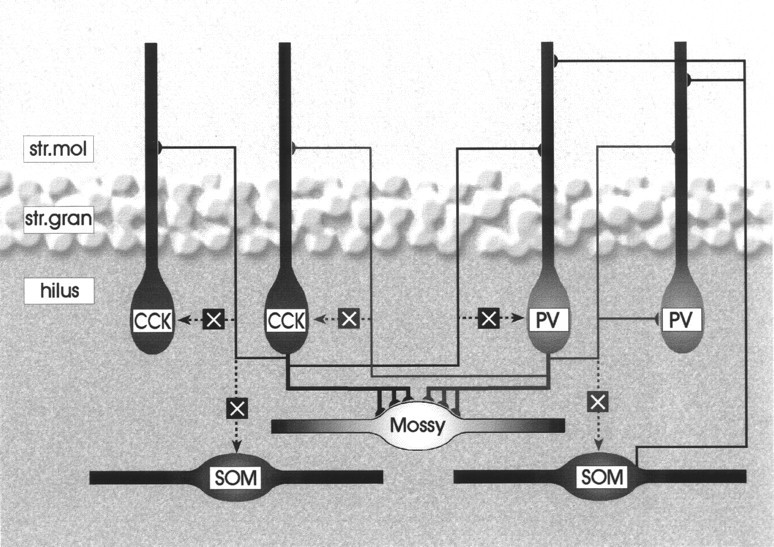
Schematic drawing demonstrating the interaction among various hilar cell types in the hilus and in str. moleculare. The connectivity of CCK- and parvalbumin-positive cells is shown inblack and gray, respectively.Dotted line and an X mark indicate lack of connection, whereas continuous lines show the verified synaptic interactions. The thickness of the lines corresponds to the strength of the connection. Note that besides a weak interaction among parvalbumin-containing cells, interneurons avoid each other in the hilus but have mutual connections in str. moleculare and str. granulosum. For clarity, only a single dendrite of each basket cell is drawn that reaches str. moleculare. Mossy cells receive innervation from both CCK- and parvalbumin-positive basket cells, but hilar interneurons, many of which are somatostatin-containing, are avoided. The innervation of parvalbumin-positive cells by somatostatin-immunoreactive neurons was demonstrated by Katona et al. (1999).