


Fig. 7.
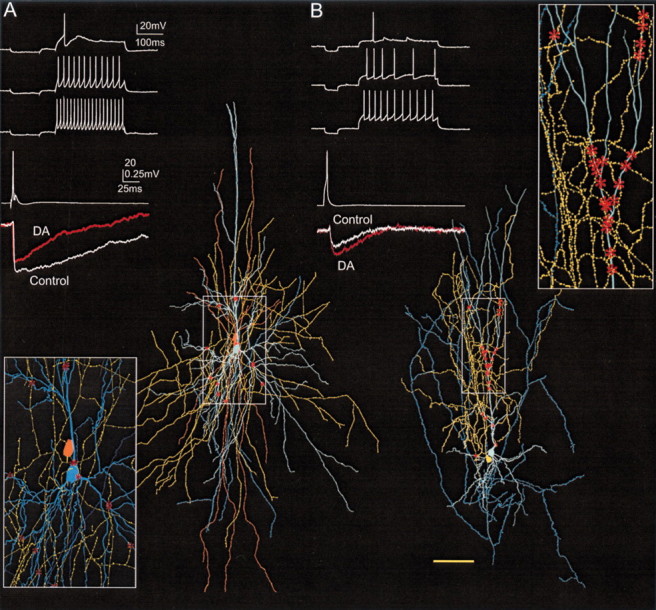
Electrophysiological and morphological characteristics of two neuronal pairs from an FS and non-FS NP-P group, respectively. Three consecutive traces recorded from an FS cell (A) and a non-FS (regular spiking) cell (B) during injection of depolarizing current pulses of three intensities are shown. A single spike induced by narrow current injection in these two presynaptic interneurons elicited correlated IPSPs in the A and B pair, respectively. The two control IPSPs (white line) exhibited distinct properties, as described in Figure 2, whereas DA reduced the IPSP in the FS NP-P pair but enhanced it in the non-FS NP-P pair. Computer reconstructions of these two biocytin-filled interneuron–pyramidal pairs at two magnifications are shown. The interneuron of the FS NP-P pair is a fast-spiking basket cell of the FS type, which forms 14 putative synaptic contacts on the soma and proximal dendrites of the pyramidal neuron (inset,bottom left). The interneuron of the non-FS NP-P pair is an accommodating bitufted cell of the non-FS type with a regular spiking firing pattern. Its beaded axons form 25 putative synaptic contacts primarily on the middle and distal dendrites of the postsynaptic pyramidal neuron with which it interacted (inset, top right). Light blue, Somata and dendrites of the pyramidal neuron;blue, axons of the pyramidal neuron;yellow, axonal arbors of the presynaptic interneuron;orange, dendrites of this interneuron. Scale bar, 100 μm; A, inset, 50 μm;B, inset, 40 μm.Asterisks indicate putative synaptic contacts.