


Figure 3.
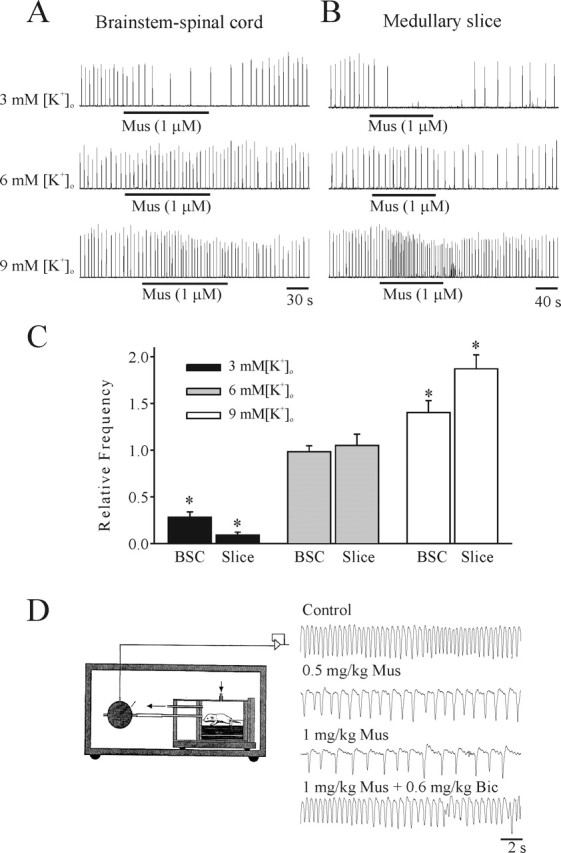
[K+]o dependency of responses to chloride-mediated conductances. The effects on respiratory frequency of muscimol in P2 brainstem–spinal cord (A) and medullary slice (B) preparations bathed in 3, 6, or 9 mm [K+]o. Muscimol (1 μm; Mus) decreased respiratory frequency when the brainstem–spinal cord or medullary slice preparations were superfused with 3 mm [K+]o bathing solution. In contrast, muscimol (1 μm) increased respiratory frequency when the same preparation was superfused with 9 mm [K+]o bathing solution. Muscimol (1 μm) had no significant effect on respiratory frequency when the same preparation was superfused with 6 mm [K+]o. C, Population data for responses to muscimol of brainstem–spinal cord (BSC) and medullary slice (Slice) preparations bathed in media with different [K+]o. D, The effects of intraperitoneal administration of two doses of muscimol to an unanesthetized P2 rat pup. Respiratory frequency was measured using a whole-body plethysmograph contained within an infant incubator for temperature control. The muscimol-induced suppression of respiratory frequency was antagonized by bicuculline (Bic). *p < 0.05, significant difference relative to control.