


Figure 6. A Pulvino-cortical Circuit for Estimating Decision Confidence.
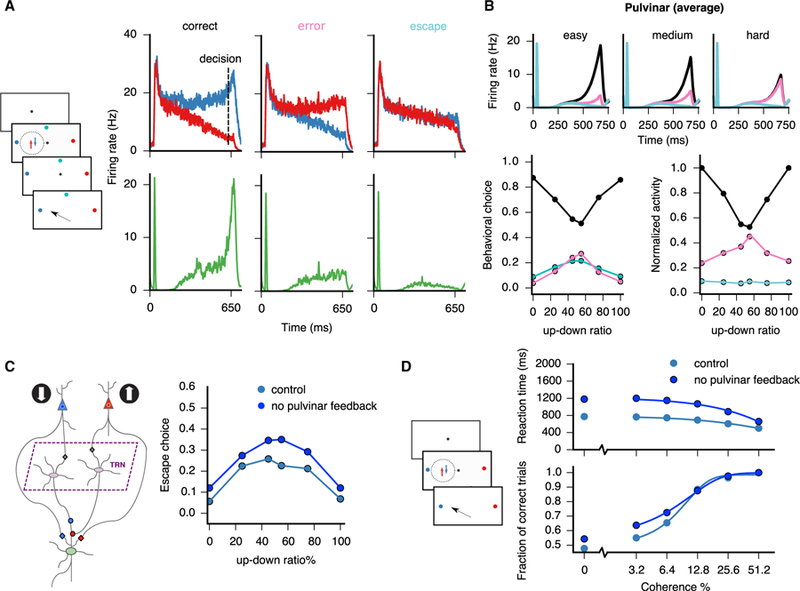
(A) Schematic of the task is shown on the left (see details in main text). Single cells in the pulvinar (green, bottom) represent confidence through their firing rate for correct, error, and escape trials. A necessary condition for a correct trial is that the cortical population representing more evidence, here the blue population (top), has a greater activity than the population representing less evidence, the red population, at the time of decision. Moreover, for both correct and error trials, the difference between the activities at the decision time must be greater than a predefined bound ε = 4 Hz. Otherwise, the subject forgoes the decision and escapes (opts out). (B) Top: average pulvinar firing rates as a function of difficulty (easy, medium, and hard) and trial type (correct, black; error, pink; escape, cyan), color coded as in (A). Bottom: behavioral choice (left) and normalized pulvinar activities (right) as a function of difficulty and trial type are shown. (C) Simulated unilateral lesion to the pulvinar, i.e., no feedback to the cortex, causes an increase in escape frequency with respect to control. (D) In a reaction-time version of the random-dot discrimination task, a lesion to the pulvinar results in slower reaction times with higher accuracy (a form of speed-accuracy tradeoff), more noticeable at low coherence levels.