


Figure 2 – ARID1A depletion causes transcriptional attenuation in OCCC cells with minor effects on chromatin accessibility.
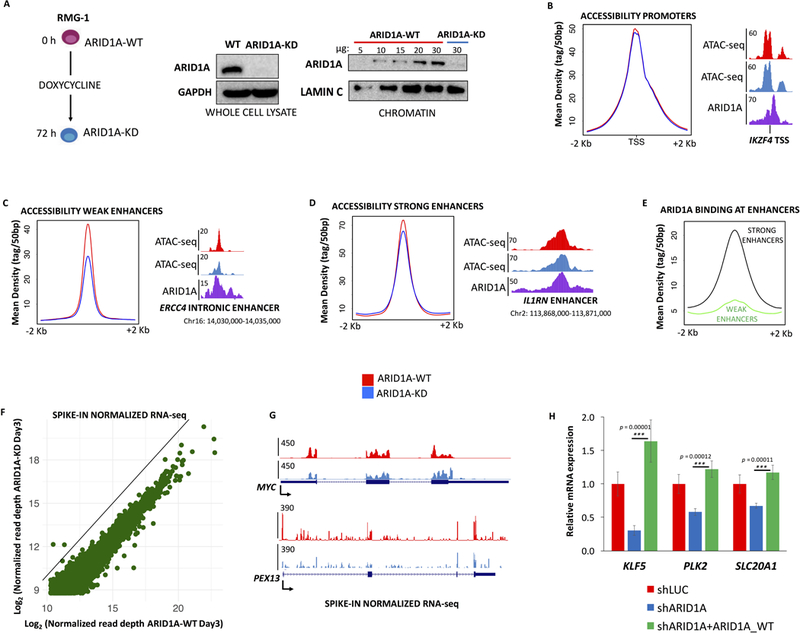
(A) ARID1A is efficiently depleted from RMG-1 cells in 72 hours, using a doxycycline inducible shRNA. Whole cell and chromatin extracts were probed by immunoblot. (B) Average ATAC-seq profiles (ARID1A-WT, KD) show that accessibility at promoters is not affected by ARID1A depletion. (C) Average ATAC-seq profiles (ARID1A-WT, KD) show that accessibility at weak enhancers (3rd and 4th quartile of H3K27ac enrichment) is significantly reduced upon ARID1A depletion. (D) Average ATAC-seq profiles (ARID1A-WT, KD) show that accessibility at strong enhancers (1st and 2nd quartile of H3K27ac enrichment) is marginally affected by ARID1A depletion. (E) Comparison of ARID1A ChIP-seq profiles at weak and strong enhancers. (F) Correlation plot (spike-in normalized RNA-seq) of all expressed coding genes (GENCODE annotations) in RMG-1 cells, ARID1A-KD elicits broad transcriptional downregulation. (G) RNA-seq at select loci displays transcriptional attenuation upon ARID1A-KD. (H) Parental RMG-1 cells were infected with shRNAs against ARID1A and rescued with exogenously expressed full-length ARID1A. Quantitative RT-PCR at three candidate genes shows that downregulation of the mRNA is significantly reversed (n=3) by ARID1A overexpression (fold change compared to shLUC, normalized by 18s rRNA).