


Figure 4. The Fbx4-TRF1 Interface Is Essential for Fbx4-dependent TRF1 Ubiquitination.
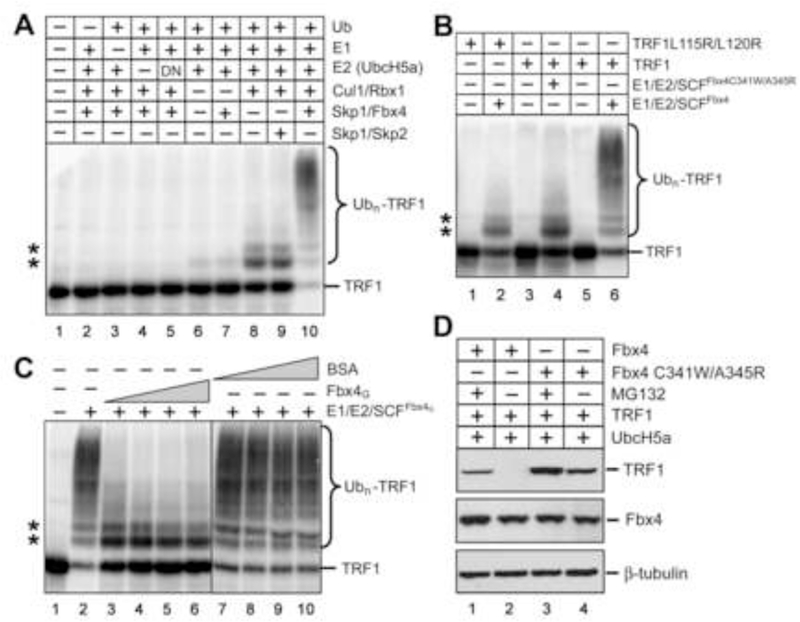
(A) Fbx4-dependent of ubiquitination of TRF1. Purified recombinant TRF1 was 33Plabeled by protein kinase GST-cyclin B/Cdk1 and 33P-TRF1 was separated from GSTcyclin B/Cdk1 by depletion with GSH beads. 33P-TRF1 was then incubated with purified recombinant E1, E2(UbcH5a), E3(SCFFbx4) enzymes and ubiquitin, methylated ubiquitin, ubiquitin aldehyde and MG 132. Reaction mixtures were separated by SDS-PAGE, followed by PhosphorImaging analysis. In panels (A), (B) and (C), asterisks indicate the non-specific ubiquitination products of TRF1 due to the presence of Cul1/Rbx1.
(B) The Fbx4-TRF1 interface is essential for Fbx4-dependent ubiquitination of TRF1. Reactions were performed as in (A), but TRF1L115R/L120R was used as substrate in one reaction and SCFFbx4C341W/A345R as E3 ligase in another.
(C) Addition of Fbx4G suppresses Fbx4-dependent ubiquitination of TRF1. Ubiquitination assays were performed as in (A), but increasing amount of Fbx4G (3, 6, 12, 24 μM) or BSA (3, 6, 12, 24 μM) was added in the reactions.
(D) HEK 293T cells were transfected with TRF1, UbcH5a, Fbx4 WT or Fbx4 C341W/A345R. Four hours after transfection, cells were split into two plates and grown for 24 hours prior to being treated with 2 µM MG 132 or DMSO for 16 hours. Cells were lysed and cell extracts were immunoblotted with indicated antibodies.