


Figure 2. Ropivacaine and Liposomal Bupivacaine blocked sensory processing without affecting motor behavior.
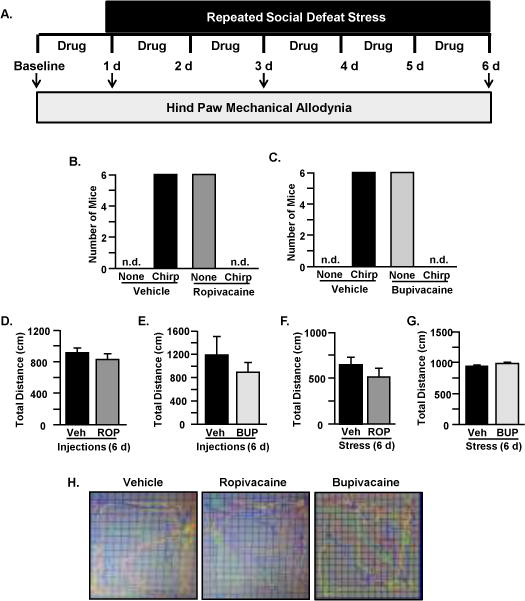
A) Experimental Design is shown. Male C57BL/6 mice were tested for mechanical allodynia prior to exposure to stress (Baseline) and 12 hours after the first, third, and sixth day of stress. Either Ropivacaine or Liposomal Bupivacaine (Drug) was injected prior to each stress exposure. To confirm blockade of sensory processing, lack of vocalization (i.e., no chirping) to electrical noxious stimuli was measured in mice treated with B) Ropivacaine and C) Liposomal Bupivacaine. Total distance traveled was not affected by six days of injections with D) Ropivacaine or E) Liposomal Bupivacaine. Furthermore, total distance was not affected by six days of stress and injections with F) Ropivacaine or G) Liposomal Bupivacaine. H) Representative open-field plots of mice injected with Vehicle, Ropivacaine, and Liposomal Bupivacaine are shown to confirm motor activity. Bars represent average ± SEM.