


Figure 2. Mechanisms of oncogenic super-enhancer formation.
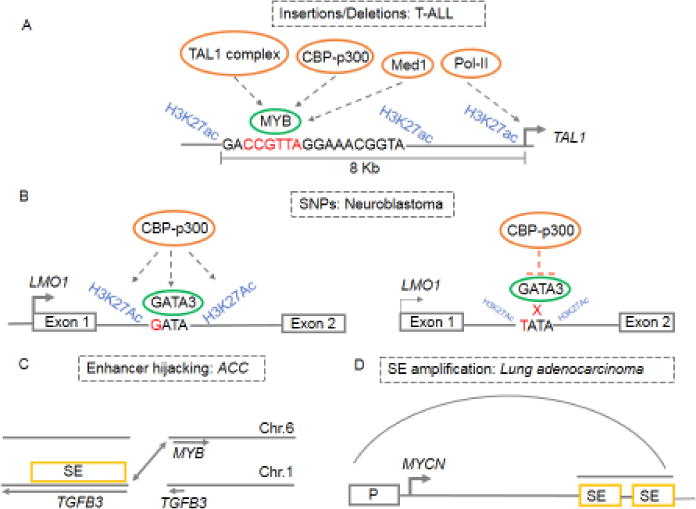
(A) Short insertion mutations that introduce novel MYB binding sites upstream of the TAL1 oncogene, resulting in the formation of a SE that drives TAL1 expression in T-ALL. MYB binding to these de novo sites facilitates SE formation through recruitment of CBP-p300 acetyl-transferase and the TAL1 transcription factor complex, which drive key genes involved in leukemogenesis [38]. (B) SE formation at the LMO1 oncogene in neuroblastoma is contingent upon GATA3 binding at a conserved intronic GATA binding site conferred by the tumorigenic “G” allele. Cells harboring the protective “T” allele (TATA) at this locus have impaired GATA3 binding, leading to diminished recruitment of H3K27Ac, resulting in decreased enhancer activity and greatly reduced LMO1 expression [54]. (C) A chromosomal translocation as found in adenoid cystic carcinoma (ACC) that repositions an unrelated SE in proximity to the MYB oncogene, resulting in its high expression [30]. (D) Focal amplification of SE regions as in lung adenocarcinoma, where a focal amplification ~450s kb downstream of the MYCN locus leads to SE formation and drives high expression of the oncogene [59]. Grey arcs represent physical interactions between SEs and the gene promoter (P).