


Figure 3.
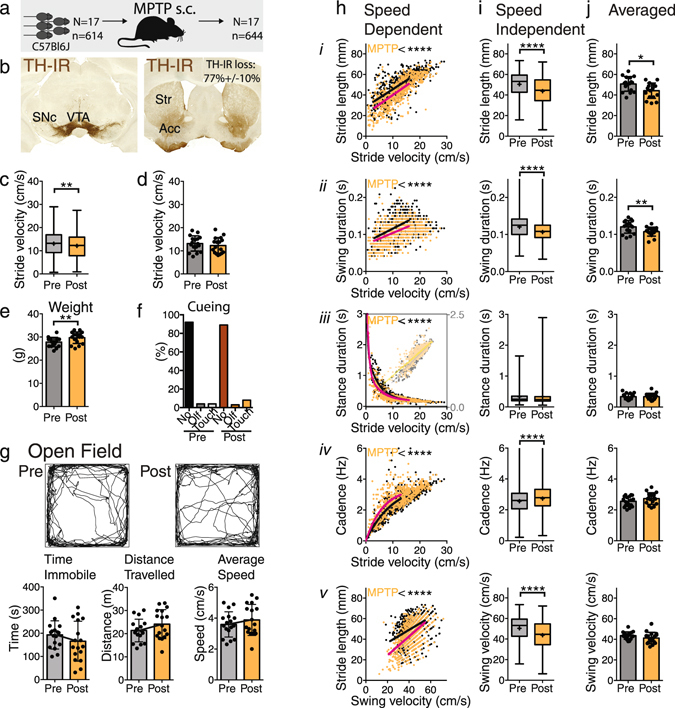
Effects of MPTP treatment on gait. (a) In 17 C57Bl6 mice gait and locomotor activity was studied before and after s.c. MPTP treatment. (b) MPTP induced bilateral loss of tyrosine-hydroxylase immunoreactivity in the striatum. (c and d) Velocity was significantly lower post MPTP as determined by stride to stride data (Mann Whitney Rank test; Supplementary Table S3), but this was not detected in the averaged data sets (2-tailed paired t-test; Supplementary Table S3). (e) Post MPTP animals gained weight (paired, 2-tailed t-test). (f) Cueing was not necessary to obtain sufficient trials or data points. (g) Open field performance was not different pre and post MPTP treatment. (h) Relationships of stride length (i), swing duration (ii), stance duration (iii), cadence (iv) as a function of stride velocity and stride length as a function of swing speed (v). The fit of one curve to both data sets was compared with the fit of individual curves fit to each dataset. All gait parameters showed highly significant differences with shortened stride length, decreased swing and stance duration, and increased cadence (F test, Supplementary Table S3). (i) (i-v): The distribution of the stride-to-stride data showed significant differences in the same gait parameters as the speed dependent analysis, except for stance duration. However, these are difficult to interpret due to changes in velocity in the stride-to-stride data sets (Mann Whitney Rank test, Supplementary Table S3). (j) (i-v): Averaged data sets revealed decreased stride length and swing durations, but no changes in other gait parameters (paired 2 tailed t-test; Supplementary Table S3). Asterisks indicate level of significance.