


Figure 3. Signalling, neural circuits and alcohol.
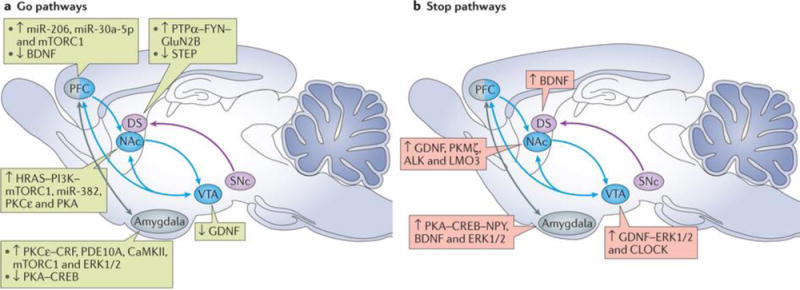
The go (part a) and stop (part b) pathways affect the function of several neural circuits. In the schematics, up arrows depict activation or increased expression of a molecule, whereas down arrows depict decreases in expression and/or activity of a molecule. The mesocorticolimbic circuitry (blue) mediates reward processing. Glial cell line-derived neurotrophic factor (GDNF), signalling via extracellular signal-regulated kinases 1 and 2 (ERK1/2) and circadian locomoter output cycles protein kaput (CLOCK), acts as a stop-pathway molecule in the ventral tegmental area (VTA) and dampens alcohol drinking, whereas HRAS–phosphoinositide 3-kinase (PI3K)–mechanistic target of rapamycin complex 1 (mTORC1), calcium/calmodulin-dependent protein kinase type II (CaMKII), protein kinase Cε (PKCε) and microRNA-382 (miR-382) act as go-pathway molecules in the nucleus accumbens (NAc) and promote alcohol drinking. In the prefrontal cortex (PFC), mTORC1 (go pathway) is activated in a reconsolidation of an alcohol-seeking session, and brain-derived neurotrophic factor (BDNF) levels are reduced after excessive drinking in response to increases in miR-206 and miR-30a-5p levels (go-pathway molecules). The nigrostriatal circuitry (purple) has a role in goal-directed behaviours (dorsomedial striatum (DMS)), habitual learning and compulsive behaviour (dorsolateral striatum (DLS)). The tyrosine-protein kinase FYN–protein-tyrosine phosphatase-α (PTPα)–GluN2B signalling pathway is centred in the DMS (go pathway), and BDNF–ERK1/2 signalling mainly occurs in the DLS (stop pathway). The reduction in activity of striatum-enriched protein-tyrosine phosphatase (STEP) in the DMS also contributes to the go pathway. The extended amygdala (grey) is implicated in the negative emotional state that characterizes alcohol withdrawal and relapse. The go-pathway actions of PKCε–corticotropin-releasing factor (CRF) and 3′,5′-cyclic nucleotide phosphodiesterase 10A (PDE10A) are centred in the central amygdala (CeA) and basolateral amygdala, respectively; CaMKII and ERK1/2 also have a role in go-pathway signalling in the CeA. These signalling molecules promote anxiety-like and alcohol-drinking behaviours. By contrast, the BDNF–ERK1/2 (stop) pathway in the CeA and medial amygdala (MeA) dampens these phenotypes. In addition, malfunctioning of cyclic AMP-dependent protein kinase A (PKA)–cAMP response element (CRE)-binding protein (CREB) signalling in the CeA and MeA also contributes to the interplay between stress and heightened drinking. Finally, mTORC1 (go pathway) in the CeA mediates alcohol-associated memory reconsolidation. ALK, anaplastic lymphoma kinase; DS, dorsal striatum; LMO3, LIM domain only protein 3; NPY, neuropeptide Y; PKMζ, protein kinase Mζ; SNc, substantia nigra pars compacta.