


Figure 2.
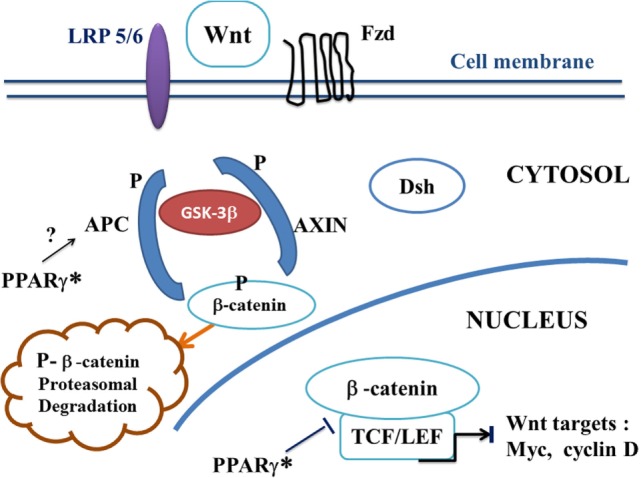
A potential canonical Wnt/beta-catenin pathway in ALS treated by PPAR gamma agonists. In the presence of PPAR gamma agonists, the “on state” of canonical Wnt/beta-catenin pathway may be interrupted at two potential levels. Firstly, via a hypothetical action of PPAR gamma* on APC. Inactivation of the destruction complex AXIN/APC/GSK-3beta is suppressed. Beta-catenin is phosphorylated by GSK-3beta. Thus, APC and AXIN complex with GSK-3beta and beta-catenin to enhance the destruction process of beta-catenin into the proteasome. Phosphorylated beta-catenin is recognized by an ubiquitin ligase, ubiquinated and degraded into the proteasome. The canonical Wnt pathway is in “off state.” Second, PPAR gamma can inhibit the beta-catenin/TCF/LEF complex into the nucleus, thus inhibiting the transcription of canonical Wnt target genes. Abbreviations: APC, adenomatous polyposis coli; Dsh, Dishevelled; Fzd, Frizzled; GSK-3beta, glycogen synthase kinase-3beta; LRP5/6, low density lipoprotein receptor-related protein 5/6; PPAR gamma*, PPAR gamma activated by agonists; TCF/LEF, T-cell factor/lymphoid enhancer factor; canonical Wnt target genes: c-Myc, cyclin D, etc.