


Figure 2.
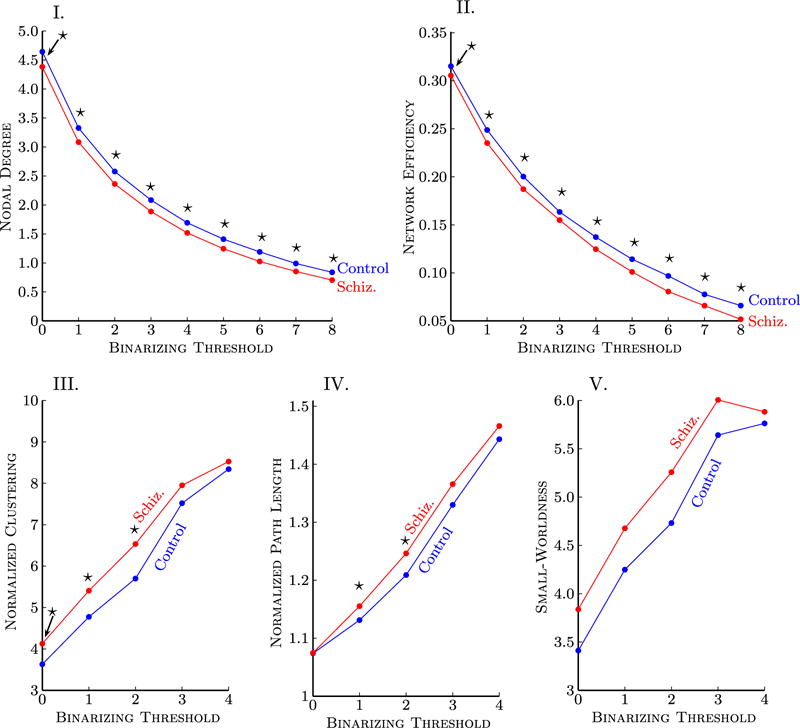
Graph measures describing topological attributes of corticocortical connectivity were quantified in a sample of patients with schizophrenia. The binarizing threshold (horizontal axis) determined the minimum number of streamlines that needed to interconnect a pair of nodes for a connection to be assumed. Data points marked with a star indicate a significant difference (p < .05) between patients and control subjects. Because the same hypothesis was tested at each threshold, correction for multiple comparisons was not performed. Note that T = 0 indicates at least one or more streamlines must be present for a link to be drawn. (I) Nodal degree and (II) network efficiency were reduced in schizophrenia for all binarizing thresholds considered. A trend for increased: (III) clustering, (IV) path length, and (V) small-worldness was demonstrated in patients but was not significant at most thresholds. For binarizing thresholds exceeding T = 4, the graph for at least one subject broke apart into two or more disconnected subgraphs. The binarizing threshold was therefore constrained when considering path length, clustering, and small-worldness. The clustering coefficient and path length were normalized with degree-matched random graphs.