


Figure 5.
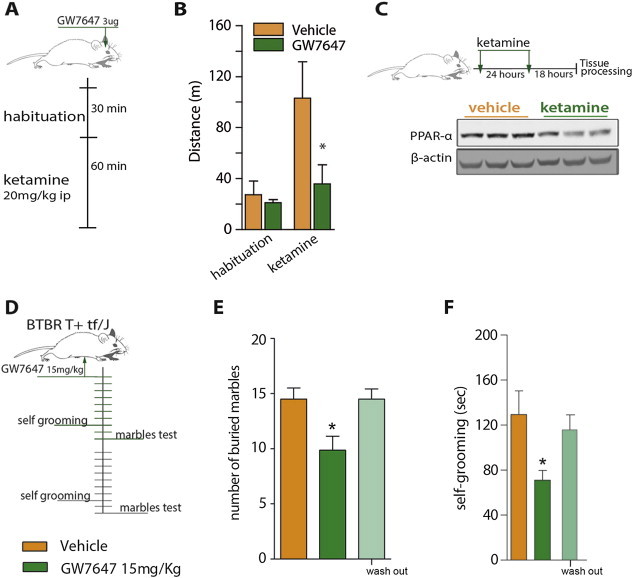
Pharmacological activation of Ppar-α reduces NMDAR antagonist–induced locomotion and reduces repetitive behavior in BTBR T+ tf/J mice. A single brain administration of a selective PPAR-α agonist reduces ketamine–induced locomotion. (A) Treatment schematic: the PPAR-α agonist, GW767 (3ug) administered into the lateral brain ventricle (ICV) 30 min before ketamine (20 mg kg-1, IP). (B) The cumulative locomotion during the habituation and after ketamine injection (n = 6–7; *p < 0.05 vs vehicle-ketamine group; two-tailed Student's t-test). (C) Down-regulation of cortical PPAR-α following repeated ketamine injections in wild type mice (n = 3). Treatment with a PPAR-α agonist ameliorates behavioral repetition in a genetic model of ASD – the BTBR T+ tf/J mice (male, 14 weeks of age). (D) Treatment schematic: GW767 (15 mg kg-1, IP) treatment for 7–10 days followed by a wash out week. (E) Effect of GW767 treatment on the marbles burying and (F) self-grooming behavior (n = 8–10; *p < 0.05 vs vehicle treated mice, &p < 0.05 vs GW767-treated; one-way ANOVA, followed by Tukey's multiple comparisons test).