


Fig. 2. Measurements of oxidative stress in CF mucus.
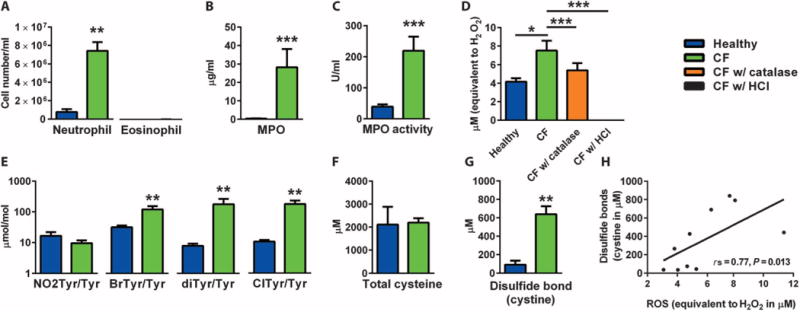
(A) Neutrophil cell number is significantly higher in induced sputum from patients with CF (n = 13) than in induced sputum from healthy subjects (n = 14). (B) MPO concentration measurements are higher in induced sputum from CF patients (n = 13) than in induced sputum from healthy controls (n = 15). (C) MPO activity measurements are higher in induced sputum from CF patients (n = 13) than in induced sputum from healthy controls (n = 15). (D) ROS, as detected by conversion of carboxy-H2DCFDA to its green fluorescent form, are markedly higher in spontaneously expectorated supernatant from CF patients (n = 5) than in induced sputum from healthy controls (n = 5). Hydrogen peroxide contributes significantly to the ROS signal, as evidenced by the reduction in ROS with catalase. The elimination of the ROS signal by HCl is included as a negative control of the enzyme-based assay. (E) Oxidized protein products measured using MS are higher in spontaneously expectorated supernatant from CF patients (n = 5) than in induced sputum from healthy controls (n = 5). (F) A fluorescent assay using dithiothreitol (DTT) and monobromobimane (mBBr) shows that the amount of total accessible cysteines is not significantly different between the spontaneously expectorated CF sputum (n = 5) and the induced healthy sputum (n = 5). (G) With iodoacetamide pre-treatment, the same assay shows that the concentration of cystines (disulfide bonds) is markedly higher in the CF sputum (n= 5) than in the healthy sputum (n = 5). (H) The concentration of disulfide bonds correlates positively with ROS. rs = 0.77, P = 0.013 [data from (D) and (F)]. Data are means ± SEM. *P < 0.05; **P < 0.01; ***P < 0.001.