


Fig. 1.
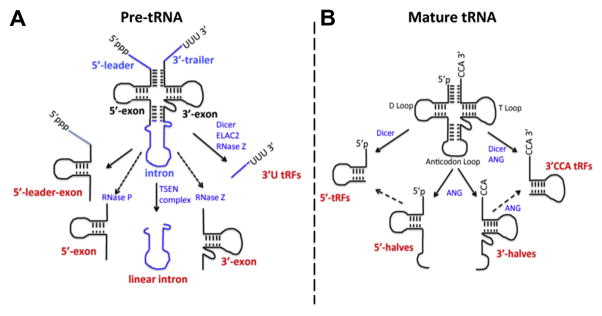
Processing of precursor and mature forms of tRNA in tRNA fragments. (A) Processing of precursor tRNA. Transcribed pre-tRNA contains distinct 5′- and 3′-extensions (5′-leader and 3′-trailer (blue)) that have to be removed by RNase P and RNase Z during tRNA processing. In some cases, the 5′-leader is not removed giving rise to 5′-leader exon fragments. Intron (blue)-containing pre-tRNAs are spliced by the TSEN complex. Usually, such introns are quickly degraded but in some pathological cases linear introns can accumulate. 5′-exons and 3′-exons are naturally present in the nucleus as products of intron-containing tRNA splicing. Upon 3′-trailer removal, the CCA-adding enzyme TRNT1 adds CCA to the 3′-ends of tRNA. In some cases, 3′-trailers accumulate and are exported to the cytoplasm as 3′-U tRFs. (B) Processing of mature cytoplasmic tRNA. Mature tRNA can be cleaved in the anticodon loop by angiogenin (ANG) to produce 5′- and 3′-tRNA halves (or 5′- and 3′-tiRNAs, respectively. Dicer-dependent cleavage of tRNA in the D arm of tRNA results in the production of small tRNA fragments, 5′-tRFs. Similarly, cleavage in the T arm by Dicer or ANG results in the production of tRFs containing CCA at their 3′-ends (so called 3′CCA tRFs). Both 5′-tRFs and 3′CCA tRFs may also be processed from 5′- and 3′-tRNA halves, respectively (dashed arrows).