


Fig. 6.
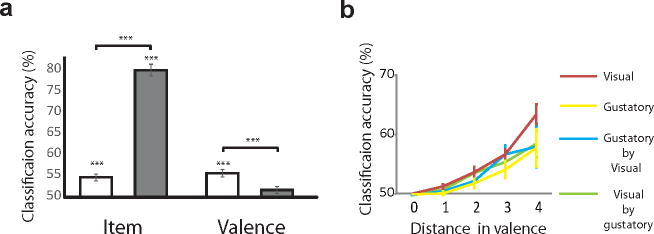
Cross-participant classification of items and affect. (a) Classification accuracies of cross-participant multivoxel patterns for specific items and subjective valence in the VTC (gray) and OFC (white). Each target item or valence was estimated by all other participants’ representation in a leave-one-out procedure. Performance was calculated by the target’s similarity to its estimate compared to all other trials in pairwise comparison (50% chance). For item classification, t test (OFC: t15 = 5.7, P =0.00008, VTC: t15 = 21.4, P = 2.4 × 10⁻¹²), paired t test (OFC vs. VTC: 15 = –15.9, P = 8.4 × 10⁻¹¹). For valence classification, t test (OFC: t15 = 6.4, P = 0.00002, VTC: t15 = 2.0, P = 0.13), paired t test (OFC vs. VTC: t15 = 4.2, P = 0.0007). Bonferroni correction was applied, based on number of comparisons for each ROI (2 (ROI). A t test within a region was one-sided while paired t test was two-sided. n = 16 participants. (b) Relationship between classification accuracies and valence distance in the OFC. Accuracies increased monotonically as experienced valence across trials became more clearly differentiated for all conditions. ANOVA (visual: F1.4, 20.3 = 37.4, P = 5.6 × 10⁻⁶, gustatory: F1.3, 18.9 = 4.7, P = 0.033, visual × gustatory: F1.2, 18.6 = 9.7, P = 0.004, gustatory × visual: F1.4, 19.6 = 4.3, P = 0.04). Greenhouse-Geisser correction was applied since Mauchly’s test revealed violation of assumption of sphericity. For visual and visual by gustatory, n = 16 participants. For gustatory and gustatory × visual, n = 15 participants. Error bars represent s.e.m. *** P < 0.001, ** P < 0.01