


Figure 6. The miRNA ceRNA Network.
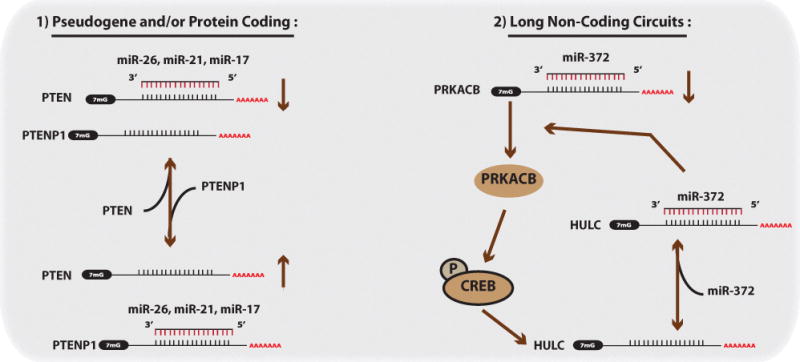
In the ceRNA network, ceRNAs can affect miRNA targeting primarily by acting as sponges. 1) Given that many genes also have a number of pseudogenes with conserved miRNA binding sites, as is the case with PTEN, the abundance of the pseudogene (PTENP1) will influence how strong the regulatory action of a particular miRNA is on the intended mRNA target (in this case PTEN). However, the system is oscillatory in that when PTENP1 are lower the PTEN levels, miRNAs will preferentially target PTEN, and vice versa. 2) Long noncoding RNAs can also be apart of this network. PRKACB can normally be targeted by miR-372; however, in response PRKACB can induce HULC long-noncoding RNA levels by phosphorylating and activating CREB. HULC serves as a sponge for miR-372, thereby preventing the miR-372 regulation of PRKACB.