


Figure 2. The N-terminal domain of Rtr1 is the functional phosphatase domain.
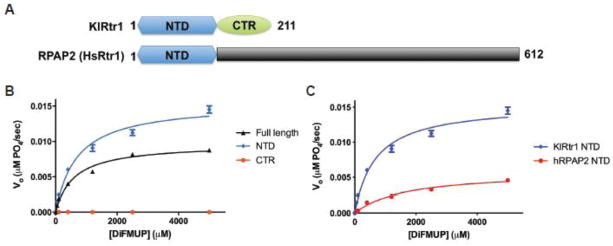
a) Domain breakdown of Rtr1 in yeasts and vertebrates. Yeast Rtr1 proteins are smaller proteins with conserved N-terminal (NTD) and C-terminal domains (CTR). Vertebrate Rtr1 (RPAP2) proteins are typically larger with the only conservation to yeast Rtr1 proteins found within the NTD.
b) Steady state phosphatase assays (n = 3) of KlRtr1 against DiFMUP for full-length (black), NTD (blue), and CTR (red) (10μM protein, all constructs). The full-length curve is derived from the dataset used in Fig. 1C.
c) Steady state phosphatase assays (n = 3) of hRPAP2 NTD (red) (10μM) against DiFMUP. KlRtr1 NTD (from Fig. 2B) is shown as a comparison.