


Fig. 4. HGN194 dIgA1 and dIgA2 have similar affinities for monomeric gp1201157ip.
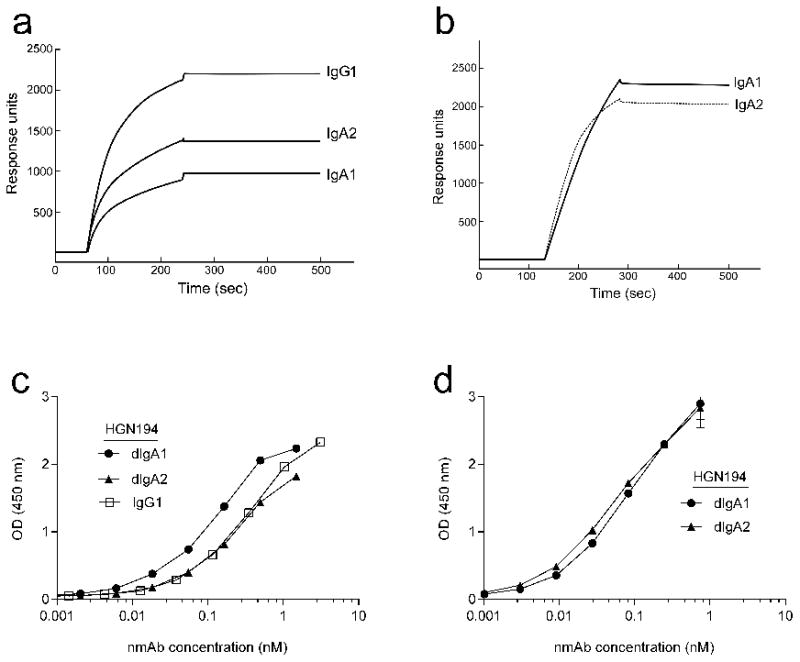
(a) Surface plasmon resonance (SPR) analysis: HGN194 dIgA1, dIgA2, and IgG1 binding to monomeric gp1201157ip. Gp1201157ip was immobilized on a CM5-chip and Abs flowed over as analytes, with association and dissociation phases of up to 3 min (flow rate, 30 μl/min). Qualitative SPR responses are shown for IgG1, dIgA1 and dIgA2 analytes (60 nM) interacting with chip-bound, soluble monomeric gp1201157ip. (b) SPR analysis of binding of soluble monomeric gp1201157ip to chip-immobilized HGN194 dIgA1 and dIgA2. Abs were coupled to a CM5-chip to a surface density of 5,600 response units (RU) for dIgA1 and 4,800 RU for dIgA2, respectively. Different concentrations of gp1201157ip were injected as analyte in randomized duplicate runs for 3 min (flow rate, 30 μl/min) and representative sensograms of gp1201157ip binding (20 nM) to dIgA1 and dIgA2 are shown. (c) ELISA binding of HGN194 isotypes to gp1201157ip: detection with goat anti-human λ chain Abs, and (d) goat anti-human α-chain specific. The data shown are representative of two independent experiments.