


Fig. 4.
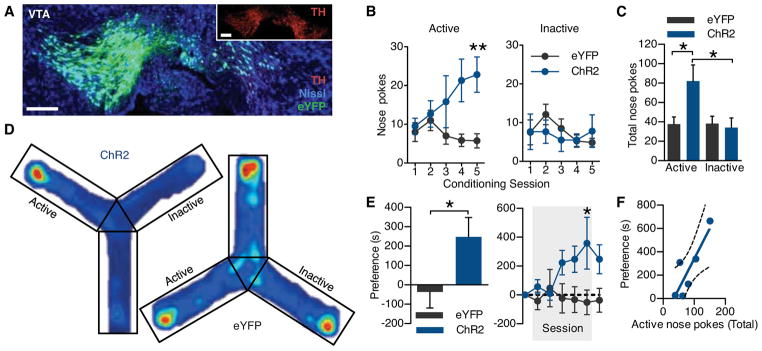
Wirelessly powered μ-ILED devices operantly drive conditioned place preference. (A) Cell-type specific expression of ChR2(H134)-eYFP (green) in dopaminergic, TH (red) containing neurons of the VTA. For clarity, inset shows TH channel alone. All scale bars = 100 μm. (B) Operant learning curve on the active (left) and inactive (right) nose poke devices over 5 days of 1-hour trials in the Y-maze. Active pokes drive 1 s of 20 Hz light (5 ms pulses) from the μ-ILED device on a fixed-ratio-1 schedule (n = 6–8 mice/group; Two-way ANOVA with Bonferroni post-hoc; **p < 0.01). (C) Mean number of nose pokes ± SEM across all five conditioning sessions. (*p < 0.05 One-way ANOVA with Bonferroni post-hoc) (D) Heat maps of activity during the post-test, hotter colors represent longer duration in a location in that part of the apparatus. (E) Left, place preference scores calculated as post-test minus pre-test in the active nose poke-paired context. Five days of self-stimulation significantly conditioned a place preference that developed over the course of the training sessions and remained during the post-test (right; *p < 0.05 t-test compared to controls; *p < 0.05 Two-way ANOVA with Bonferroni post-hoc). All error bars represent means ± SEM (F) Scatter plot demonstrating positive correlation (r = 0.8620, p = 0.0272) between post-test preference and total number of active nose pokes during training in the ChR2(H134)-eYFP group.