


Fig. 2.
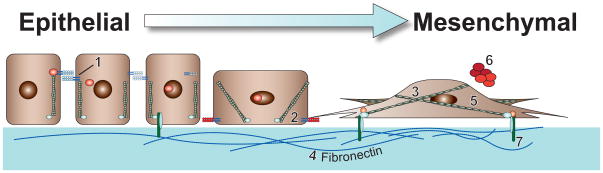
Transdifferentiation from polarized epithelial-like to mesenchymal-like morphologies. Provided numbers depict classical biomarkers of initiated EMT programs, while accompanying boxes describe the EMT-related functions of these highlighted markers. (1) E-cadherin, the primary component of adherens junctions. During EMT, TGF-β represses E-cadherin expression, as well as induces its internalization from the plasma membrane (Miettinen, et al., 1994). (2) N-cadherin, an adhesion molecule that promotes cellular migration (Hazan, et al., 2000). EMT stimulated by TGF-β is associated with increased expression of N-cadherin (Bhowmick, et al., 2001a). (3) Vimentin, an intermediate filament protein that is expressed in all primitive cell types, but not in differentiated epithelial cells. Vimentin may function to drive EMT programs (Mendez, et al., 2010), and also serves as a canonical marker for detecting transdifferentiated mesenchymal cell types (Grunert, et al., 2003). (4) Fibronectin, a critical ECM component whose elevated production by cancer cells is classically associated with EMT programs. TGF-β is a potent inducer of fibronectin production and deposition into the ECM (Ignotz and Massague, 1986). (5) α-Smooth Muscle Actin (α-SMA), a major component of contractile microfilaments and a canonical marker for detecting myofibroblasts. TGF-β stimulation of EMT elicits α-SMA expression (Masszi, et al., 2003), which strongly associates with increased tumor invasion, and with decreased patient survival (Yazhou, et al., 2004). (6) Matrix Metalloproteinases (MMPs), proteolytically degrade basement membranes to allow primary tumor cells to invade the surrounding tissue and intrasvasate into tumor associated vasculature. While several MMPs are induced during EMT, MMP-9 is a well-established target of TGF-β signaling (Duivenvoorden, et al., 1999, Kim, et al., 2007a, Lee, et al., 2008). (7) β3 integrin, a transmembrane protein that physically links the extracellular matrix to intracellular signaling systems and the cytoskeleton via focal adhesion complexes. β3 integrin is rapidly and robustly upregulated by TGF-β and interacts physically with TβR-II via a FAK-dependent mechanism (Galliher and Schiemann, 2006, Wendt and Schiemann, 2009).