


Fig. 1. Mechanisms of A20 inhibition of NF-κB.
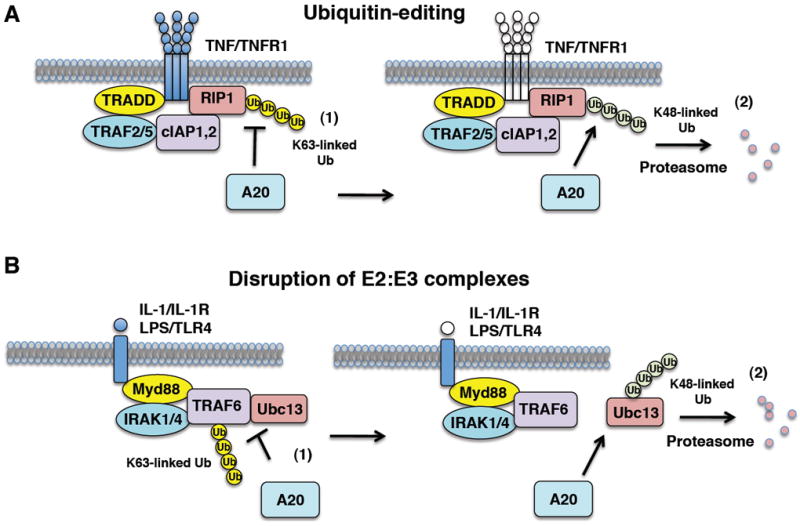
(A) The ubiquitin-editing function of A20. In response to TNF stimulation, A20 expression is induced and inhibits NF-κB in a negative feedback loop in a two-step manner. (1) A20 first hydrolyzes K63-linked polyubiquitin chains on RIP1 in an OTU-dependent manner to inhibit IKK and NF-κB signaling. (2) A20 then conjugates K48-linked polyubiquitin chains onto RIP1 to trigger its proteasomal degradation. (B) Disruption of E2:E3 ubiquitin enzyme complexes by A20. The E3 ligase TRAF6 inducibly interacts with the E2 enzymes Ubc13 and UbcH5c upon IL-1R/TLR4 stimulation. (1) A20 interacts with Ubc13, UbcH5c and TRAF6 and disrupts the binding between TRAF6 and the E2 enzymes. (2) A20 then conjugates K48-linked polyubiquitin chains on Ubc13 (and UbcH5c) to trigger its proteasomal degradation.