


Fig. 4. A model for the reaction cycle of ABC transporters based on ATP-dependent dimerization of ATP-binding cassettes.
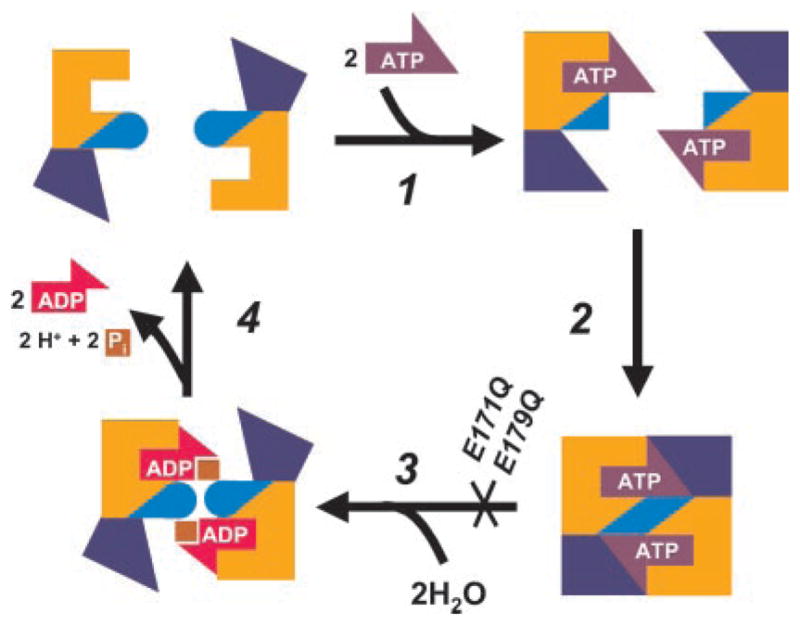
The ATP-binding core and antiparallel β-subdomain are shown in yellow. The initial step (step 1) combines binding of ATP to protein monomers with the α-helical subdomain (dark blue) rotation and γ-phosphate linker (light blue) shift. This step is rapidly followed by cassette dimerization (step 2). Hydrolysis of ATP (step 3) results in the reversal of the previous conformational changes coupled to dissociation of the dimer and release of hydrolysis products (step 4). The E171Q mutant of MJ0796 and the equivalent E179Q mutant of MJ1267 become locked in the dimeric state because hydrolysis cannot occur, and the protein remains in the thermodynamically favorable ATP-bound conformation. The cooperativity of ATP hydrolysis exhibited by wild type MJ0796 (Hill constant of 1.7) supports this model as the dimer formation occurs concomitantly with the cooperative binding of two ATP molecules.