


Figure 8. Presynaptic excitation of D2R-expressing MSNs by D2Rs is prevented by endocannabinoids.
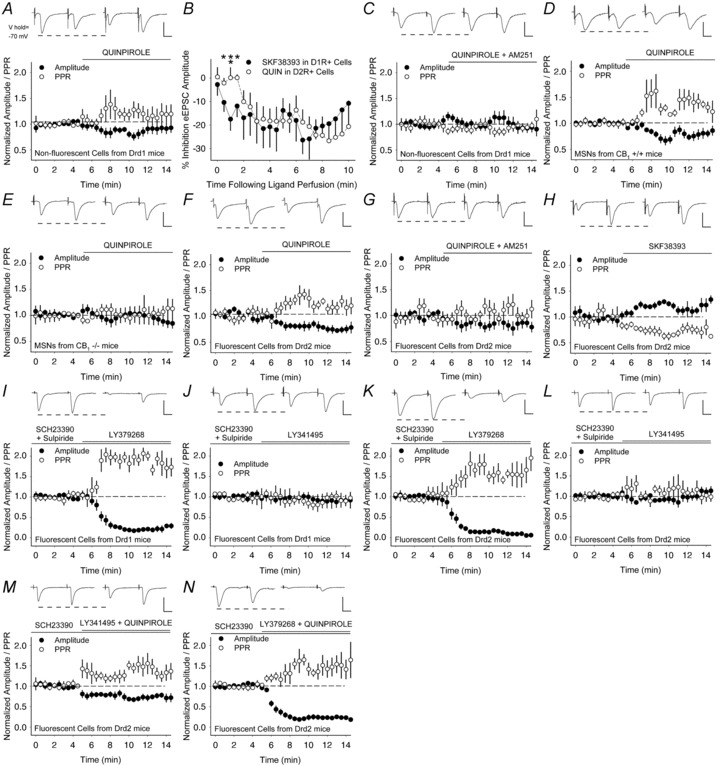
A, the D2R agonist quinpirole decreased the amplitude of the first eEPSC (of the pair) and increased the PPR in non-fluorescent MSNs from Drd1-EGFP mice. B, inhibition of the eEPSC amplitude by quinpirole in D2R-expressing cells was delayed compared to inhibition by the D1R agonist SKF38393 in D1R-expressing cells. *P < 0.05, **P < 0.01, ANOVA. C, the CB1R antagonist AM251 blocked inhibition by quinpirole in non-fluorescent cells from Drd1-EGFP mice. D and E, quinpirole decreased the amplitude and reduced the PPR in MSNs from CB1+/+ mice (D), but not in cells from CB1−/− mice (E). F and G, in fluorescent cells from Drd2-EGFP mice, quinpirole decreased the eEPSC amplitude and increased the PPR (F) and AM251 prevented inhibition by quinpirole (G). H, the D1R agonist SKF38393 increased the eEPSC amplitude and reduced the PPR. I and J, in the presence of D1 and D2 receptor antagonists SCH23390 and sulpiride, the mGluR2/3 agonist LY379268 suppressed the amplitude and increased the PPR in D1R+ cells (I), while the mGluR2/3 antagonist had no effect (J). K and L, the mGluR2/3 agonist also suppressed the amplitude and increased the PPR in D2R+ cells (K), while the mGluR2/3 antagonist LY341495 had no effect (L). M and N, in the presence of the D1R antagonist SCH23390, the D2R agonist quinpirole remained inhibitory when combined with the mGluR2/3 antagonist (M), and the the combination of mGluR2/3 agonist and quinpirole suppressed corticoaccumbal activity (N). Bar in panels A and C–N, 100 pA, 12.5 ms.