


Fig.2.
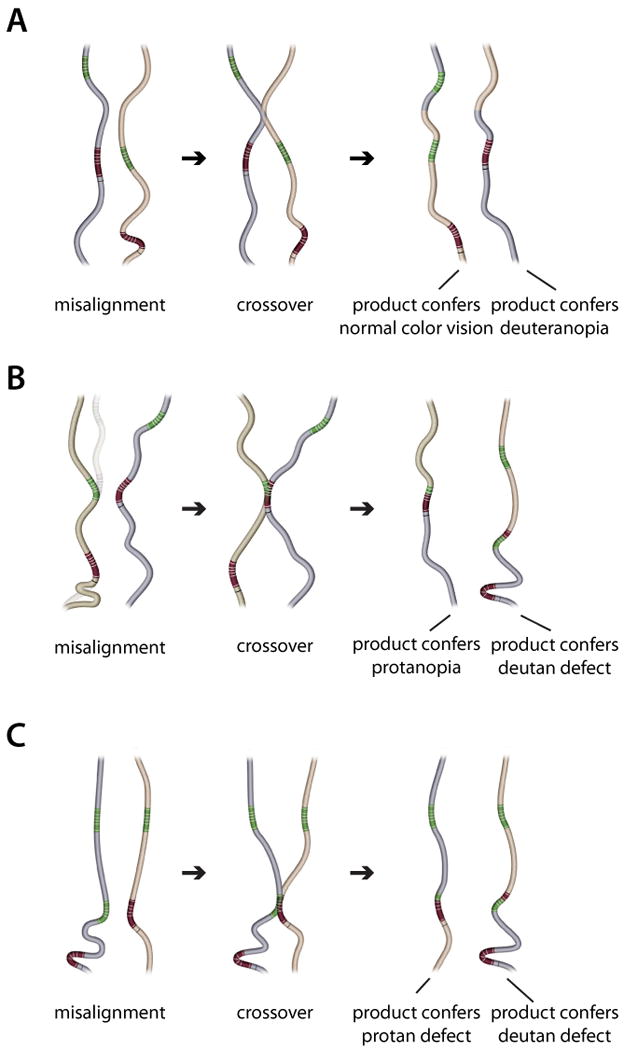
Recombination produces an opsin array that causes color vision deficiencies. A) Misalignment of the opsin gene arrays on the two X-chromosomes in a female allows a crossover in the region between the L and M genes in one array and the homologous region downstream of the M gene in the other array. This produces two new X-chromosome opsin gene arrays. One array has an L gene and two M genes and will confer normal color vision. The second array has a single opsin gene, an L gene, and produces the color vision defect, deuteranopia, when inherited by a male. B) Misalignment of the opsin gene arrays on the two X-chromosomes in a female allows a crossover between the L gene on one X chromosome and the M gene on the other X-chromosome. This produces two new arrays that differ in gene number from the parental arrays. A gene that derives part of its sequence from a parental L gene and part from a parental M gene encodes a pigment whose spectral sensitivity is primarily determined by the parental origin of exon 5. The array with one gene confers protanopia because the single gene derives exon 5 from the parental M gene. The array with three genes will cause a deutan color vision defect. The second gene in this array encodes an L-class pigment because it derives exon 5 from the parental L opsin gene. The severity of the deutan defect depends on the amino acid differences at the spectral tuning sites in the two L-class pigments. If there are no differences at the spectral tuning sites, deuteranopia will result; if there are differences, a male that inherits this array will be deuteranomalous. C) Recombination between an array with 3 opsin genes and another with 2 opsin genes is expected to produce arrays that cause color vision defects at a high frequency because the mismatch in gene number on the two arrays means there is no perfect alignment. Misalignment that results in a crossover between an L gene on one X-chromosome and the M gene on the other will produce two new arrays that cause color vision defects if inherited by a male. One array will have two genes, both of which encode opsins that form M-class pigments because the first gene in the array derives exon 5 from the parental M gene. Males inheriting such an array will have a protan defect, the severity of which is determined by amino acid differences specified at the spectral tuning sites. The second array produced has two L genes followed by an M gene. It will cause a male to have a deutan defect, the severity of which is determined by the spectral differences encoded by the genes encoding opsins that will form L-class pigments.