


Figure 6.
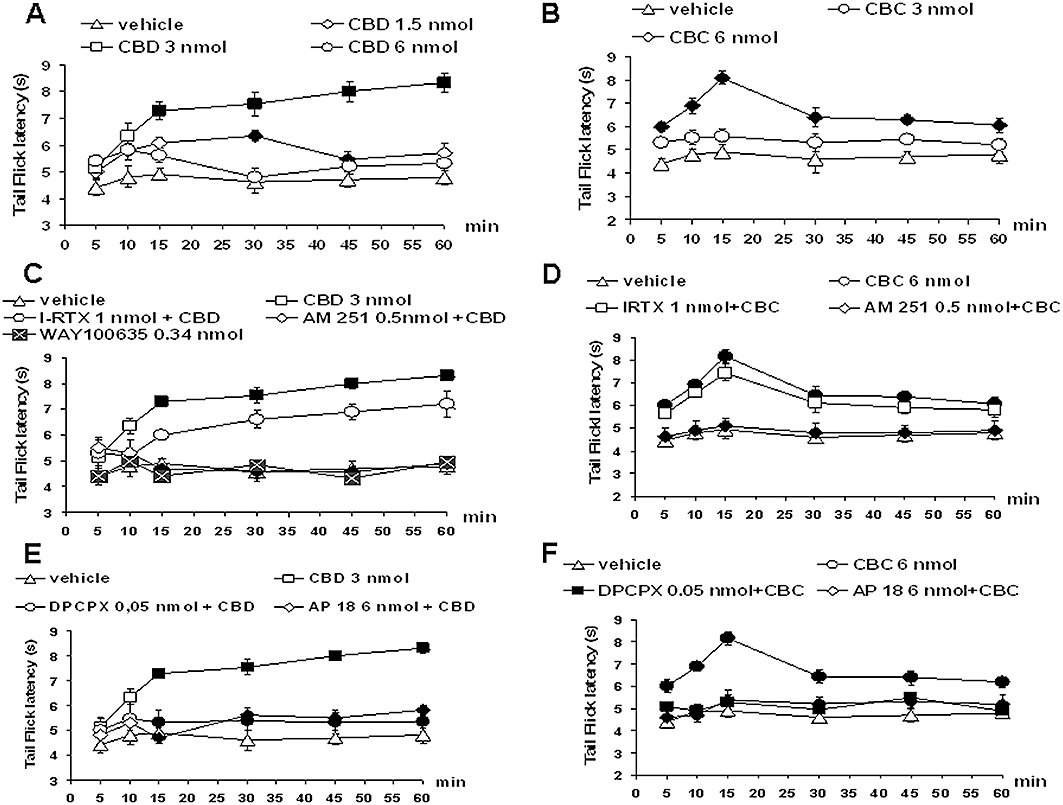
Effect of vehicle, cannabidiol (CBD) (1.5, 3 and 6 nmol) and cannabichromene (CBC) (3 and 6 nmol) alone or CBD (3 nmol) or CBC (6 nmol) in combination with AM251 (0.5 nmol), I-RTX (1 nmol), DPCPX (0.05 nmol) and AP18 (6 nmol) on the tail-flick latency. A shows the effect of intra-vl PAG microinjections of vehicle and CBD (1.5, 3 and 6 nmol). B shows the effect of intra-vl PAG administration of CBC (3 and 6 nmol). C shows the effect of intra-vl PAG administration of CBD (3 nmol) in combination with AM251 (0.5 nmol), I-RTX (1 nmol) or WAY100635 (0.34 nmol). D shows the effect of intra-vl PAG administration of CBC (6 nmol) in combination with AM251 (0.5 nmol) or I-RTX (1 nmol). E shows the effect of intra-vl PAG administration of CBD (3 nmol) in combination with DPCPX (0.05 nmol) or AP18 (6 nmol). F shows the effect of intra-vl PAG administration of CBC (6 nmol) in combination with DPCPX (0.05 nmol) or AP18 (6 nmol). Each point represents the mean ± standard error of the mean (S.E.M) of 12–16 rats. Filled symbols indicate values significantly different (P < 0.05) from vehicle or from CBD (3 nmol) and CBC (6 nmol). DPCPX, 1,3-dipropyl-8-cyclopentylxanthine; I-RTX, 5′-iodo-resiniferatoxin; vl-PAG, ventrolateral periaqueductal grey.