


Fig. 9.
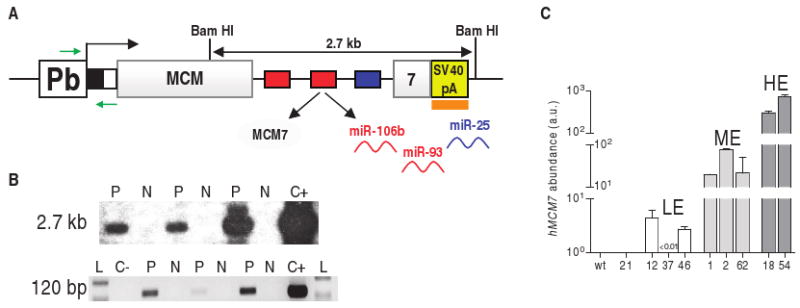
Pb/MCM7i13 transgenic construct. (A) Pb, prostate-specific rat probasin promoter ARR2PB; black box, HA tag; white box, Xpress tag; gray boxes, human MCM7 coding sequence; red and blue boxes, miR-93/106b and miR-25 genes; yellow box, SV40 poly(A) (SV40 pA); orange box, probe used for Southern analysis of transgenic lines; green arrows, primers used for PCR analysis of transgenic lines and for genotyping. (B) Top: Southern blot analysis. Genomic DNA extracted from tails was digested with Bam HI and hybridized with a probe complementary to the SV40 poly(A) region as shown in (A). The Bam HI–digested Pb/MCM7i13 plasmid was used as positive control (C+). Bottom: PCR analysis. A forward primer complementary to the probasin promoter and a reverse primer complementary to the tag were used, as shown in (A). Empty Pb and Pb/MCM7i13 plasmids were used as negative (C−) and positive (C+) controls. L, 100-bp ladder. Three representative positive (P) and negative (N) mice are shown. (C) Abundance of the transgenic construct measured by real-time PCR in nine different lines. A primer pair specific for human MCM7 coding sequence was used. LE, ME, HE: low, medium, and high expressors, respectively. Human MCM7 was not detectable in wild-type (wt) mice, confirming the specificity of the primers. See also fig. S9A.