


Figure 5. NicK-dependent replication is required for stability of ICEBs1 after excision.
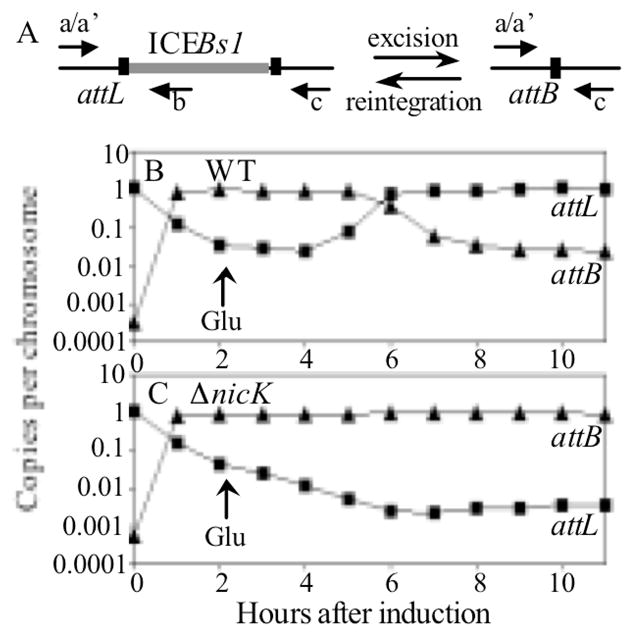
A. Schematic for detecting attL, the junction between the chromosome and the left end of ICEBs1, and attB, the empty attachment site in the bacterial chromosome formed after excision of ICEBs1. ICEBs1 is indicated by the gray line in the drawing on the left and is not shown after excision on the right. qRT-PCR using primer pairs a and b or a′ and c detected attL and attB, respectively.
B, C. Replication-competent wild type, CAL874 (B), and replication-defective ΔnicK, CAL1215 (C), strains were grown in minimal L-arabinose medium at 37°C and expression of Pxyl-rapI was induced during exponential growth (OD600 ~0.2) by addition of D-xylose for 2 hours. Expression of Pxyl-rapI was then repressed by removal of xylose and resuspension (and dilution) into minimal D-glucose medium at an OD600 of ~0.025. Samples were taken at the indicated times, covering ~7 doublings as cells entered stationary phase, and qRT-PCR was used to determine the copy number of attL and attB relative to that of a nearby gene (ydbT) outside of ICEBs1. The relative copy number is plotted as a function of time after addition of xylose to induce ICEBs1. The arrow at 2 hours indicates the shift to glucose (Glu) to repress expression of Pxyl-rapI. Data presented are from one representative experiment.