


Figure 2.
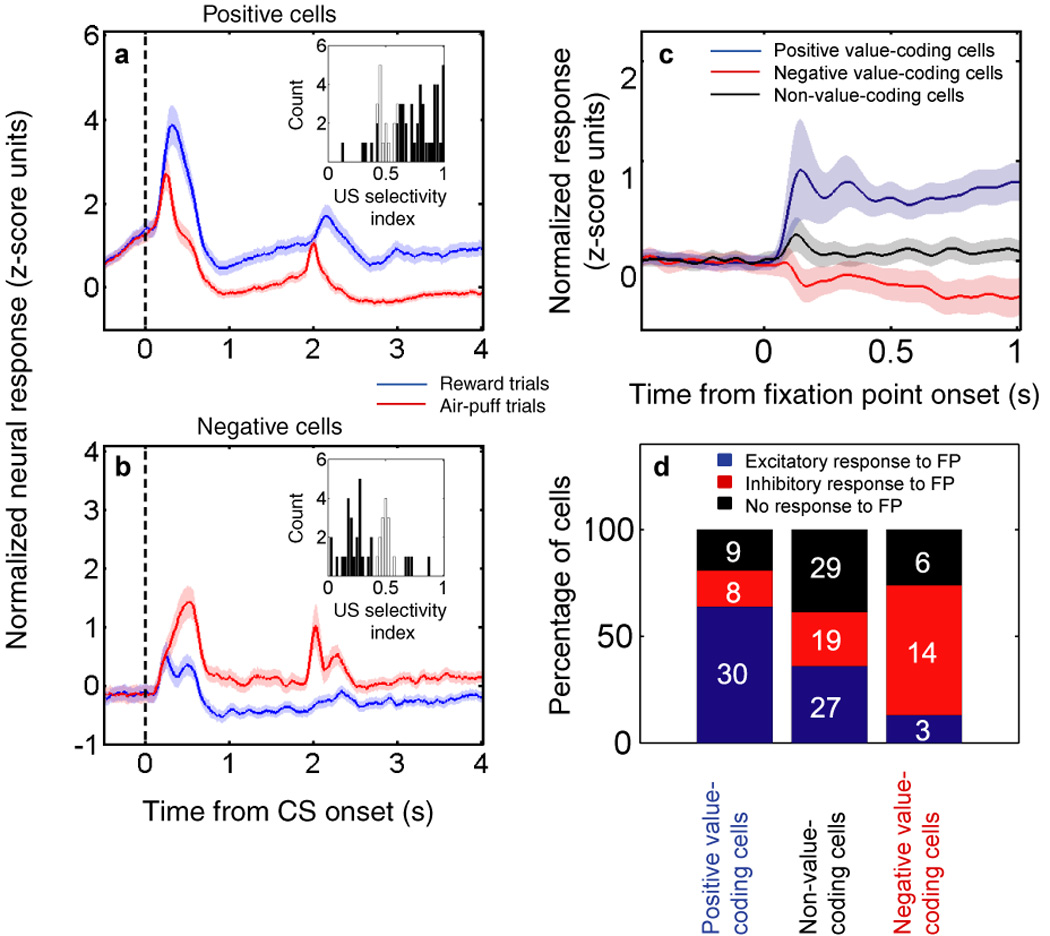
Populations of neurons in primate amygdala encode the value of conditioned stimuli, of unconditioned stimuli and of a fixation point. (a and b) Population responses to conditioned and unconditioned stimuli in a trace conditioning task in which novel, abstract images are followed by either reward or air-puff. Plots are normalized and averaged peri-stimulus time histograms (PSTHs) aligned on the time of CS presentation (vertical dashed line). Reward or air-puff occurred at either 1.8 or 1.85 s, depending on the session. Blue line, activity on rewarded trials. Red line, activity on air-puff trials. Shading indicates SEM. Inset histograms, reinforcement selectivity indices calculated for each neuron using an ROC analysis; see [29•] for details. (a) Population responses of positive value-coding cells. Note that US selectivity indices are predominantly greater than 0.5, indicating a higher firing rate for reward than for air-puff. (b) Population responses of negative value-coding cells. Note that US selectivity indices are predominantly less than 0.5, indicating a higher firing rate for air-puff than for reward. (c) Population normalized average response to fixation point (FP) presentation for positive value-coding cells (blue), negative value-coding cells (red), and non-value-coding cells (black). Shaded areas indicate SEM. Note that the FP is a mildly positive stimulus, and that positive and negative value-coding cells respond to it in a manner consistent with their responses to CSs; see [27•] for details. (d) Bar chart showing the percentage of cells with increases (blue), decreases (red), or no change (black) in activity during FP presentation. The number of cells of each type is indicated. The majority of positive value-coding cells increase firing to the FP, while the majority of negative value-coding cells decrease firing to the FP. Figure adapted with permission from [27•] and [29•].