


FIGURE 3. Minimal kinetic mechanism for hTDG.
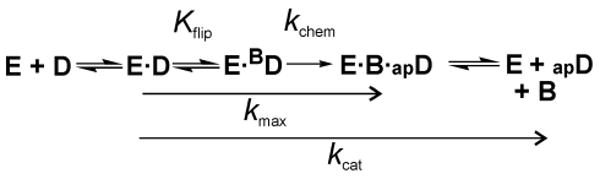
Shown is a minimal kinetic mechanism for hTDG, including the steps that comprise kcat, which is obtained from steady state kinetics, and kmax, as obtained from single turnover kinetics with a saturating enzyme concentration (used here). Association of hTDG (E) and DNA substrate (D) forms the initial collision complex, E·D, and base-flipping (Kflip) gives the reactive enzyme-substrate complex, E·BD (where BD is base-flipped DNA). Base flipping likely involves a conformational change for hTDG, which is not explicitly shown. The chemical step (kchem) involves cleavage of the base-sugar (N-glycosidic) bond and addition of the water nucleophile, producing the ternary product complex, E·B·apD (B is the nucleobase, apD is abasic DNA). Release of the excised base likely precedes the dissociation of abasic DNA, which is known to be very slow. As shown, kmax is influenced by Kflip and kchem, where kmax = kchem(Kflip/1 + Kflip).