


Fig. 1.
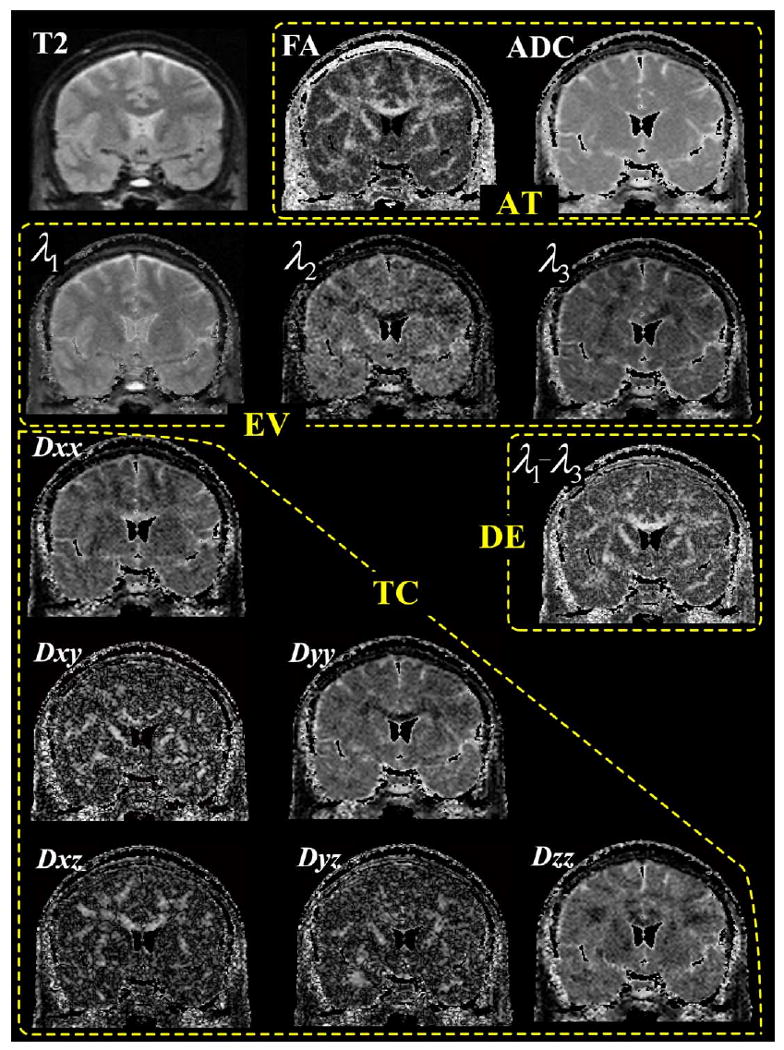
Types of intensity information used for registration. T2, FA (fractional anisotropy), and mean ADC (apparent diffusion coefficient, the trace of tensor) images in the first row, DE (difference of the first and second eigenvalues, i.e., λ1 − λ2) in the right side of the third row are used as a single channel registration respectively. AT contains two channels information, i.e., fractional anisotropy and trace of tensor (mean ADC). Three channels of information in EV (eigenvalues, i.e., λ1, λ2, and λ3 images) are displayed in the second row. Absolute intensity of each channel of TC (tensor components, i.e., Dxx, Dxy, Dxz, Dyy, Dyz, and Dzz gradient images) is seen in the last three rows. Areas with very low signal (surrounding air) or with mean apparent diffusion coefficient (ADC) values higher than 2.0 μs/mm2 (cerebrospinal fluid) were excluded.