


Figure 4.
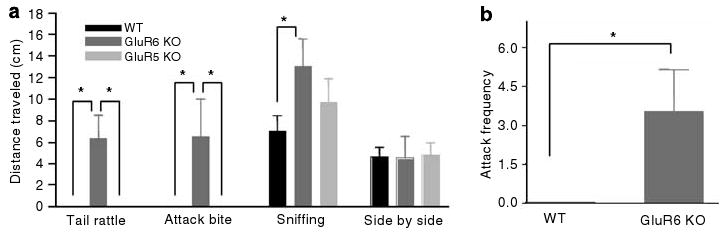
GluR6 KO mice display robustly aggressive behavior. (a) In the social interaction test, pairs of mice within the same strain were placed in opposite corners of an open-field arena. The frequency of social behaviors was counted over 5 min. GluR6 KO mice displayed a high frequency of destructive (aggressive) behaviors compared with GluR5 KO and WT mice (one-way ANOVA for ‘tail rattling’: F2,19 = 11.4, P < 0.001; ‘attack bite’: F2,19 = 3.9, P < 0.04). GluR6 KO mice displayed a high frequency of exploratory behavior compared with WT mice (one-way ANOVA for ‘sniffing’: F2,19 = 3.44, P = 0.05; post hoc Fisher LSD test for ‘sniffing’: GluR6 KO vs WT mice, P < 0.03). GluR6 KO mice displayed the same side-by-side behavior as GluR5 KO and WT mice (one-way ANOVA for ‘side by side’ F2,19 = 0.02, P = NS). (b) In the resident–intruder test, a 129Sv/Ev naive male mouse was introduced to the home cage of each mouse tested. The frequency of attacks on the intruder was counted over 5 min. GluR6 KO mice exhibited a high frequency of attack events toward their intruder compared with WT mice, who exhibited no attacks toward their intruder (Student's t-test: t23 =−2.12, P < 0.05). Results are means±s.e.m. *P≤0.05.