



Abstract
Several human monoclonal antibodies (hmAbs) including b12, 2G12, and 2F5 exhibit relatively potent and broad HIV-1-neutralizing activity. However, their elicitation in vivo by vaccine immunogens based on the HIV-1 envelope glycoprotein (Env) has not been successful. We have hypothesized that HIV-1 has evolved a strategy to reduce or eliminate the immunogenicity of the highly conserved epitopes of such antibodies by using “holes” (absence or very weak binding to these epitopes of germline antibodies that is not sufficient to initiate and/or maintain an efficient immune response) in the human germline B cell receptor (BCR) repertoire. To begin to test this hypothesis we have designed germline-like antibodies corresponding most closely to b12, 2G12, and 2F5 as well as to X5, m44, and m46 which are cross-reactive but with relatively modest neutralizing activity as natively occurring antibodies due to size and/or other effects. The germline-like X5, m44, and m46 bound with relatively high affinity to all tested Envs. In contrast, germline-like b12, 2G12, and 2F5 lacked measurable binding to Envs in an ELISA assay although the corresponding mature antibodies did. These results provide initial evidence that Env structures containing conserved vulnerable epitopes may not initiate humoral responses by binding to germline antibodies. Even if such responses are initiated by very weak binding undetectable in our assay it is likely that they will be outcompeted by responses to structures containing the epitopes of X5, m44, m46, and other antibodies that bind germline BCRs with much higher affinity/avidity. This hypothesis, if further supported by data, could contribute to our understanding of how HIV-1 evades immune responses and offer new concepts for design of effective vaccine immunogens.
Keywords: Germline, Antibody, Immune responses, HIV, Escape, Vaccine
Introduction
Potent broadly cross-reactive neutralizing antibodies (bnAbs) are relatively rarely found in patients with HIV-1 infection. Possible causes include protection of conserved structures of the virus envelope glycoprotein (Env) by variable loops, extensive glycosylation, occlusion within the oligomer, and conformational masking, as well as the rapid generation of HIV-1 mutants that outpace the development of such antibodies and immunoregulatory mechanisms [1], [2], [3], [4]. The Env is immunogenic and a number of Env-specific hmAbs have been identified [5]. However, only several hmAbs, including IgG b12 [6], [7], IgG 2G12 [8], [9], [10], and IgG 2F5 [11], have been extensively characterized [3], [12] and found to exhibit relatively potent and broad neutralizing activity to isolates from different clades. The existence of these antibodies has fueled the hope that the development of efficacious HIV vaccine is achievable provided that an immunogen containing the epitopes of these antibodies is appropriately designed. However, in spite of the large amount of research an antibody-based vaccine capable of eliciting broadly neutralizing antibodies has not been achieved [13]. Our inability to achieve elicitation of such bnAbs in humans indicates that there are still unknown fundamental immunological mechanisms that allow HIV-1 to evade elicitation of bnAbs. Understanding these mechanisms could provide novel tools for development of efficacious vaccines.
Early studies have found relatively extensive antigen-driven maturation and non-restricted use of the V genes in several HIV-specific antibodies [14], [15], [16], [17]. Later, an analysis of non-neutralizing HIV gp41-specific human antibodies showed an average mutation frequency of approximately 10% [18]. A more recent study of the gene usage and extent of maturation of CD4-induced (CD4i) antibodies suggested a restricted VH1-69 gene usage for CD4i antibodies with long CDR3 and VH1-24 for CD4i antibodies with short CDR3s [19]. It was noted in this study that two of the best characterized anti-gp120 bnAbs, b12 and 2G12, have nearly 2-fold higher somatic hypermutation (about 20% mutation frequency) than other gp120-reactive antibodies analyzed in the study (Table 1 in [19]).
We have hypothesized that the high divergence of the known bnAbs from their corresponding germline antibodies may indicate that the germline antibodies lack the capability to bind the epitopes of the mature antibodies. We designed germline-like antibodies corresponding to b12, 2G12, and 2F5 as well as to several human HIV-1-specific hmAbs (X5 [20], m44 [21], and m46 [22]). Fab X5 is a potent CD4i bnAb but as a full-size (IgG1) antibody exhibits on average significantly decreased potency likely due to size-restricted access to its epitope [23]. IgG1 m44 and IgG1 m46 are gp41-specific cross-reactive HIV-1-neutralizing hmAbs with relatively modest potency. We found that germline-like b12, 2G12 and 2F5 did not bind to any of the Envs although the corresponding mature antibodies did bind with relatively high level of activity. In contrast the germline-like X5, m44, and m46 bound with relatively high affinity to all tested Envs. These results provide initial evidence that germline-like antibodies corresponding to known bnAbs antibodies may not be capable of binding to the Env to initiate and/or maintain an immune response leading to their elicitation in vivo.
Materials and methods
Proteins. Bal gp120-CD4 was provided by Tim Fouts (University of Maryland, Baltimore, MD) and other recombinant proteins (gp120s and gp140s) were provided by Christopher Broder (USUHS, Bethesda, MD).
Analysis of antibody sequences and design of germline-like antibodies. The heavy and light chain nucleotide sequences were analyzed with JoinSolver ® [24]. The mAb V(D)J alignments were assigned to the germline gene that yielded the fewest nucleotide mismatches. Values of p < 0.05 were used to compare D segment alignments to that expected from random chance. The minimum requirement for D segment alignment was 9 or 10 (depending on the length of the V to J region) matching nucleotides and at least 2 additional matches for every mismatch. Germline-like sequences were determined by reverting mutations to the germline sequence while retaining the original CDR3 junctions and terminal deoxynucleotidyl transferase (TdT) N nucleotides.
Gene synthesis and expression plasmid constructions. ScFv DNAs corresponding to mature and germline-like X5, m44, m46, b12, 2G12, and 2F5 were synthesized by Genescript (Genescript, Piscatawy, NJ) and their accuracies were confirmed by sequencing. The VH of each of the antibodies was followed by a (GGGGS)3 linker and the VL. SfiI restriction site was added to both N and C termini for each scFv during gene synthesis for cloning into pComb3X plasmid (provided by Dennis Burton, Scripps Institute, La Jolla, CA) for expression in bacteria. The pComb3X vector adds a His tag to the C terminus of each inserted scFv. The His tag was used subsequently for scFv purification and detection in ELISA. The DNA fragments encoding selected scFv antibodies were fused with Fc of human IgG1 and cloned into the mammalian cell expression vector pSecTag2B (Invitrogen, Carlsbad, CA) for expression of the fusion proteins.
Antibody expression and purification. For scFv expression, Escherichia coli strain HB2151 was transformed by the scFv constructs described above. A single clone was inoculated into 2YT supplemented with 100 U of ampicillin, 0.2% glucose and incubated at 37 °C with shaking. When the OD600 reached 0.9, IPTG was added to achieve a final concentration of 1 mM and the culture continued overnight at 30 °C with shaking. Cells were then collected, lysed with polymyxin B (Sigma, St. Louis) in PBS, and the supernatant was subjected to the Ni–NTA agarose bead (Qiagen, Hilden, Germany) purification for the soluble scFvs. The scFv-Fc constructs were transfected into the 293 freestyle cells with polyfectin transfection agent (Invitrogen). Four days after transfection, the culture medium was collected and the secreted scFv-Fc proteins were purified using a protein-A Sepharose column (GE Healthcare, Piscataway, NJ).
ELISA. Protein antigens diluted in PBS buffer in concentrations ranging from 1 to 4 μg/ml were added to the 96 well plate and left at 4 °C overnight to coat the plate. The plate was then blocked with PBS + 5% dry milk buffer. ScFv and scFv-Fc in different concentrations were diluted in the same blocking buffer and applied to the ELISA plate. The mouse-anti-His-HRP was used to detect the His tag at the C terminus end of each of the scFv clones and the mouse-anti-human Fc-HRP was used to detect the Fc tag of the scFv-Fcs in most of the ELISA unless indicated otherwise. The HRP substrate ABTS (Roche, Mannheim, Germany) was then added to each well and OD 405 was taken 5–10 min afterward.
Results
High divergence of HIV-1-neutralizing hmAbs from germline antibodies
We have identified and characterized a number of hmAbs against HIV-1 some of which exhibit cross-reactive neutralizing activity against primary isolates from different clades [21], [22], [25], [26], [27], [28], [29], [30], [31], [32] as well as a number of hmAbs against the SARS CoV [33], [34], Hendra and Nipah viruses [35], [36], [37]. One of the antibodies (m396) potently neutralizes SARS CoV isolates from humans and animals [34] and others (m102 and m102.4) both henipaviruses, Nipah and Hendra [35], [36]. The identification of many hmAbs against various infectious agents has provided an opportunity to analyze and compare their antibody sequences.
We identified the closest germline Ig genes and calculated the antibody gene divergence as the number of amino acid changes from the corresponding germline antibodies (using mostly the VH gene for comparison). We found that all of our HIV-1-specific antibodies and three bnAbs with publicly available DNA sequences, b12, 2G12 and 2F5, were hypermutated more than normal donor memory B cells which average 13 mutations per VH sequence [38] (Table 1 and data not shown). In contrast, the antibodies against the SARS CoV and henipaviruses including m396, m102, and m102.4 had only several mutations from the closest germline (on average < 5%, data not shown). Potent antibody against a bacterial pathogen (Yersinia pestis) also had relatively low (3%) number of mutations (Xiao et al., unpublished). These results indicate that bnAbs against HIV-1 are significantly more divergent from the closest germline antibodies than hmAbs against SARS CoV and henipaviruses with potent and broad neutralizing activity.
Table 1.
Germline-like V(D)J gene usage, CDR3 sequence, and variable gene mutation.
| Ab chain | V | D | J | CDR3 sequence | V NT gene nucleotide mutations |
|---|---|---|---|---|---|
| X5 HC | IGHV1-69∗01 | IGHD3-22∗01 | IGHJ4∗02 | GCG AGA GAT TTT GGC CCC GAC TGG GAA GAC GGT GAT TAC TAT GAT AGT AGT GGC CGG GGG TTC TTT GAC TAC | 27 |
| X5 LC | IGKV3-20∗01 | — | IGKJ2∗01 | CAG CAG TAT GGT AGC TCA CCG TAC ACT | 13 |
| m44 HC | IGHV4-61∗01 | IGHD3-10∗02a | IGHJ4∗02 | GCG CGA GGA ACT CGG GGC GGT TCA ACC CTT GAC TAC | 42 |
| m 44 LC | IGKV3-20∗01 | — | IGJK3∗01 | CAG CAG TAT GGT AGC TCA CCT CGT TTC CTT | 24 |
| m46 HC | IGHV4-34∗01 | IGHD5-12∗01Ra,b | IGHJ4∗02 | GTG ACC ACT CGT CGT GGT AGC CAC TAC AAG GAT GAC TAC | 52 |
| m46 LC | IGKV1-9∗01 | — | IGJK1∗01 | CAA CAG CTT AAT AGT TAC CCT CGG ACG | 20 |
| b12 HC | IGHV1-03∗01 | IGHD3-10∗02a | IGHJ6∗03 | GCG AGA GTG GGG CCA TAT AGT TGG GAT GAT TCT CCC CAG TAC AAT TAT TAT ATG GAC GTC | 36 |
| b12 LC | IGKV3-20∗01 | — | IGKJ2∗01 | CAG CAG TAT GGT GCC TCC TCG TAC ACT | 35 |
| 2G12 HC | IGHV3-21∗01 | IGHD4 familya,b,c | IGHJ3∗01 | GCG AGA AAG GGA TCT GAC AGA CTA AGC GAC AAC GAT CCT TTT GAT GTC | 60 |
| 2G12 LC | IGKV1-5∗03 | — | IGKJ1∗01 | CAA CAG TAT AAT AGT TAT TCT TAC ACT | 34 |
| 2F5 HC | IGHV2-05∗10 | IGHD3-03∗01 | IGHJ6∗02 | GCA CAC CGA CGG GGG CCA ACC ACA CTC TTT GGA GTG GTT ATT GCC CGG GGA CCA GTG AAC GGT ATG GAC GTC | 40 |
| 2F5 LC | IGKV1-13∗02 or 1D-13∗01 | — | IGKJ4∗01 | CAA CAG TTT AAT AGT TAC CCT CAC ACT | 34 |
The best D alignment has >5% probability that the D match is a random match.
The best D segment alignment for m44 is to the inverted (R) IGHD5-12⁎01 germline gene.
An individual D4 gene could not be identified.
Design of germline-like X5, m44, m46, b12, 2G12, and 2F5
To test whether the closest germline-like antibodies that presumably initiated the hypermutation process can bind the Env, we designed corresponding germline-like antibodies (Table 1). Because of the diversity of the D segment in the heavy chain CDR3 (H3) of m44, m46, b12, and 2G12 the germline sequence could not be determined with 95% confidence and the original D segment amino acid sequence was used for synthesizing the germline-like Ab.
Germline-like scFvs X5, m44, and m46 bind but b12, 2G12, and 2F5 lack measurable binding to Envs
To explore the hypothesis that some germline antibodies against conserved epitopes may not bind structures containing epitopes of their corresponding mature antibodies we synthesized the genes for six germline-like antibodies in a scFv format. The purified scFvs were tested for binding in an ELISA assay where recombinant Envs (gp140s) were used as target antigens. We observed high affinity binding of germline-like X5 and lower affinity binding for the germline-like antibodies m44 and m46 (Fig. 1 ). In contrast, there was no measurable binding for the germline-like antibodies b12, 2G12, and 2F5 even at very high (μM range) concentrations (ELISA signal at or below negative control with irrelevant antigens) (Fig. 2 ). These results demonstrate that the germline-like antibodies corresponding to these three antibodies do not bind to recombinant gp140 in our ELISA assay even at high concentrations.
Fig. 1.
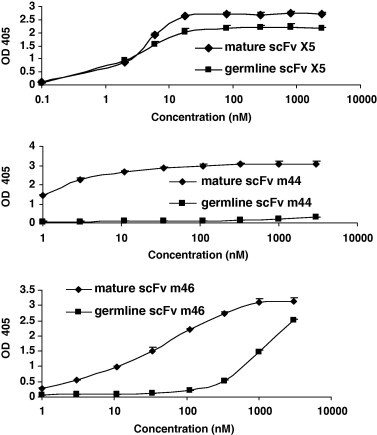
Detectable bindings of germline-like X5, m44, and m46 antibodies in scFv format to Env. Bal gp120-CD4 fusion protein was coated on a 96 well ELISA plate for detection of scFv X5 binding, whereas 89.6 gp140 was coated for detection of scFv m44 and m46 bindings at indicated concentrations. Mature and germline-like antibodies were compared.
Fig. 2.
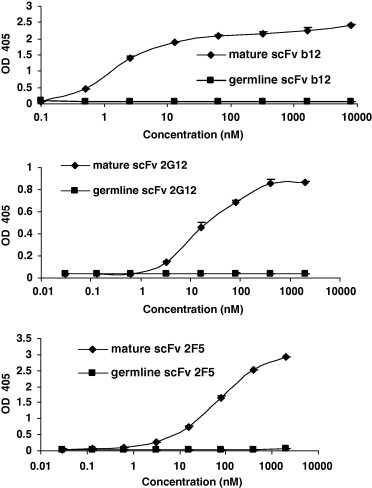
Lack of binding of germline-like b12, 2G12, and 2F5 antibodies in scFv format. Bal gp120 was coated for detection of b12 binding and 89.6 gp140 was coated for detection of binding by both scFv 2G12 and 2F5. Mature and germline-like formats were compared.
Bivalent Fc fusion proteins of germline-like b12, 2G12, and 2F5 lack measurable binding to Envs
To test whether avidity effects could lead to measurable binding of the germline-like b12, 2G12, and 2F5 we constructed, expressed and purified bivalent scFv-Fc fusion proteins. These antibodies did not exhibit measurable binding in the same ELISA assay even at very high (μM range) concentrations (Fig. 3 ). As expected, due to avidity effects the binding of the germline-like m44 and m46 Fc fusion proteins was enhanced (Fig. 4 ). These results indicate that bivalent avidity effects do not lead to measurable binding of germline-like b12, 2G12, and 2F5 in our ELISA assay.
Fig. 3.
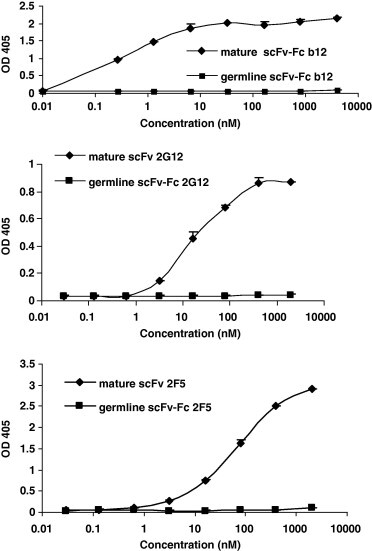
Lack of binding of germline-like b12, 2G12, and 2F5 antibodies in Fc fusion protein format to Env. Bal gp120 was coated for detection of mature and germline-like scFv-Fc b12 binding and 89.6 gp140 was coated for detection of binding by mature scFv and germline-like scFv-Fc 2G12 and 2F5.
Fig. 4.
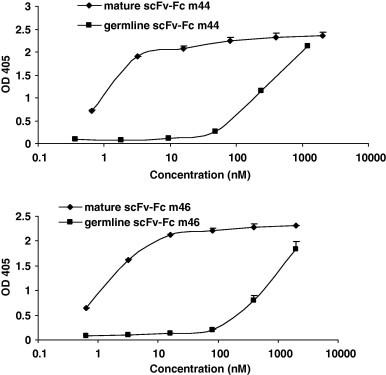
Detectable bindings of germline-like m44 and m46 antibodies in Fc fusion protein format to Env. Env 89.6 gp140 was coated for detection of binding by scFv-Fc m44 and m46 fusion proteins.
Discussion
We and others [19] have found that a number of HIV-1-specific neutralizing antibodies have unusually high frequencies of somatic hypermutation. The increase in somatic hypermutation was associated with an increase in nonsynonymous amino acid substitutions. In contrast, the neutralizing hmAbs against several viruses causing acute infections contain fewer amino acid substitutions. Notably, the potent bnAbs against SARS CoV and henipaviruses were selected by screening a large non-immune antibody library derived from ten healthy volunteers against the respective Envs, as a method for resembling to a certain extent in vivo immunization [39]). To mimic better the B cells that respond to primary immunization, the heavy chains of the antibodies in this library from normal donors were of μ type corresponding to IgM+ B cells. When the same library and screening methodology was used against HIV-1 Envs, only weakly neutralizing non-cross-reactive antibodies resulted (data not shown). Panning with another IgM library from large number of healthy individuals resulted in non-neutralizing or even infection-enhancing antibodies [40]. Previous attempts to select HIV-specific antibodies from non-immune libraries have also resulted in antibodies with modest neutralizing activity and limited breadth of neutralization [41], [42]. These results indicate that HIV-1 has developed a strategy to protect its highly conserved epitopes against initial immune responses. In contrast, SARS CoV and henipaviruses appear to lack such a mechanism and their Envs contain exposed, conserved receptor binding sites that can bind IgM + B cells with sufficient affinity to induce class switch and affinity maturation. Therefore, unlike HIV-1, Env-based vaccine immunogens and in particular the receptor binding domains of SARS CoV and henipaviruses can be highly effective in eliciting bnAbs.
Further support for this line of reasoning is our finding that germline-like b12, 2G12, and 2F5 lack measurable binding to Envs. We have not detected binding at relatively high (up to 10 μM) antibody concentrations. Although in general the threshold for B cell activation is believed to be on the order of μM equilibrium dissociation constants, it was demonstrated that even lower affinity/avidity interactions can trigger B cell activation in mice [43], [44]. However, even if binding occurs with very low avidity activated B cells expressing such BCRs are likely to be outcompeted by B cells expressing BCRs that bind to other epitopes with higher affinity/avidity. Such epitopes include those of X5 as a representative of a CD4i epitope and m44 and m46 as representatives of gp41 epitopes. X5 and other CD4i antibodies target a highly conserved and immunogenic structure overlapping with the coreceptor binding site; such antibodies are abundant in patients with HIV-1 infection [45]. It has been demonstrated that the differences in responses of high and low affinity B cells can be relatively small but in competition experiments only the high-affinity B cells respond to antigen [46], [47]. One can hypothesize that during lengthy chronic infections, HIV has evolved mechanisms to protect its most vulnerable but functionally important conserved structures including the CD4 binding site, conserved carbohydrates and gp41 membrane proximal external region (MPER) by using “holes” in the human germline BCR repertoire, i.e., these structure do not bind or bind very weakly to germline antibodies. At the same time HIV has evolved other structures which are either not accessible for full-size antibodies (e.g. some CD4i epitopes including the X5 one) or are not functionally important but can bind with relatively high affinity to B cells expressing germline antibodies that can outcompete those B cells expressing BCRs against conserved epitopes, if any.
In conclusion, the results indicate another possible mechanism used by HIV-1 to evade neutralizing immune responses. HIV-1 may be able to protect its vulnerable exposed conserved epitopes by using “holes” in the human germline repertoire. Germline BCRs that can recognize these epitopes and initiate and/or maintain immune responses by competing with BCRs that bind to other non-essential or non-accessible epitopes with high affinity may be missing from the naïve repertoire. We would like to emphasize that this study is only an initial attempt to explore this possible mechanism and much more work is needed to prove it and to use the knowledge gained for the design of effective vaccine immunogens capable of eliciting potent bnAbs against HIV-1.
Acknowledgments
We thank Ruth Ruprecht, Hana Golding, Robert Blumenthal, Christopher Broder, Jorge Flores, Helen Quill, Nancy Miller, Garnett Kelsoe, and Barton Haynes for stimulating discussions and suggestions, Christopher Broder, Gerald Quinnan, Barton Haynes, Dennis Burton, and Tim Fouts for providing reagents, and John Owens for help. This work was supported by the Intramural Research Program of the NIH, National Cancer Institute, Center for Cancer Research, by Federal funds from the NIH, National Cancer Institute, under Contract No. NO1-CO-12400, and by the Gates Foundation to D.S.D.
References
- 1.Johnson W.E., Desrosiers R.C. Viral persistence: HIV’s strategies of immune system evasion. Annu. Rev. Med. 2002;53:499–518. doi: 10.1146/annurev.med.53.082901.104053. [DOI] [PubMed] [Google Scholar]
- 2.Wei X., Decker J.M., Wang S., Hui H., Kappes J.C., Wu X., Salazar-Gonzalez J.F., Salazar M.G., Kilby J.M., Saag M.S., Komarova N.L., Nowak M.A., Hahn B.H., Kwong P.D., Shaw G.M. Antibody neutralization and escape by HIV-1. Nature. 2003;422:307–312. doi: 10.1038/nature01470. [DOI] [PubMed] [Google Scholar]
- 3.Burton D.R. Antibodies, viruses and vaccines. Nat. Rev. Immunol. 2002;2:706–713. doi: 10.1038/nri891. [DOI] [PubMed] [Google Scholar]
- 4.Poignard P., Saphire E.O., Parren P.W., Burton D.R. Gp120: biologic aspects of structural features. Annu. Rev. Immunol. 2001;19:253–274. doi: 10.1146/annurev.immunol.19.1.253. [DOI] [PubMed] [Google Scholar]
- 5.Zolla-Pazner S. Identifying epitopes of HIV-1 that induce protective antibodies. Nat. Rev. Immunol. 2004;4:199–210. doi: 10.1038/nri1307. [DOI] [PMC free article] [PubMed] [Google Scholar]
- 6.Burton D.R., Pyati J., Koduri R., Sharp S.J., Thornton G.B., Parren P.W., Sawyer L.S., Hendry R.M., Dunlop N., Nara P.L., et al. Efficient neutralization of primary isolates of HIV-1 by a recombinant human monoclonal antibody. Science. 1994;266:1024–1027. doi: 10.1126/science.7973652. [DOI] [PubMed] [Google Scholar]
- 7.Roben P., Moore J.P., Thali M., Sodroski J., Barbas C.F., 3rd, Burton D.R. Recognition properties of a panel of human recombinant Fab fragments to the CD4 binding site of gp120 that show differing abilities to neutralize human immunodeficiency virus type 1. J. Virol. 1994;68:4821–4828. doi: 10.1128/jvi.68.8.4821-4828.1994. [DOI] [PMC free article] [PubMed] [Google Scholar]
- 8.Sanders R.W., Venturi M., Schiffner L., Kalyanaraman R., Katinger H., Lloyd K.O., Kwong P.D., Moore J.P. The mannose-dependent epitope for neutralizing antibody 2G12 on human immunodeficiency virus type 1 glycoprotein gp120. J. Virol. 2002;76:7293–7305. doi: 10.1128/JVI.76.14.7293-7305.2002. [DOI] [PMC free article] [PubMed] [Google Scholar]
- 9.Scanlan C.N., Pantophlet R., Wormald M.R., Ollmann S.E., Stanfield R., Wilson I.A., Katinger H., Dwek R.A., Rudd P.M., Burton D.R. The broadly neutralizing anti-human immunodeficiency virus type 1 antibody 2G12 recognizes a cluster of alpha1 → 2 mannose residues on the outer face of gp120. J. Virol. 2002;76:7306–7321. doi: 10.1128/JVI.76.14.7306-7321.2002. [DOI] [PMC free article] [PubMed] [Google Scholar]
- 10.Trkola A., Purtscher M., Muster T., Ballaun C., Buchacher A., Sullivan N., Srinivasan K., Sodroski J., Moore J.P., Katinger H. Human monoclonal antibody 2G12 defines a distinctive neutralization epitope on the gp120 glycoprotein of human immunodeficiency virus type 1. J. Virol. 1996;70:1100–1108. doi: 10.1128/jvi.70.2.1100-1108.1996. [DOI] [PMC free article] [PubMed] [Google Scholar]
- 11.Muster T., Steindl F., Purtscher M., Trkola A., Klima A., Himmler G., Ruker F., Katinger H. A conserved neutralizing epitope on gp41 of human immunodeficiency virus type 1. J. Virol. 1993;67:6642–6647. doi: 10.1128/jvi.67.11.6642-6647.1993. [DOI] [PMC free article] [PubMed] [Google Scholar]
- 12.Ferrantelli F., Ruprecht R.M. Neutralizing antibodies against HIV—back in the major leagues? Curr. Opin. Immunol. 2002;14:495–502. doi: 10.1016/s0952-7915(02)00362-x. [DOI] [PubMed] [Google Scholar]
- 13.Haynes B.F., Montefiori D.C. Aiming to induce broadly reactive neutralizing antibody responses with HIV-1 vaccine candidates. Expert Rev. Vaccines. 2006;5:579–595. doi: 10.1586/14760584.5.4.579. [DOI] [PubMed] [Google Scholar]
- 14.Andris J.S., Johnson S., Zolla-Pazner S., Capra J.D. Molecular characterization of five human anti-human immunodeficiency virus type 1 antibody heavy chains reveals extensive somatic mutation typical of an antigen-driven immune response. Proc. Natl. Acad. Sci. USA. 1991;88:7783–7787. doi: 10.1073/pnas.88.17.7783. [DOI] [PMC free article] [PubMed] [Google Scholar]
- 15.Moran M.J., Andris J.S., Matsumato Y., Capra J.D., Hersh E.M. Variable region genes of anti-HIV human monoclonal antibodies: non-restricted use of the V gene repertoire and extensive somatic mutation. Mol. Immunol. 1993;30:1543–1551. doi: 10.1016/0161-5890(93)90462-k. [DOI] [PubMed] [Google Scholar]
- 16.Felgenhauer M., Kohl J., Ruker F. Nucleotide sequences of the cDNAs encoding the V-regions of H- and L-chains of a human monoclonal antibody specific to HIV-1-gp41. Nucleic Acids Res. 1990;18:4927. doi: 10.1093/nar/18.16.4927. [DOI] [PMC free article] [PubMed] [Google Scholar]
- 17.Marasco W.A., Bagley J., Zani C., Posner M., Cavacini L., Haseltine W.A., Sodroski J. Characterization of the cDNA of a broadly reactive neutralizing human anti-gp120 monoclonal antibody. J. Clin. Invest. 1992;90:1467–1478. doi: 10.1172/JCI116014. [DOI] [PMC free article] [PubMed] [Google Scholar]
- 18.Binley J.M., Ditzel H.J., Barbas C.F., 3rd, Sullivan N., Sodroski J., Parren P.W., Burton D.R. Human antibody responses to HIV type 1 glycoprotein 41 cloned in phage display libraries suggest three major epitopes are recognized and give evidence for conserved antibody motifs in antigen binding AIDS. Res. Hum. Retroviruses. 1996;12:911–924. doi: 10.1089/aid.1996.12.911. [DOI] [PubMed] [Google Scholar]
- 19.Huang C.C., Venturi M., Majeed S., Moore M.J., Phogat S., Zhang M.Y., Dimitrov D.S., Hendrickson W.A., Robinson J., Sodroski J., Wyatt R., Choe H., Farzan M., Kwong P.D. Structural basis of tyrosine sulfation and VH-gene usage in antibodies that recognize the HIV type 1 coreceptor-binding site on gp120. Proc. Natl. Acad. Sci. USA. 2004;101:2706–2711. doi: 10.1073/pnas.0308527100. [DOI] [PMC free article] [PubMed] [Google Scholar]
- 20.Moulard M., Phogat S.K., Shu Y., Labrijn A.F., Xiao X.D., Binley J.M., Zhang M.Y., Sidorov I.A., Broder C.C., Robinson J., Parren P.W.H.I., Burton D.R., Dimitrov D.S. Broadly cross-reactive HIV-1-neutralizing human monoclonal Fab selected for binding to gp120-CD4-CCR5 complexes. Proc. Natl. Acad. Sci. USA. 2002;99:6913–6918. doi: 10.1073/pnas.102562599. [DOI] [PMC free article] [PubMed] [Google Scholar]
- 21.Zhang M.Y., Vu B.K., Choudhary A., Lu H., Humbert M., Ong H., Alam M., Ruprecht R.M., Quinnan G., Jiang S., Montefiori D.C., Mascola J.R., Broder C.C., Haynes B.F., Dimitrov D.S. Cross-reactive human immunodeficiency virus type 1-neutralizing human monoclonal antibody which recognizes a novel conformational epitope on gp41 and lacks reactivity against self antigens. J. Virol. 2008 doi: 10.1128/JVI.00033-08. [DOI] [PMC free article] [PubMed] [Google Scholar]
- 22.Choudhry V., Zhang M.Y., Sidorov I.A., Louis J.M., Harris I., Dimitrov A.S., Bouma P., Cham F., Choudhary A., Rybak S.M., Fouts T., Montefiori D.C., Broder C.C., Quinnan G.V., Jr., Dimitrov D.S. Cross-reactive HIV-1 neutralizing monoclonal antibodies selected by screening of an immune human phage library against an envelope glycoprotein (gp140) isolated from a patient (R2) with broadly HIV-1 neutralizing antibodies. Virology. 2007;363:79–90. doi: 10.1016/j.virol.2007.01.015. [DOI] [PMC free article] [PubMed] [Google Scholar]
- 23.Labrijn A.F., Poignard P., Raja A., Zwick M.B., Delgado K., Franti M., Binley J., Vivona V., Grundner C., Huang C.C., Venturi M., Petropoulos C.J., Wrin T., Dimitrov D.S., Robinson J., Kwong P.D., Wyatt R.T., Sodroski J., Burton D.R. Access of antibody molecules to the conserved coreceptor binding site on glycoprotein gp120 is sterically restricted on primary human immunodeficiency virus type 1. J. Virol. 2003;77:10557–10565. doi: 10.1128/JVI.77.19.10557-10565.2003. [DOI] [PMC free article] [PubMed] [Google Scholar]
- 24.Souto-Carneiro M.M., Longo N.S., Russ D.E., Sun H.W., Lipsky P.E. Characterization of the human Ig heavy chain antigen binding complementarity determining region 3 using a newly developed software algorithm, JOINSOLVER. J. Immunol. 2004;172:6790–6802. doi: 10.4049/jimmunol.172.11.6790. [DOI] [PubMed] [Google Scholar]
- 25.Zhang M.Y., Shu Y., Phogat S., Xiao X., Cham F., Bouma P., Choudhary A., Feng Y.R., Sanz I., Rybak S., Broder C.C., Quinnan G.V., Evans T., Dimitrov D.S. Broadly cross-reactive HIV neutralizing human monoclonal antibody Fab selected by sequential antigen panning of a phage display library. J. Immunol. Methods. 2003;283:17–25. doi: 10.1016/j.jim.2003.07.003. [DOI] [PubMed] [Google Scholar]
- 26.Moulard M., Zhang M.Y., Dimitrov D.S. In: Biopharmaceutical Antibodies. Subramanian G., editor. Kluwer; New York: 2003. Novel HIV neutralizing antibodies selected from phage display libraries; pp. 105–117. [Google Scholar]
- 27.Zhang M.Y., Xiao X., Sidorov I.A., Choudhry V., Cham F., Zhang P.F., Bouma P., Zwick M., Choudhary A., Montefiori D.C., Broder C.C., Burton D.R., Quinnan G.V., Jr., Dimitrov D.S. Identification and characterization of a new cross-reactive human immunodeficiency virus type 1-neutralizing human monoclonal antibody. J. Virol. 2004;78:9233–9242. doi: 10.1128/JVI.78.17.9233-9242.2004. [DOI] [PMC free article] [PubMed] [Google Scholar]
- 28.Zhang M.Y., Shu Y., Sidorov I., Dimitrov D.S. Identification of a novel CD4i human monoclonal antibody Fab that neutralizes HIV-1 primary isolates from different clades. Antiviral Res. 2004;61:161–164. doi: 10.1016/j.antiviral.2003.09.009. [DOI] [PubMed] [Google Scholar]
- 29.Zhang M.Y., Shu Y., Rudolph D., Prabakaran P., Labrijn A.F., Zwick M.B., Lal R.B., Dimitrov D.S. Improved breadth and potency of an HIV-1-neutralizing human single-chain antibody by random mutagenesis and sequential antigen panning. J. Mol. Biol. 2004;335:209–219. doi: 10.1016/j.jmb.2003.09.055. [DOI] [PubMed] [Google Scholar]
- 30.Choudhry V., Zhang M.Y., Dimitrova D., Prabakaran P., Dimitrov A.S., Fouts T.R., Dimitrov D.S. Antibody-based inhibitors of HIV infection. Expert Opin. Biol. Ther. 2006;6:523–531. doi: 10.1517/14712598.6.5.523. [DOI] [PubMed] [Google Scholar]
- 31.Zhang M.Y., Dimitrov D.S. Novel approaches for identification of broadly cross-reactive HIV-1 neutralizing human monoclonal antibodies and improvement of their potency. Curr. Pharm. Des. 2007;13:203–212. doi: 10.2174/138161207779313669. [DOI] [PubMed] [Google Scholar]
- 32.Zhang M.Y., Choudhry V., Sidorov I.A., Tenev V., Vu B.K., Choudhary A., Lu H., Stiegler G.M., Katinger H.W., Jiang S., Broder C.C., Dimitrov D.S. Selection of a novel gp41-specific HIV-1 neutralizing human antibody by competitive antigen panning. J. Immunol. Methods. 2006;317:21–30. doi: 10.1016/j.jim.2006.09.016. [DOI] [PMC free article] [PubMed] [Google Scholar]
- 33.Prabakaran P., Gan J., Feng Y., Zhu Z., Choudhry V., Xiao X., Ji X., Dimitrov D.S. Structure of severe acute respiratory syndrome coronavirus receptor-binding domain complexed with neutralizing antibody. J. Biol. Chem. 2006;281:15829–15836. doi: 10.1074/jbc.M600697200. [DOI] [PMC free article] [PubMed] [Google Scholar]
- 34.Zhu Z., Chakraborti S., He Y., Roberts A., Sheahan T., Xiao X., Hensley L.E., Prabakaran P., Rockx B., Sidorov I.A., Corti D., Vogel L., Feng Y., Kim J.O., Wang L.F., Baric R., Lanzavecchia A., Curtis K.M., Nabel G.J., Subbarao K., Jiang S., Dimitrov D.S. Potent cross-reactive neutralization of SARS coronavirus isolates by human monoclonal antibodies. Proc. Natl. Acad. Sci. USA. 2007;104:12123–12128. doi: 10.1073/pnas.0701000104. [DOI] [PMC free article] [PubMed] [Google Scholar]
- 35.Zhu Z., Dimitrov A.S., Bossart K.N., Crameri G., Bishop K.A., Choudhry V., Mungall B.A., Feng Y.R., Choudhary A., Zhang M.Y., Feng Y., Wang L.F., Xiao X., Eaton B.T., Broder C.C., Dimitrov D.S. Potent neutralization of Hendra and Nipah viruses by human monoclonal antibodies. J. Virol. 2006;80:891–899. doi: 10.1128/JVI.80.2.891-899.2006. [DOI] [PMC free article] [PubMed] [Google Scholar]
- 36.Zhu Z., Bossart K.N., Bishop K.A., Crameri G., Dimitrov A.S., McEachern J.A., Feng Y., Middleton D., Wang L.F., Broder C.C., Dimitrov D.S. Exceptionally potent cross-reactive neutralization of Nipah and Hendra viruses by a human monoclonal antibody. J. Infect. Dis. 2008;197:846–853. doi: 10.1086/528801. [DOI] [PMC free article] [PubMed] [Google Scholar]
- 37.Prabakaran P., Zhu Z., Xiao X., Biragyn A., Dimitrov A.S., Broder C.C., Dimitrov D.S. Potent human monoclonal antibodies against SARS CoV, Nipah and Hendra viruses. Expert Opin. Biol. Ther. 2009;9:355–368. doi: 10.1517/14712590902763755. [DOI] [PMC free article] [PubMed] [Google Scholar]
- 38.Longo N.S., Lugar P.L., Yavuz S., Zhang W., Krijger P.H., Russ D.E., Jima D.D., Dave S.S., Grammer A.C., Lipsky P.E. Analysis of somatic hypermutation in X-linked hyper-IgM syndrome shows specific deficiencies in mutational targeting. Blood. 2009;113:3706–3715. doi: 10.1182/blood-2008-10-183632. [DOI] [PMC free article] [PubMed] [Google Scholar]
- 39.Parren P.W., Fisicaro P., Labrijn A.F., Binley J.M., Yang W.P., Ditzel H.J., Barbas C.F., III, Burton D.R. In vitro antigen challenge of human antibody libraries for vaccine evaluation: the human immunodeficiency virus type 1 envelope. J. Virol. 1996;70:9046–9050. doi: 10.1128/jvi.70.12.9046-9050.1996. [DOI] [PMC free article] [PubMed] [Google Scholar]
- 40.Chen et al., Cross-reactive human IgM monoclonal antibodies that bind HIV-1 envelope glycoproteins, Viruses, submitted for publication. [DOI] [PMC free article] [PubMed]
- 41.Miller M.D., Geleziunas R., Bianchi E., Lennard S., Hrin R., Zhang H., Lu M., An Z., Ingallinella P., Finotto M., Mattu M., Finnefrock A.C., Bramhill D., Cook J., Eckert D.M., Hampton R., Patel M., Jarantow S., Joyce J., Ciliberto G., Cortese R., Lu P., Strohl W., Schleif W., McElhaugh M., Lane S., Lloyd C., Lowe D., Osbourn J., Vaughan T., Emini E., Barbato G., Kim P.S., Hazuda D.J., Shiver J.W., Pessi A. A human monoclonal antibody neutralizes diverse HIV-1 isolates by binding a critical gp41 epitope. Proc. Natl. Acad. Sci. USA. 2005;102:14759–14764. doi: 10.1073/pnas.0506927102. [DOI] [PMC free article] [PubMed] [Google Scholar]
- 42.Louis J.M., Bewley C.A., Gustchina E., Aniana A., Clore G.M. Characterization and HIV-1 fusion inhibitory properties of monoclonal Fabs obtained from a human non-immune phage library selected against diverse epitopes of the ectodomain of HIV-1 gp41. J. Mol. Biol. 2005;353:945–951. doi: 10.1016/j.jmb.2005.09.044. [DOI] [PubMed] [Google Scholar]
- 43.Dal Porto J.M., Haberman A.M., Shlomchik M.J., Kelsoe G. Antigen drives very low affinity B cells to become plasmacytes and enter germinal centers. J. Immunol. 1998;161:5373–5381. [PubMed] [Google Scholar]
- 44.Dal Porto J.M., Haberman A.M., Kelsoe G., Shlomchik M.J. Very low affinity B cells form germinal centers, become memory B cells, and participate in secondary immune responses when higher affinity competition is reduced. J. Exp. Med. 2002;195:1215–1221. doi: 10.1084/jem.20011550. [DOI] [PMC free article] [PubMed] [Google Scholar]
- 45.Decker J.M., Bibollet-Ruche F., Wei X., Wang S., Levy D.N., Wang W., Delaporte E., Peeters M., Derdeyn C.A., Allen S., Hunter E., Saag M.S., Hoxie J.A., Hahn B.H., Kwong P.D., Robinson J.E., Shaw G.M. Antigenic conservation and immunogenicity of the HIV coreceptor binding site. J. Exp. Med. 2005;201:1407–1419. doi: 10.1084/jem.20042510. [DOI] [PMC free article] [PubMed] [Google Scholar]
- 46.Shih T.A., Meffre E., Roederer M., Nussenzweig M.C. Role of BCR affinity in T cell dependent antibody responses in vivo. Nat. Immunol. 2002;3:570–575. doi: 10.1038/ni803. [DOI] [PubMed] [Google Scholar]
- 47.Shih T.A., Roederer M., Nussenzweig M.C. Role of antigen receptor affinity in T cell-independent antibody responses in vivo. Nat. Immunol. 2002;3:399–406. doi: 10.1038/ni776. [DOI] [PubMed] [Google Scholar]