


Figure 1.
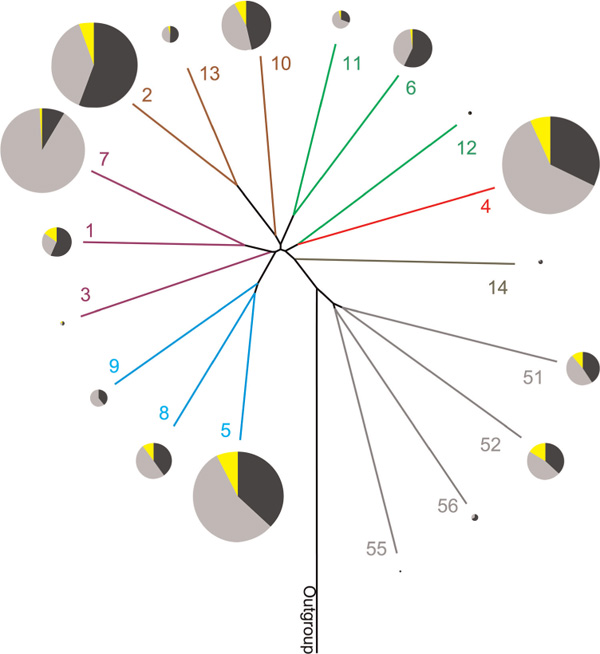
A phylogenetic analysis of one representative from each family of the human OR gene repertoire. In this tree, one can see the following: (1) a general guideline for how the different families relate to one another (although this is very general, and the branching is not always this well defined); (2) the numbers near each branch denote the OR family number; (3) each pie chart size is scaled to represent the number of the OR genes inside that family (black = functional genes, grey = pseudogenes, yellow = segregating pseudogenes [SPGs]). SPGs are genes that segregate in populations between intact genes and pseudogenes -- due to a disruptive SNP [34]. This disruptive mutation can introduce a stop codon, or alter a highly conserved amino acid that is important for proper function of the protein. In Tables 1-5, the SPGs are counted as 'functional genes' or 'pseudogenes', according to the Human Genome Project public version. Additional information can be found at the HORDE database (http://bioportal.weizmann.ac.il/HORDE/).