


Figure 1. NPC proliferation is impaired in the dentate gyrus of GSK3 knockin mice.

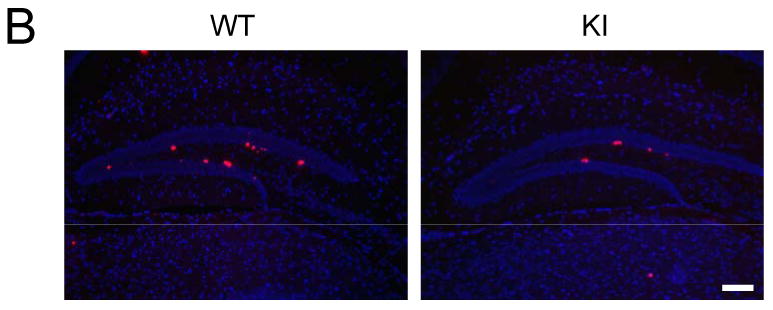

(A) Immunoblots showing that serine phosphorylation of GSK3α and GSK3β is absent in the hippocampus of GSK3 knockin mice, whereas total and tyrosine-phosphorylated levels of GSK3α and GSK3β are equal in GSK3 knockin (KI) and wild-type (WT) mice. (B) Immunohistochemical detection of BrdU-positive cells (red) in the hippocampus of WT and KI mice. Nuclei are labeled with bisbenzimide (blue). Scale bar, 100 μm. (C) Unbiased stereological quantitation of BrdU-positive cells in the hippocampal dentate gyrus (DG). Values are means ± S.E.; n=10/group; *p<0.001. (D) Dentate gyrus volumes of WT and KI mice. Values are means ± S.E.; n=10/group. (E) Unbiased stereological quantitation of active caspase-3-positive cells in the hippocampal dentate gyrus WT and KI mice. Values are means ± S.E.; n=5/group.