


Figure 3.
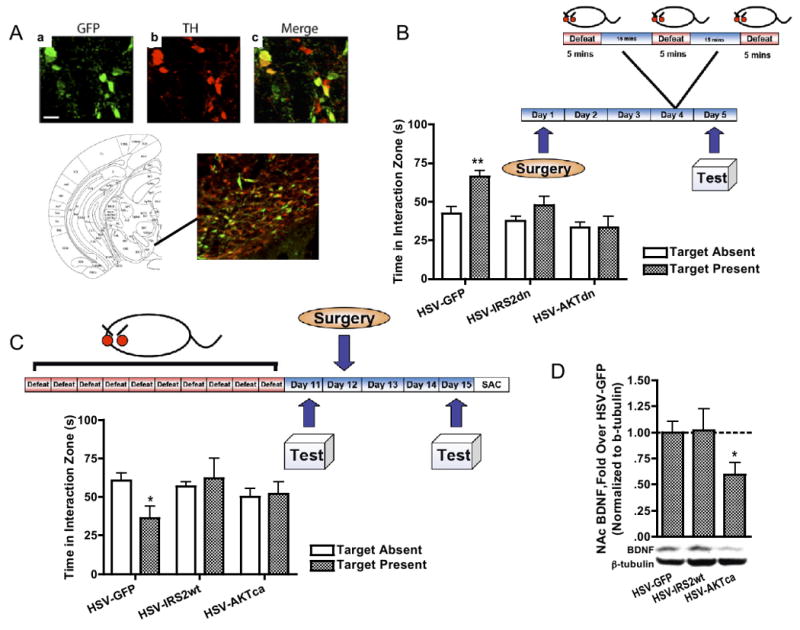
Decreased ventral tegmental area (VTA) AKT activity mediates social avoidance following chronic social defeat stress. (A) Validation of viral-mediated gene transfer in VTA (scale bar = 20 μm), showing cells expressing virally encoded GFP (a, Cy2), tyrosine hydroxylase (TH)-positive cells (b, Cy3), and merged confocal image of A and B showing double labeling (C) in region of VTA as shown in schematic (50). (B) Naïve mice infused with HSV-GFP and subjected to submaximal social defeat showed high levels of interaction (t10 = 3.83, p< .01), whereas IRS2dn or AKTdn overexpression in the VTA decreased interaction levels (p > .1 in both cases). (C) In the converse experiment, we examined the effects of viral manipulation on three matched groups of susceptible mice [30.2 ± 7.8 seconds, 36.5 ± 5.4 seconds, and 35.0 ± 6.2 seconds, F(2,28) = .23, p>.5, n = 7−11). Whereas a clear avoidance phenotype was observed after an intra-VTA injection of HSV-GFP (t19 = 2.65, p < .05), HSV-IRS2wt, or HSV-AKTca alleviated this form of avoidance (p > .5). (D) One day after the avoidance test in C, NAc BDNF protein levels in HSV-AKTca-infected mice are significantly lower than those in control animals (t19 = 2.52, p < .05). Data are shown as mean + SEM, with * and ** indicating significant (p < .05 or p < .01, respectively) comparisons from respective control animals. BDNF, brain-derived neurotrophic factor; GFP, green fluorescent protein; HSV, herpes simplex virus; TH, tyrosine hydroxylase.