


Figure 6. SPON-1 is required for motor neuron fasciculation and dorsoventral guidance.
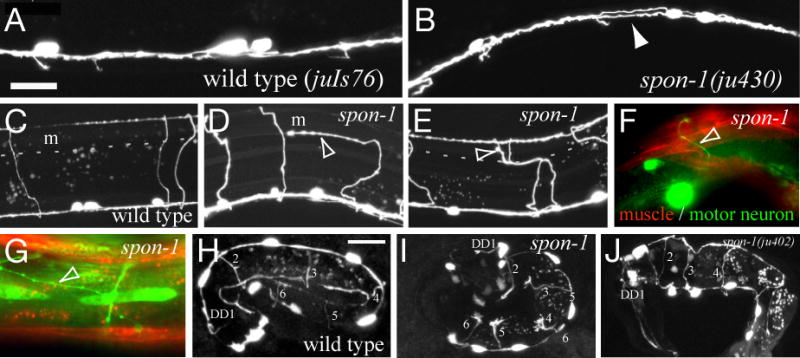
(A-D) Motor neuron processes (juIs76) in wild type (A,C) and spon-1(ju430) mutant L4s (B,D). (B) defasciculation of D neuron ventral processes in ju430 mutants (arrowhead). (C) motor neuron commissures in the wild type extend from ventral to dorsal on the right side. (D,E) Motor commissures in spon-1(ju430) mutants turn laterally (arrowhead) upon contacting the dorsal muscle quadrant (m, dotted line) and either extend and terminate subdorsally (D) or turn back to the dorsal midline (arrowhead, E). (F,G) Commissural guidance defects occur independently of muscle detachment (trIs10); commissure guidance can be normal (arrow) in regions of body wall muscle detachment (F) and can be aberrant in regions of normal attachment (G). (H-J) D neuron outgrowth in wild type (juIs76) (H), in ju430 juIs76 embryo (I, progeny of animal shifted to 25°C as L4) and in spon-1(ju402) arrested hatchling (J, ynIs37 marker); all six D neuron commissures (DD1-6) extend dorsally. Scale, 10 μm.