


Figure 3. Effect of morphine on gastrointestinal transit in moderate (A) and high (B) morphine antinociception tolerance models.
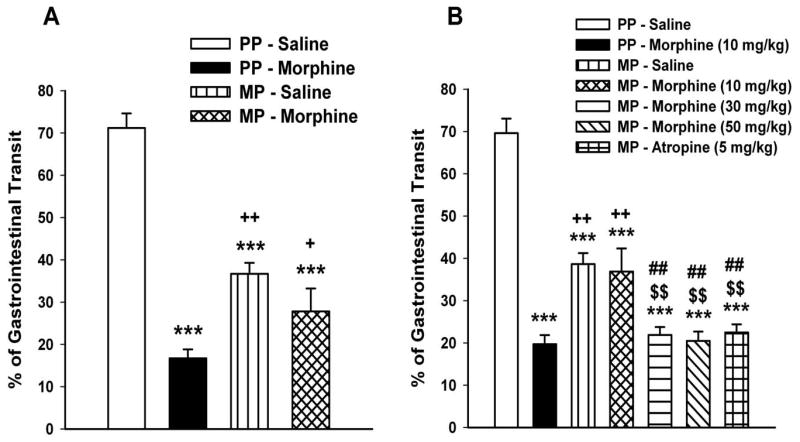
Experiments were conducted 72-h following the implantation of the placebo pellet (PP) or the 75 mg morphine pellet (MP). The low (5.5-fold) tolerant mice were pelleted with a 75 mg morphine pellet, whereas the high (53.2-fold) tolerant mice received ramping morphine injections in addition to the pellet. Mice were fasted for 14-h before testing. A charcoal meal was administered by oral gavage, 20 min following the injection of saline or morphine (10 mg/kg s.c.). Mice were sacrificed 30 min later and the distance traveled by the leading edge of the charcoal was calculated as percentage of the total length from the pylorus to the ileo-caecal junction. Data are expressed as mean ± S.E.M. (n=6-12). *** significantly different from PP-Saline group at P < 0.001; ++significantly different from PP-Morphine group at P < 0.05; +significantly different from PP-Morphine group at P < 0.01; $$significantly different from MP-Saline group at P < 0.05 and ##significantly different from MP-Morphine (10 mg/kg) group at P < 0.05.