


Fig. 4.
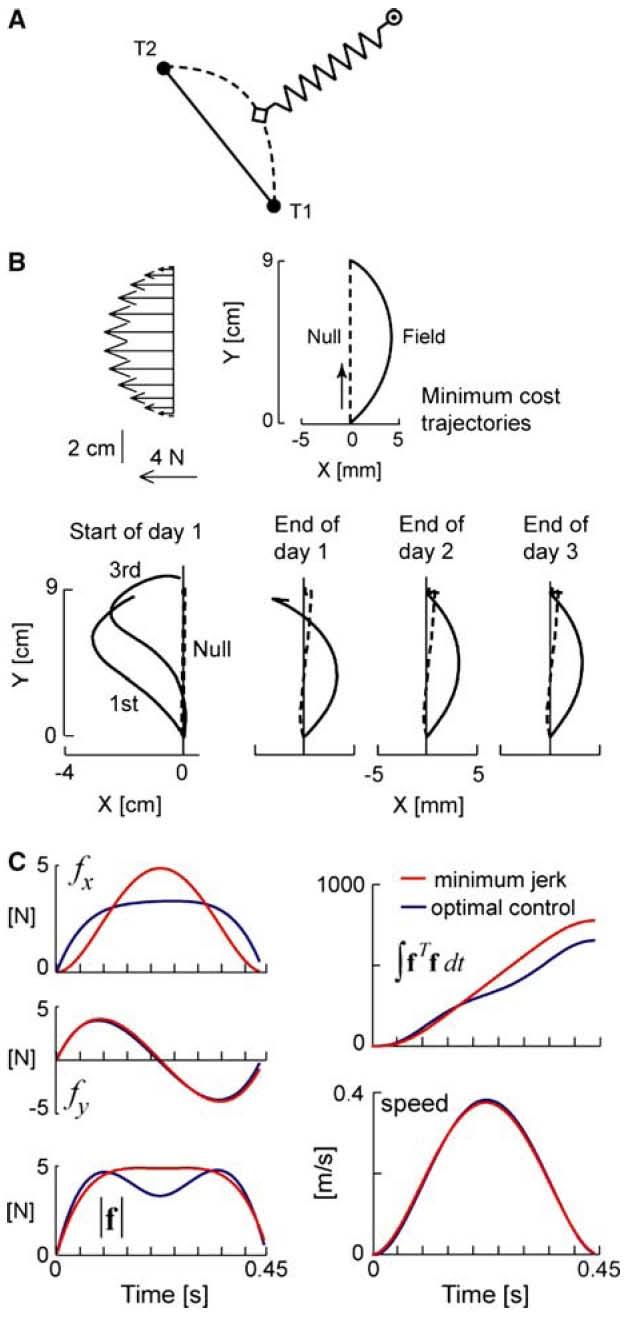
Task dynamics affect reach trajectories. A. The task is to reach from point T1 to T2. In one condition, the reach takes place in free space (straight line). In another condition, a spring is attached to the hand. In this case, the subject chooses to move the hand along an arc (redrawn from Uno et al. 1989). B. A velocity dependent force field pushes the hand perpendicular to its direction of motion. For example, for an upward movement the forces push the hand to the left. The motion that minimizes cost of Eq. (1) is not a straight line, but one that has a curvature to the right. The data shows hand paths for a typical subject at start of training on day 1, and then end of training each day. Except for the 1st and 3rd trials, all other trajectories are average of 50 trials. C. A rationale for why a curved movement is of lower cost. The curves show simulation results on forces that the controller produces, and speed of movement, in the optimal control scenario of Eq. (1) and in a scenario where the objective is to minimize jerk. (Data in parts B and C from Izawa et al. 2006)