



Abstract
Persistent herpes zoster-associated pain is a significant clinical problem and an area of largely unmet therapeutic need. Progress in elucidating the underlying pathophysiology of zoster-associated pain and related co-morbidity behaviour, in addition to appropriately targeted drug development has been hindered by the lack of an appropriate animal model. This study further characterises a recently developed rat model of zoster-associated hypersensitivity and investigates (a) response to different viral strains; (b) relationship between viral inoculum concentration (‘dose’) and mechanical hypersensitivity (‘response’); (c) attenuation of virus-associated mechanical hypersensitivity by clinically useful analgesic drugs; and (d) measurement of pain co-morbidity (anxiety-like behaviour) and pharmacological intervention in the open field paradigm (in parallel with models of traumatic peripheral nerve injury). VZV was propagated on fibroblast cells before subcutaneous injection into the glabrous footpad of the left hind limb of adult male Wistar rats. Control animals received injection of uninfected fibroblast cells. Hind-limb reflex withdrawal thresholds to mechanical, noxious thermal and cooling stimuli were recorded at specified intervals post-infection. Infection with all viral strains was associated with a dose-dependent mechanical hypersensitivity but not a thermal or cool hypersensitivity. Systemic treatment with intraperitoneal (i.p.) morphine (2.5mg/kg), amitriptyline (10mg/kg), gabapentin (30mg/kg), (S)-(+)-ibuprofen (20mg/kg) and the cannnabinoid WIN55,212-2 (2mg/kg) but not the antiviral, acyclovir (50mg/kg), was associated with a reversal of mechanical paw withdrawal thresholds. In the open field paradigm, virus-infected and nerve-injured animals demonstrated an anxiety-like pattern of ambulation (reduced entry into the central area of the open arena) which was positively correlated with mechanical hypersensitivity. This may reflect pain-related comorbidity. Further, anxiety-like behaviour was attenuated by acute i.p. administration of gabapentin (30mg/kg) in nerve-injured, but not virus-infected animals. This model will prove useful in elucidating the pathophysiology of zoster-associated pain and provide a tool for pre-clinical screening of analgesic drugs.
Keywords: zoster-associated pain, postherpetic neuralgia, neuropathy, analgesia, open field, anxiety-like behaviour
VZV is a highly virulent neurotropic virus, which in susceptible individuals causes varicella (chickenpox) as the primary infection. The virus is then retrogradely transported along axons of sensory neurones from the skin to establish a latent infection within sensory ganglia in the peripheral nervous system (Kennedy et al., 1998; Kennedy et al., 1999; Kinchington, 1999; Kennedy, 2002a; Mitchell et al., 2003). Viral reactivation usually occurs as a result of senescence of cellular immunity and presents as acute herpes zoster (AHZ) (shingles) (Kennedy et al., 1999; Abendroth and Arvin, 2001; Kennedy, 2002b; Mitchell et al., 2003). However, recovery from AHZ may frequently become complicated by the development of postherpetic neuralgia (PHN), a neuropathic pain syndrome characterised by persisting pain arising in areas affected by herpes zoster at least three months after healing of skin lesions (Dworkin and Portenoy, 1994). Without treatment, the reported incidence of pain persisting three months after the development of herpetic rash is 8% to 15% and increases rapidly in the elderly population (Bowsher, 1999; Johnson and Patrick, 2003). PHN may be accompanied by varying degrees of sensory deficits including abnormal hyper-sensory phenomena, such as allodynia (an abnormal pain response to innocuous stimuli) and hyperalgesia (an increased response to noxious stimuli), and/or hyposensory phenomena, such as partial or complete sensory loss (Nurmikko, 1995; Fields et al., 1998; Pappagallo et al., 2000). PHN is an area of major therapeutic need; a recent metanalysis of the clinical trial literature revealed that even with the most effective drugs, only 30-50% of patients obtain more than 50% pain relief, often at the cost of side effects (Hempenstall et al., 2005).
The need for the investigation of the mechanisms involved in the establishment and maintenance of PHN and in the development of effective drugs for its treatment has resulted in the exploration of animal models of persistent zoster-associated pain. Following the introduction of an in vivo rodent model of VZV persistent infection (Sadzot-Delvaux et al., 1990), Fleetwood-Walker et al., (1999) described the first pain-related associations (mechanical allodynia and thermal hyperalgesia) of rodent VZV infection. Immunohistochemical analysis of rat dorsal root ganglia (DRG) by Garry et al., (2005) later confirmed the presence of a viral immediate-early gene protein (IE62) in both myelinated A- and unmyelinated C-afferent sensory neurons. However, none of the animal models described to date (Myers et al., 1985; Sadzot-Delvaux et al., 1990; Myers and Connelly, 1992; Fleetwood-Walker et al., 1999; Dalziel et al., 2004; Garry et al., 2005) reproduce VZV pathophysiology completely and there is still the need to refine current models to better reflect the clinical scenario.
Our study further characterises the rat model of VZV infection described by Fleetwood-Walker et al., (1999) and specifically extends behavioural paradigms beyond stimulus-evoked reflex limb withdrawal paradigms conventionally employed in pain models, to encompass more complex outcome measures of integrated pain behaviour reflecting neuropathic pain co-morbidities, in particular anxiety-like behaviour in the open field paradigm. This is of importance as patients with neuropathic pain frequently suffer considerable co-morbidity (e.g. anxiety) (Meyer-Rosberg et al., 2001) and spontaneous pain which are currently not being modelled in standard behavioural tests. Additionally, examination of anxiety-like behaviour was undertaken in parallel with conventional models of traumatic peripheral nerve injury (partial sciatic nerve injury and spinal nerve transection).
Experimental Procedures
Animal maintenance
Experiments were performed on adult male Wistar rats, 240-350g (mean weight 300g), Harlan (Bicester, U.K.) and B&K (Hull, U.K.). (B&K animals were used for open field experiments only). The animals were housed in individually ventilated colony cages and maintained on a 14:10 hour light/dark cycle with free access to food and water. All experiments were performed in accordance with the U.K. Animals (Scientific Procedures) Act 1986 and associated British Home Office regulations.
Preparation and injection of viral inoculum
VZV was propagated on fibroblast (primary human embryonic lung) cells and harvested when cells exhibited approximately 80% cytopathic effect (cpe) on microscopy (equivalent to 104-105 plaque forming units). Cpe refers to the destruction of normal fibroblast cell architecture due to viral lytic infection and is characterized by the presence of vacuoles and granules. Virus-infected cells were gently scraped from the flask surface onto which they had formed a monolayer culture and the cell suspension centrifuged at 1500 rpm, 4°C for 15 minutes. The resulting pellet from each 75cm2 flask was resuspended in 150μl sterile phosphate buffer solution (Invitrogen). Animals were anaesthetised (pentobarbitone, 40mg/kg i.p. Animalcare Ltd., York, U.K.) and subcutaneously (s.c.) injected with 50μl viral inoculum into the mid-plantar glabrous footpad of the left (ipsilateral) hind limb using a 25 gauge needle. Control animals received similar injection of uninfected fibroblast cells (mean count 6 - 8 × 10⁶ cells/75cm2 flask).
Viral strains
VZV strains Dumas and Ellen were provided by Dr. R. G. Dalziel, University of Edinburgh, U.K. Dumas is a clinical isolate for which the VZV sequence is known (Davison and Scott, 1986) and Ellen is a highly passaged laboratory strain (Moffat et al., 1998). Two further low tissue culture passage viral strains were harvested from an East London cohort of patients participating in a separate study on zoster-associated pain (local ethics committee permission for this study was obtained). Both patients were in their late 60s with similar demographics and had suffered from AHZ infection following a brief prodromal illness. However, PHN was known to develop in only one patient.
Partial sciatic nerve injury (PSNI) and spinal nerve transection (SNT) surgery
Surgery was performed under general anaesthesia with isoflurane. Briefly, for PSNI surgery, the left (ipsilateral) sciatic nerve was exposed just above its trifurcation and 1/3 - 1/2 of the nerve trunk ligated with a 7-0 non-absorbable silk suture (Mersilk, Ethicon) (Seltzer et al., 1990). In sham animals, the sciatic nerve was exposed in the same way but not ligated. SNT surgery was performed using a technique modified from Kim and Chung (Kim and Chung, 1992). A 2 - 3 cm midline skin incision was made at the level of the iliac crests. Blunt dissection was used to separate the ipsilateral paraspinal muscles from the spinous processes of the L4 to S2 vertebrae. The transverse process of L6 was identified and a hemi-laminectomy performed to expose the L5 and L6 spinal nerve roots. The L5 nerve root was tightly ligated (4-0 Mersilk, Ethicon) and then transected 1 - 2 mm distal to the ligature. Transection of the L5 nerve route was confirmed on post-mortem and only data from these animals was included in the analysis. In sham animals, an identical procedure was performed except hemi-laminectomy; ligation and transection were not executed. Postoperative analgesia consisted of s.c. injection of 0.05ml 0.5% bupivicaine (Antigen Pharmaceuticals, Ireland) to the wound site followed by i.p. administration of carprofen (20%, 0.1ml/200g body weight, Pfizer) two hours later.
Behavioural reflex testing
Animals were tested in individual plexiglass observation chambers (dimensions 23 × 18 × 14 cm) by a single experimenter. Behavioural reflex responses were assessed at baseline and at intervals post-injury (see supplemental material for assessment to noxious thermal and cool stimuli): (a) Punctate mechanical hypersensitivity was assessed using the electronic “von Frey device” (Somedic, type 735). The calibrated force transducer (0.5mm2 diameter tip) was applied at a rate of 8 - 15 grams/second to the mid-plantar surface of each hind paw in turn until an active limb withdrawal response was observed (Bridges et al., 2001). A mean paw withdrawal threshold (PWT) was then calculated from a set of five applications (see supplemental material for assessment using conventional von Frey filaments). (b) Paw withdrawal latency (PWL) to light brushing of the mid-plantar surface of the hind paw (i.e. dynamic mechanical stimulation) was determined as previously described (Field et al., 1999). Briefly, the stimulus (cotton bud) was applied three times to each paw in turn, for up to 15 seconds or until an active paw withdrawal response was observed. Hypersensitivity to dynamic stimulus was considered to be present for paw withdrawal <8 seconds (Field et al., 1999).
Experiments
1) Determination of the nature and duration of VZV-induced mechanical hypersensitivity
Animals (n = 3) were infected with VZV (Dumas, 80% cpe) as described above and behavioural testing continued until sensory thresholds returned to baseline levels.
2) Viral strain comparison
Animals were randomly allocated to receive injection with one of the following strains: Ellen (n = 6); Dumas (n = 9); viral isolate known to be associated with development of PHN following AHZ infection (n = 6); viral isolate from a zoster patient not associated with development of PHN (n = 6). All animals received s.c injection of 50μl viral inoculum (harvested at approximately 80% cpe) into the glabrous footpad of the left hind limb. Control animals received injection of uninfected fibroblast cells (n = 9). Behavioural testing to punctate mechanical, noxious thermal and cooling stimuli was performed at intervals post-infection (p.i).
3) Viral dose-response
VZV (Dumas) was harvested at three different cpes (or ‘doses’). In order to more accurately determine the quantity of infectious virus at each given dose, plaque titration was performed. Briefly, serial dilutions of viral inoculum were propagated onto Vero cells (derived from an African green monkey kidney cell line) and allowed to form plaques. The number of plaque forming units (pfu), characterised by the formation of syncitia with sharp boundaries and glassy appearance, was then determined one week later. This allowed a retrospective estimate of the amount of virus present in the original inoculum (in pfu/ml) to be calculated. Animals were then randomly allocated (n = 6 per group) to receive s.c injection of 50μl viral inoculum at 15% cpe (3 × 10² pfu/ml), 35% cpe (8.6 × 10³ pfu/ml) or 100% cpe (6 × 10⁵ pfu/ml) as previously described. Response was defined as ‘the mean percentage decrease from baseline ipsilateral PWTs to punctate mechanical stimulation on day 14 p.i. (time from which maximum behavioural change was generally observed)’. In this way, a dose-response relationship was constructed. Separate animals were used for each dose examined.
4) Pharmacological sensitivity testing
Fifty-two animals were infected with VZV (Dumas; 93% mean cpe; 2.4 × 10⁵ mean pfu/ml) as previously described and behavioural testing to punctate mechanical stimulation was performed at intervals up to 30 days p.i. Only animals demonstrating a statistically significant (paired t-test; p<0.05) decrease in ipsilateral PWTs on day 14 p.i. compared to baseline were retained for pharmacological studies. Animals were randomly allocated to the following treatment groups: morphine (2.5mg/kg, n = 6) (Decosterd et al., 2004); amitriptyline (10mg/kg, n = 7) (Vissers et al., 2003; Decosterd et al., 2004); gabapentin (30mg/kg, n = 5) (Back et al., 2004; Decosterd et al., 2004; LaBuda and Little, 2005); (S)-(+)-Ibuprofen (20mg/kg, n = 6) (Bonabello et al., 2003; Schafers et al., 2004); WIN55,212-2 (2mg/kg, n = 6) (Bridges et al., 2001; LaBuda and Little, 2005); acyclovir (50mg/kg, n = 7) (Biron et al., 1982; Bruggeman et al., 1987; Dalziel et al., 2004); or vehicle (40% DMSO/saline, n = 6, or saline/sterile water, n = 7). (All drugs, including vehicle, were obtained from Sigma, while gabapentin was obtained from Pfizer). Each drug was given in a twice daily paradigm (08:00 and 18:00) for four consecutive days (18 - 21 p.i. inclusive) and each animal received only one drug. Sensory thresholds were examined 2 hours after the morning dose and the investigator was ‘blinded’ to the various treatment groups.
5) Open field activity
The open field apparatus consisted of a square plastic arena (100 × 100 × 40 cm) to which animals had not previously been exposed (Cryan and Holmes, 2005). Animals were randomly allocated to the following groups: naïve (n = 15); PSNI (n = 10); PSNI sham (n = 11); SNT (n = 11); SNT sham (n = 8); VZV-infected (Dumas, 80% cpe) (n = 12) and fibroblast-infected controls (n = 12). PWTs to punctate mechanical stimulation were recorded at baseline and on day 14 post-surgery/infection at which time animals were introduced into the novel open field arena. The animals were tested on day 14 as this was found to be the time at which maximal mechanical hypersensitivity was generally established. Each animal was placed in turn into the middle of the arena and its spontaneous locomotor activity recorded for 15 minutes under low level lighting conditions (lux 4, measured in the centre of the arena) using an infrared camera (Sanyo VCB 3372). The data were archived and analysed using EthoVision software (version 2.0, Tracksys Ltd., Nottingham). The following outcome measures were examined: frequency of entry into and time spent (seconds) in the centre (40 × 40 cm), and total distance traveled (cm).
6) Pharmacological sensitivity testing in the open field paradigm
Separate animals were used for pharmacological studies in the open field paradigm. Animals were randomly allocated to the following groups: SNT (n = 17); SNT sham (n = 14); VZV-infected (Dumas, 80% cpe) (n = 15) and fibroblast-infected controls (n = 12). Development of punctate mechanical hypersensitivity in nerve-injured and virus-infected animals was assessed on day 14 post-injury, and only animals demonstrating a statistically significant (paired t-test; p<0.05) decrease in ipsilateral PWTs compared to baseline were retained for pharmacological studies. Animals were then randomly assigned to receive acute i.p. administration of either gabapentin (30 mg/kg) (de-Paris et al., 2000) or saline vehicle 20 minutes before testing in the open field paradigm (as described above).
Immunohistochemical localization of VZV IE62 protein in DRG
At the end of the behavioural testing period, virus-infected (from all groups) and control animals (n = 3) were killed with i.p. pentobarbitone (100mg/kg Animalcare Ltd., York, U.K) and transcardially perfused with 100ml heparinised saline followed by 300ml 4% paraformaldehyde solution. DRG from lumbar segments L4 and L5 ipsilateral to the side of VZV infection were harvested and pooled. Tissue was post-fixed in paraformaldehyde for 2 - 4 hours before being placed in 15% sucrose solution overnight. DRG were then transferred to a 30% sucrose solution and left for 24 hours before embedding in OCT embedding matrix (Van Waters Rogers (VWR) International Ltd., Leicester, U.K.). Cryostat sections (10μm) were taken and tissue was thaw-mounted on poly-L-lysine slides (VWR). Immunofluorescent detection of viral protein was performed using a polyclonal primary antibody directed against VZV IE62 protein (1:250 dilution) as previously described (Garry et al., 2005). (VZV-infected fibroblasts in culture were used as positive control, while for negative control, primary antibody was omitted). Co-localization with the neuron-specific nuclear protein, NeuN (1:1000, Chemicon) was additionally performed and only those cells staining NeuN positive were included in the subsequent analysis. A standardised threshold intensity for detection of VZV or NeuN immunoreactive cells was applied uniformly to all DRG images captured under identical conditions. Using the image analysis and processing software Leica QWin V3 (Milton Keynes, U.K.), the overall percentage and cell size distribution of NeuN labeled VZV positive neurons from randomly selected sections 100μm apart, was determined for each group. At least 100 NeuN labeled cells were sampled per group. Soma area of VZV positive neurons was then measured using image analysis and the % of NeuN labeled cells positive for VZV IE62 protein was then calculated.
Statistical Analysis
Statistical analysis was performed using Sigmastat (Jandel Scientific Software version 2.0). For all intra- and inter-group comparisons, the Kruskal-Wallis one way analysis of variance (ANOVA) on ranks was performed followed by the Tukey test (Dunn’s test where sample sizes are unequal) or Dunnett’s test where appropriate. The Tukey (or Dunn’s) test was used for pairwise comparisons between ipsilateral and contralateral paws at each time point while Dunnett’s test was used to compare the ipsilateral (or contralateral) response thresholds at each time point back to respective baseline values. Similarly in pharmacological studies, Dunnett’s test was used for ipsilateral paw comparisons using the PWT at day 14 p.i. as the pre-drug reference to which subsequent thresholds were compared. For statistical comparisons in the open field experiment, a paired t-test was used to compare ipsilateral PWTs at baseline to those at day 14 post-surgery/infection within groups. To compare open field outcome measures between groups, a t-test (followed where appropriate by the Mann Whitney rank sum test) was used. Significance level was taken at p<0.05. Variance is expressed as standard error of the mean (sem).
Results
In all virus-infected and control injected animals, the initial erythema and swelling at the site of injection completely resolved by 24 hours p.i. No overt signs of non-weight bearing, nor indeed motor impairment ipsilateral to the site of infection were observed throughout the experimental period. Cutaneous lesions did not develop and phenotypic changes were only evident on formal sensory testing.
Chronic resolving nature of VZV-induced mechanical hypersensitivity
Significant hypersensitivity to punctate mechanical stimulation was observed (when compared to mean baseline and contralateral limb) at all time points up to day 49 p.i., after which time sensory thresholds returned to baseline values. Behavioural change developed progressively from injection until day 35 p.i. when the decrease was maximal. From this time, behavioural change, though significant, was reduced until complete resolution of hypersensitivity was observed by day 53 p.i. (Fig. 1A). In contrast, hypersensitivity to dynamic mechanical stimulus followed a slower course of development with change evident from day 14 p.i. (becoming significantly different to the contralateral limb on day 28 p.i.). Resolution of hypersensitivity to dynamic mechanical stimulus (defined as PWL >8 seconds) occurred on day 42 p.i., with a return to baseline values on day 49 p.i. (Fig. 1B). A reduction in response thresholds was also noted in the contralateral limb.
Figure 1.

Nature and duration of VZV-induced hypersensitivity to A) punctuate mechanical stimulation (electronic von Frey device) and B) dynamic mechanical stimulation (cotton bud). Animals (n = 3) were infected with VZV (strain Dumas) on day 0 and behavioural testing was performed at intervals until sensory thresholds returned to baseline values. The dotted line in B) represents the threshold for hypersensitivity i.e. paw withdrawal latency (PWL) <8 secs is consistent with dynamic mechanical hypersensitivity as described in the method by Field et al., (1999). +p<0.05 statistical difference in threshold response between ipsilateral and contralateral hind paws (one way ANOVA followed by Tukey test); *p<0.05 significant difference between response threshold at this time point compared to mean pre-infection baseline threshold (one way ANOVA followed by Dunnett’s test).
VZV-induced mechanical hypersensitivity is not influenced by viral strain
For both Dumas and Ellen strains, hypersensitivity to punctate mechanical stimulation developed in the limb ipsilateral to VZV infection by day 4 p.i. (Fig. 2A). Statistical significance was obtained at all time points for PWT comparisons between the ipsilateral paw and mean baseline, and between the ipsilateral and contralateral paws within groups. A maximum effect was generally observed from day 14 p.i.: mean percentage decrease from baseline PWTs was 22.1% ± 1.02 and 18.2% ± 1.14 for Dumas- and Ellen-infected rats respectively (Fig. 2B). Following infection with the viral strain known to be associated with PHN, and with the strain with no known PHN association, a heightened mechanical sensitivity similarly developed from day 4 p.i. and became maximal from day 14 p.i.: mean percentage decrease from baseline PWTs was 31.7% ± 1.49 and 19.1% ± 1.69 respectively (Fig. 2C). Overall, there appear to be no consistent differences in mechanical hypersensitivity between viral strains. Hypersensitivity to noxious thermal or cool stimuli was not observed in any strain (see supplemental material).
Figure 2.

Ipsilateral paw withdrawal thresholds (PWT) in response to punctate mechanical stimulation following infection with different viral strains. A) Dumas (n = 9) -∎- and Ellen (n = 6) -▴- infected animals compared to uninfected fibroblast-injected control animals (n = 9) -∘- (+p<0.05 statistical difference between virus-infected and control animals, one way ANOVA followed by Tukey test; *p<0.05 significant difference between response threshold at this time point compared to mean pre-infection baseline threshold, one way ANOVA followed by Dunnett’s test); B) PWT responses expressed as the mean percentage decrease from baseline (*p<0.05 statistical difference between viral strains, one way ANOVA followed by Tukey test); and C) comparison of VZV-induced mechanical hypersensitivity following injection with a viral strain known to be associated with development of PHN following herpes zoster infection (n = 6), a viral strain not associated with the development of PHN following herpes zoster infection (n = 6) and the Dumas strain (n = 9) (*p<0.05 statistical difference between PHN-associated and not associated strains; +p<0.05 statistical difference between the PHN associated strain and Dumas strain; #p<0.05 statistical difference between viral strain not associated with development of PHN and Dumas strain - one way ANOVAs followed by Tukey test). Time at which VZV infection was performed (↑).
VZV-induced mechanical hypersensitivity is sensitive to the concentration of injected virus
VZV infection of rats is associated with a mechanical hypersensitivity that is sensitive to the concentration of virus injected: the mean percentage decrease from baseline in ipsilateral PWTs on day 14 p.i. was 1.2% ± 1.1 at 15% cpe; 17.5% ± 1.6 at 35% cpe and 30.3% ± 1.6 at 100% cpe. Dose-response relationship approximated to a hyperbola (Fig. 3) while log-dose response was linear within this range. (See supplemental material for von Frey filament data).
Figure 3.

Viral dose-response relationship. Dose was defined as percentage cytopathic effect (cpe) (Dumas strain, 15%, 35% and 100% cpe), whilst response was defined as ‘the mean (± sem) percentage decrease from baseline ipsilateral paw withdrawal thresholds to punctate mechanical stimulation on day 14 post-infection’.
VZV-induced mechanical hypersensitivity is sensitive to a range of analgesic drugs
The mean percentage decrease from baseline ipsilateral PWTs in VZV-infected animals (n = 50) on day 14 p.i. was 28.6% ± 1.4. Two animals did not demonstrate significant behavioural change and were therefore excluded from entry. At the end of the four day drug administration period (day 21 p.i.), ipsilateral PWTs for morphine, amitriptyline, gabapentin, (S)-(+)-ibuprofen, and WIN55,212-2 treated animals had returned to baseline values: mean ipsilateral PWT was 41.0g ± 0.7. Therefore, with the exception of acyclovir, treatment by all active drugs, but not solvent was associated with a reversal of mechanical withdrawal thresholds to baseline. In acyclovir and vehicle-treated animals, mechanical hypersensitivity was still evident on day 21 p.i.: mean ipsilateral PWTs were 29.4g ± 1.6 and 27.7g ± 2.4 respectively. By day 25 p.i., PWTs in morphine, amitriptyline, gabapentin, (S)-(+)-ibuprofen, and WIN55,212-2 treated animals had reverted to pre-drug (day 14 p.i.) values: mean ipsilateral PWT on day 25 p.i. was 28.7g ± 1.0. Therefore, VZV infection of rats is associated with a mechanical hypersensitivity that is sensitive to a range of analgesic drugs, but not the antiviral, acyclovir (Fig. 4) (see supplemental material for von Frey filament data).
Figure 4.

Comparison of the effect of vehicle (n = 13) versus drug administration on ipsilateral paw withdrawal response thresholds to punctate mechanical stimulation in VZV (Dumas)-infected animals. Arrow represents period of drug/vehicle administration. Each drug was given by the intraperitoneal route in a twice daily paradigm (08:00 and 18:00) for 4 consecutive days (18 - 21 post-infection inclusive), and each animal received only one drug. Sensory thresholds were examined 2 hours after the morning dose. Time course of the effect of A) morphine 2.5mg/kg (n = 6); B) amitriptyline 10mg/kg (n = 7); C) gabapentin 30mg/kg (n = 5); D) (S)-(+)-ibuprofen 20mg/kg (n = 6); E) WIN55,212-2 2mg/kg (n = 6); and F) acyclovir 50mg/kg (n = 7). Morphine, amitriptyline and gabapentin were dissolved in saline/sterile water, while (S)-(+)-ibuprofen, WIN55,212-2 and acyclovir were prepared in 40% DMSO solution. (+p<0.05 statistical difference between vehicle-administered and active drug-administered animals, one way ANOVA followed by Tukey test; *p<0.05 significant difference between response threshold at this time point compared to mean pre-infection baseline threshold, one way ANOVA followed by Dunnett’s test).
Anxiety-like behaviour in VZV-infected animals is correlated with mechanical hypersensitivity
Mechanical hypersensitivity to punctate mechanical stimulation developed in nerve-injured and VZV-infected animals (see supplemental material). Open field outcome measures and typical patterns of ambulation during a 15 minute testing session are illustrated in figures 5 and 6 respectively. Compared to sham-operated and fibroblast-infected controls, SNT and VZV-infected animals displayed greater thigmotactic (‘wall-hugging’) ambulation and entered the central area (inner zone) of the open field arena less frequently. Furthermore, inner zone frequency was found to be positively correlated with degree of mechanical hypersensitivity (Fig. 7). However no difference in behaviour was observed in PSNI and respective sham-operated animals.
Figure 5.

Open field parameters across all groups: naïve (n = 15); sham partial sciatic nerve injury (PSNI) (n = 11); PSNI (n = 10); sham spinal nerve transection (SNT) (n = 8); SNT (n = 11); uninfected fibroblast-injected control (n = 12); VZV-infected (n = 12). Open field parameters measured during a 15 minute testing session under low level lighting conditions were: A) number of entries (frequency) into the inner zone (40 × 40 cm zone); B) duration in the inner zone; and C) total distance moved throughout the arena (100 × 100 cm). *p<0.05 compared to naïve animals (t-test, followed by Mann-Whitney rank sum test where normality test failed); #p<0.05 (t-test, followed by Mann-Whitney rank sum test where normality test failed) for sham versus experimental.
Figure 6.

A) Open field arena (100cm2) and inner zone (40cm2); B-F) Examples of characteristic track patterns as monitored using an infrared camera.
Figure 7.

Relationship between open field inner zone entry and mechanical hypersensitivity. Paw withdrawal threshold (PWT) was measured using the electronic von Frey device. A) VZV (Dumas)-induced mechanical hypersensitivity is positively correlated with anxiety-like behaviour (as reflected by reduced entry into the open field inner zone). Pearson correlation coefficient, R = 0.63 (p = 0.02). ▴ represents individual VZV-infected animals on day 14 p.i. (n = 12) while the dotted line represents the trend between variables. However, there was no correlation in uninfected fibroblast-injected control animals. Mean ± sem percentage decrease in mechanical hypersensitivity for VZV-infected animals on day 14 p.i. was 26.2% ± 3.7, while mean frequency into the inner zone was 7.1 ± 1.6. For uninfected fibroblast-injected animals, there was a 1.1% ± 3.8 increase in mechanical PWTs overall, while mean frequency into the inner zone was 12.6 ± 1.9. B) Mechanical hypersensitivity is positively correlated with anxiety-like behaviour in spinal nerve transected (SNT) animals (n = 11). Pearson correlation coefficient, R = 0.71 (p = 0.01). ∎ represents individual animals 14 days post-surgery while the dotted line represents the trend between variables. However, there was no such correlation in sham animals. Mean ± sem percentage decrease in mechanical hypersensitivity for SNT animals on day 14 was 50.1% ± 2.6, while mean frequency into the inner zone was 2.9 ± 0.7. For sham animals, there was a 0.8% ± 1.6 decrease in mechanical PWTs overall, while mean frequency into the inner zone was 8.6 ± 1.5.
VZV-induced anxiety-like behaviour is not sensitive to analgesics
On day 14 post-injury, SNT-operated (n = 14) and VZV-infected (n = 12), but not respective sham animals, displayed hypersensitivity to punctate mechanical stimulation ipsilateral to the injury (see supplemental material). Seven animals were excluded from pharmacological studies due to insufficient behavioural change, autotomy or death in the post-operative period (see supplemental material). Following gabapentin administration, frequency of entry into and time spent in the central area of the open field arena was increased in SNT, but not VZV-infected animals (Fig. 8). No change in total distance traveled was observed in either group following gabapentin administration (Fig. 8).
Figure 8.

Open field pharmacological validation: effect of acute administration of gabapentin (GP) (30 mg/kg) or vehicle (saline) in A) spinal nerve transected (SNT) and sham-operated animals; and B) VZV (Dumas)-infected and uninfected-fibroblast (Hel) control animals 14 days post-surgery/infection. Drug/vehicle (n = 5 - 8 per group) was administered by the intraperitoneal (i.p.) route 20 minutes before testing in the open field. The following parameters were measured during a 15 minute testing session: (i) inner zone frequency; (ii) inner zone duration; and (iii) total distance traveled in the arena. * p<0.05 (t-test) compared to SNT or VZV-infected animals; # p<0.05 (t-test) compared to sham or Hel-injected control animals.
Immunohistochemical analysis
Presence of viral protein, IE62, was demonstrated in ipsilateral sensory neurons in all strains of virus examined but not in uninfected fibroblast cells (Fig. 9). Diffuse cytoplasmic expression of viral protein was observed in both small and large cells, although evidence for distinct intra-nuclear expression was noted in one viral strain (that associated with development of PHN following acute herpes zoster infection). The percentage VZV expression in DRG for each group and a cell size distribution analysis is illustrated (Fig. 10). Infection with the viral isolate known to be associated with development of PHN following AHZ, and the Dumas strain demonstrated the greatest VZV expression in ipsilateral DRG tissue (percentage NeuN labeled cells positive for VZV IE62 protein was 75.9% and 72.5% respectively). In contrast, infection with the viral isolate from a zoster patient in whom PHN was not associated, resulted in the least expression of viral protein IE62 (percentage NeuN labeled cells positive for VZV IE62 protein was 5.1%).
Figure 9.

Immunohistochemical demonstration of VZV IE62 protein in ipsilateral L4/5 DRG following infection with A) viral strain associated with development of PHN following acute herpes zoster infection at (i) x20 magnification (arrow indicates a VZV positive cell), (ii) x40 magnification demonstrating diffuse cytoplasmic staining, (iii) x40 magnification demonstrating intra-nuclear staining; B) VZV strain not associated with development of PHN following acute herpes zoster infection; C) Dumas strain/high cpe; D) medium cpe; E) low cpe; F) Ellen strain; and G) uninfected fibroblast control. Images were photographed at x20 magnification, scale bar 50 μm. The arrow indicates cells positive for VZV IE62 protein. These cells generally exhibited diffuse cytoplasmic staining.
Figure 10.
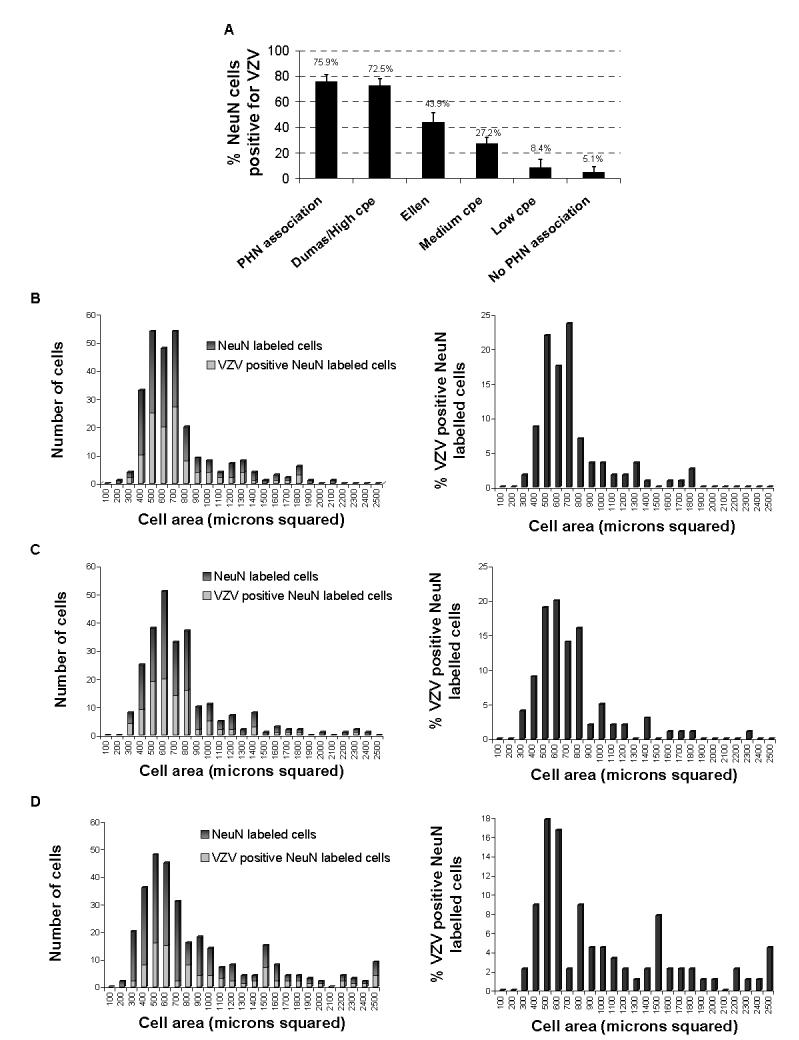
Demonstration of viral protein in sensory neurons following infection with different viral strains. A) Percentage distribution of VZV positive DRG neurons across groups (n = 3 animals per group). Using an immunofluorescence technique, ipsilateral L4 and L5 DRG from VZV-infected animals were pooled and labeled using a polyclonal antibody directed against VZV IE62 protein (1:250 dilution). Cells were co-labeled with the neuron-specific nuclear protein, NeuN and only those cells demonstrating a nucleus were included in the analysis. The number of NeuN labeled cells is ≥100 per group, taken from a series of random sections 100 μm apart (number of sections per group therefore varies until at least 100 NeuN labeled cells had been sampled). The percentage of NeuN labeled cells positive for VZV IE62 protein was then calculated and is displayed above the relevant bar for each group. Analysis of cell size distribution of VZV positive NeuN labeled cells from animals infected with B) viral strain associated with development of PHN; C) Dumas strain and D) Ellen strain, is shown.
Discussion
Our study refines a previously described rodent model of VZV infection (Fleetwood-Walker et al., 1999) and specifically investigates behavioural response to different viral strains, relationship between viral inoculum concentration and neuropathic pain behaviour and response to a range of clinically useful analgesic drugs. In addition, anxiety-like behaviour, as a more complex outcome measure of integrated pain behaviour, was examined in the open field paradigm in parallel with models of traumatic peripheral nerve injury.
In this study, hypersensitivity to punctate mechanical stimulation (suggestive of static mechanical allodynia) developed in a dose-related fashion ipsilateral to VZV infection and was not influenced by viral strain. This suggests that viral strain is not a critical factor in development of zoster-associated pain. Further, in animals that demonstrated statistically significant (p<0.05) mechanical hypersensitivity, (e.g. 80% of all animals infected in the open field pharmacological validation study), a 33.7% reduction from baseline ipsilateral PWTs was observed on day 14 p.i. (see supplemental material). The magnitude of effect at this time is not dissimilar to that seen in other pain models. Using the same behavioural testing protocol, we demonstrated a 41.7% reduction in ipsilateral PWT in a partial peripheral nerve-injury model (PSNI) and a 50.1% reduction in a model of more severe traumatic peripheral neuropathy (SNT) (see supplemental material). However, we observed no hypersensitivity in response to noxious thermal stimulation for any of the viral strains examined. Indeed in some animals, it appears that there may be a trend towards longer PWL over time, possibly reflecting a thermal sensory loss (see supplemental material). Previous studies have not investigated the phenomenon of dynamic or cold allodynia and we report for the first time the development of dynamic mechanical hypersensitivity (Fig. 1B) and absence of cold allodynia in this model (see supplemental material).
In established postherpetic neuralgia the clinical phenotype varies between individual patients and possibly over the time course of the disease. A spectrum of abnormal sensory phenomena have been documented, with hyper-sensory phenomena, such as allodynia and hyperalgesia, at one extreme and a predominantly hyposensory picture with pain in the context of partial or complete sensory loss at the other (Fields et al., 1998; Pappagallo et al., 2000). Our findings of VZV-induced dynamic mechanical hypersensitivity in combination with thermal insensitivity further support clinical observations in the field and provide the model with a degree of face validity (Nurmikko, 1995; Rowbotham and Fields, 1996; Fields et al., 1998; Pappagallo et al., 2000). Overall, the nature of the model, specifically with regard to the latency to onset, peak effect and decline of VZV-induced mechanical hypersensitivity, and the magnitude of the effect, is in general concordant with previous studies (Fleetwood-Walker et al., 1999; Dalziel et al., 2004). Importantly however, our findings are in contrast to previous reports of VZV-induced thermal hyperalgesia (Fleetwood-Walker et al., 1999; Garry et al., 2005). This dissimilarity may be due in part to experimental differences e.g. in viral inoculum concentration. Specifically, the thermal hyperalgesia reported by Garry et al., (2005) was only seen at very high viral concentrations, in excess of those used in our study.
Further, we have further demonstrated not only the presence of viral protein (IE62) in sensory neurons following infection with different viral strains, which further supports the initial findings of Dalziel et al., (2004) and Garry et al., (2005), but also the percentage distribution between strains, and a cell size distribution analysis identifying VZV in both small and large cells. It would appear that in general there is a correlation between the amount of viral protein in sensory ganglia and the degree of mechanical hypersensitivity. However, an exception to this is the viral strain not associated with development of PHN suggesting either that it may not be essential for VZV to reach the sensory ganglia for a behavioural change to be observed or that IE62 expression is not necessary.
While there is a strong clinical evidence base supporting the efficacy of certain analgesic therapies in established PHN, most of these therapies do suffer from a narrow therapeutic index which limits their clinical effectiveness (Hempenstall et al., 2005). Amongst the systemically administered treatments with the strongest evidence base for efficacy are opioids (number needed to treat for 50% reduction in baseline pain intensity (NNT) is 2.67), tricyclic antidepressants (NNT 2.64) and gabapentin (NNT 4.39) (Hempenstall et al., 2005). In terms of adverse events, the numbers needed to harm (“major” harm - sufficient to provoke withdrawal from the clinical trial) (NNH) are 6.29, 16.9 and 12.25 respectively (Hempenstall et al., 2005). In this study, we examined the influence of clinically efficacious analgesic drugs on VZV-induced mechanical hypersensitivity in the rat model of zoster-associated pain. Doses were selected based on their published therapeutic index; however behavioural deficits for the compounds tested were not evaluated in this study. We have demonstrated that chronic administration of morphine (2.5mg/kg), amitriptyline (10mg/kg) and gabapentin (30mg/kg) results in reversal of VZV-induced mechanical hypersensitivity, with return of neuropathic behaviour once drug treatment was stopped. The active stereoisomer of ibuprofen, (S)-(+)-ibuprofen (20mg/kg) also reversed VZV-induced mechanical hypersensitivity; although the clinical efficacy of systemically administered non-steroidal anti-inflammatory-type drugs has not been adequately tested in PHN (Hempenstall et al., 2005). Since cannabinoids are associated with efficacy in other rodent neuropathic pain models (Bridges et al., 2001) and in clinical trials of other neuropathic pain conditions, most notably multiple sclerosis (Rog et al., 2005), we tested the efficacy of the experimental cannabinoid agonist, WIN55,212-2 (2mg/kg) and found that it also reduced VZV-induced mechanical hypersensitivity. In contrast, administration of the anti-viral, acyclovir (50mg/kg) did not. This suggests that this model is mirroring aspects of persistent zoster-associated pain rather than AHZ, since whilst anti-viral drugs are somewhat effective in decreasing morbidity in AHZ (Coen et al., 2006), a small clinical study involving patients with established PHN found no analgesic benefit from orally administered acyclovir (Surman et al., 1990; Hempenstall et al., 2005). This observation may also provide a mechanistic insight into mechanical hypersensitivity in PHN since it suggests that ongoing viral replication (i.e. lytic infection with subsequent cell destruction) is not necessary for the maintenance of mechanical hypersensitivity. This is further supported by Dalziel et al., (Dalziel et al., 2004) who found that early chronic administration of an anti-viral agent had no effect on the development of VZV-induced mechanical hypersensitivity in rodents (i.e. viral replication is not necessary for induction of behavioural change).
One of the major challenges facing researchers in the pain field is how to make animal models of pain more clinically relevant (Mogil and Crager, 2004). Although possessing some sensitivity and specificity (Kontinen and Meert, 2003), current animal models of neuropathic pain have limited clinical predictive validity because they focus on stimulus-evoked pain and hyper-reflexia at a particular moment in time, whereas a significant proportion of patients with PHN have ongoing (and/or spontaneous) pain and sensory loss - the problem being inappropriate outcome measures. In addition, patients with neuropathic pain suffer considerable co-morbidity (e.g. anxiety and depression) which impact considerably on the overall patient experience and quality of life (Meyer-Rosberg et al., 2001; Nicolson and Verma, 2004). The results from a recent study investigating the multidimensional burden of neuropathic pain in a cohort of 126 patients suffering from lesion of a peripheral nerve or nerve root demonstrated significantly impaired health-related quality of life; specifically anxiety-related symptoms were reported in approximately 55% of patients (Meyer-Rosberg et al., 2001). However, pain co-morbidity symptoms are not reflected in classical mechanosensory tests and relatively few studies to date have investigated the potential effects of neuropathic pain on measures of anxiety-like behaviours in rodents. For example, Kontinen and colleagues (1999) found that spinal nerve ligation-induced neuropathic pain did not alter anxiety-related behaviours in the open field and elevated plus-maze tests in rats two weeks after injury. In contrast, a recent study in mice showed that persistent inflammatory pain, as well as nerve injury (PSNI) led to increased anxiety-like behaviours on the light-dark exploration test and elevated plus-maze four weeks after injury (Narita et al., 2006). In this study, we have examined anxiety-like behaviour as a more complex outcome measure of integrated pain behaviour, thus allowing us to more accurately examine the diverse symptomatology of zoster-associated pain.
Assessment of open field behaviour is a well recognized paradigm for the investigation of anxiety-like traits in animals (Belzung and Dubreuil, 1998; Prut and Belzung, 2003). The arena itself is an anxiogenic environment as the animal is separated from its social group and placed into an open unfamiliar and potentially aversive environment much larger than the animal’s natural environment. In this setting, naïve rats characteristically exhibit a thigmotactic (‘wall-hugging’) pattern of ambulation. However, to discourage this inherent pattern of behaviour, lighting conditions in the laboratory were dimmed (lux 4) and minimal human activity allowed. In this way, stress-induced inhibition of exploration behaviour was decreased and central locomotion into the inner zone increased. In this study we assessed anxiety-like behaviour in VZV-infected animals in parallel with two conventional models of traumatic peripheral neuropathy. Compared to naïve and sham animals, SNT and virus-infected animals demonstrated less central locomotion which was positively correlated with degree of mechanical hypersensitivity. However, while the behavioural profiles of both SNT and PSNI animals differed markedly compared to naive animals, SNT-operated animals displayed more anxiety-like behaviour, which may reflect the relative severity of the injury. Further, there was no difference in inner zone parameters between PSNI and respective sham-operated animals, suggesting similar anxiogenic phenotypes; however, we are unable to explain this interesting finding. A potential confounding factor in the open field paradigm is that it is based on ambulation and in nerve-injured animals motor function could conceivably be reduced. To examine this we also measured the total distance moved in the arena and found that in fact SNT and PSNI animals covered less distance compared to sham-operated animals. In contrast, there was no difference in total distance covered by VZV-infected animals compared to fibroblast-infected controls. This suggests that following VZV infection there is an increase in anxiety-like behaviour that is not simply due to motor impairment, and this may reflect more complex co-morbidity behaviour associated with pain conditions. In addition, we have demonstrated that traumatic peripheral nerve injury-induced anxiety-like behaviour in rats may be reversed by acute i.p. administration of gabapentin (30 mg/kg). However, this was not demonstrated in VZV-infected animals and may reflect differences in the degree of anxiety-like behaviour in these animals (Fig. 8).
The term, ‘zoster-associated pain’ describes the continuum of pain from AHZ to the development of PHN (Dubinsky et al., 2004). This study describes a rat model of zoster-associated pain, rather than PHN per se and is characterized by a chronic, resolving mechanical hypersensitivity that is sensitive to clinically useful analgesics and to the concentration of virus injected. The model may prove useful in elucidating the pathophysiology of zoster-associated pain and provide a tool for pre-clinical screening of analgesic drugs. Furthermore, the demonstration of anxiety-like behaviour in virus-infected animals may reflect pain co-morbidity and hence the affective component of persistent pain. Through integrated behavioural paradigms such as the open field, we can appreciate the diverse symptomatology of persistent pain; especially the nature of ongoing spontaneous pain and ultimately this will allow us to achieve greater clinical predictability.
Supplementary Material
Acknowledgements
Supported by The Wellcome Trust (London Pain Consortium). We thank Pfizer for donating gabapentin and acknowledge the invaluable help given to us by Dr R. Dalziel (University of Edinburgh) in establishing this model in our laboratory. P.R.K. was supported by US public health service grants EY07397, EY08098, and funds from Research to Prevent Blindness Inc.
List of Abbreviations
- AHZ
Acute herpes zoster
- ANOVA
Analysis of variance
- cpe
cytopathic effect
- DRG
Dorsal root ganglia
- GP
Gabapentin
- IE62
Immediate-early gene protein 62
- i.p.
intraperitoneal
- NeuN
Neuron-specific nuclear protein
- NNH
Number needed to harm
- NNT
Number needed to treat
- Pfu
Plaque forming units
- PHN
Postherpetic neuralgia
- p.i.
post-infection
- PSNI
Partial sciatic nerve injury
- PWL
Paw withdrawal latency
- PWT
Paw withdrawal threshold
- sem
standard error of the mean
- s.c.
subcutaneous
- SNT
Spinal nerve transection
- VWR
Van Waters Rogers
- VZV
Varicella zoster virus
Footnotes
Publisher's Disclaimer: This is a PDF file of an unedited manuscript that has been accepted for publication. As a service to our customers we are providing this early version of the manuscript. The manuscript will undergo copyediting, typesetting, and review of the resulting proof before it is published in its final citable form. Please note that during the production process errors may be discovered which could affect the content, and all legal disclaimers that apply to the journal pertain.
Reference List
- Abendroth A, Arvin AM. Immune evasion as a pathogenic mechanism of varicella zoster virus. Semin Immunol. 2001;13:27–39. doi: 10.1006/smim.2001.0293. [DOI] [PubMed] [Google Scholar]
- Back SK, Won SY, Hong SK, Na HS. Gabapentin relieves mechanical, warm and cold allodynia in a rat model of peripheral neuropathy. Neurosci Lett. 2004;368:341–344. doi: 10.1016/j.neulet.2004.07.091. [DOI] [PubMed] [Google Scholar]
- Belzung C, Dubreuil D. Naloxone potentiates the anxiolytic but not the amnesic action of chlordiazepoxide in C57BL/6 mice. Behav Pharmacol. 1998;9:691–698. doi: 10.1097/00008877-199812000-00005. [DOI] [PubMed] [Google Scholar]
- Biron KK, Noblin JE, de MP, Elion GB. Uptake, distribution, and anabolism of acyclovir in herpes simplex virus-infected mice. Antimicrob Agents Chemother. 1982;21:44–50. doi: 10.1128/aac.21.1.44. [DOI] [PMC free article] [PubMed] [Google Scholar]
- Bonabello A, Galmozzi MR, Canaparo R, Isaia GC, Serpe L, Muntoni E, Zara GP. Dexibuprofen (S+-isomer ibuprofen) reduces gastric damage and improves analgesic and antiinflammatory effects in rodents. Anesth Analg. 2003;97:402–408. doi: 10.1213/01.ANE.0000073349.04610.42. [DOI] [PubMed] [Google Scholar]
- Bowsher D. The lifetime occurence of herpes zoster and prevalence of post-herpetic neuralgia: A retrospective survey in an elderly population. Eur J Pain. 1999;3:335–342. doi: 10.1053/eujp.1999.0139. [DOI] [PubMed] [Google Scholar]
- Bridges D, Ahmad K, Rice ASC. The synthetic cannabinoid WIN55,212-2 attenuates hyperalgesia and allodynia in a rat model of neuropathic pain. Br J Pharmacol. 2001;133:586–594. doi: 10.1038/sj.bjp.0704110. [DOI] [PMC free article] [PubMed] [Google Scholar]
- Bruggeman CA, Engels W, Endert J. Treatment of experimental cytomegalovirus infections with acyclovir. Arch Virol. 1987;97:27–35. doi: 10.1007/BF01310731. [DOI] [PubMed] [Google Scholar]
- Carlton SM, Lekan HA, Kim SH, Chung JM. Behavioral manifestations of an experimental model for peripheral neuropathy produced by spinal nerve ligation in the primate. Pain. 1994;56:155–166. doi: 10.1016/0304-3959(94)90090-6. [DOI] [PubMed] [Google Scholar]
- Chaplan SR, Bach FW, Pogrel JW, Chung JM, Yaksh TL. Quantitative assessment of tactile allodynia in the rat paw. J Neurosci Methods. 1994;53:55–63. doi: 10.1016/0165-0270(94)90144-9. [DOI] [PubMed] [Google Scholar]
- Coen PG, Scott F, Leedham-Green M, Nia T, Jamil A, Johnson RW, Breuer J. Predicting and preventing post-herpetic neuralgia: Are current risk factors useful in clinical practice? Eur J Pain. 2006 doi: 10.1016/j.ejpain.2005.11.002. (in press).
- Cryan JF, Holmes A. Model organisms: The ascent of mouse: advances in modelling human depression and anxiety. Nature Reviews Drug Discovery. 2005;4:775–790. doi: 10.1038/nrd1825. [DOI] [PubMed] [Google Scholar]
- Dalziel RG, Bingham S, Sutton D, Grant D, Champion JM, Dennis SA, Quinn JP, Bountra C, Mark MA. Allodynia in rats infected with varicella zoster virus-a small animal model for post-herpetic neuralgia. Brain Res Brain Res Rev. 2004;46:234–242. doi: 10.1016/j.brainresrev.2004.07.008. [DOI] [PubMed] [Google Scholar]
- Davison AJ, Scott JE. The complete DNA sequence of varicella-zoster virus. J Gen Virol. 1986;67:1759–1816. doi: 10.1099/0022-1317-67-9-1759. [DOI] [PubMed] [Google Scholar]
- Decosterd I, Allchorne A, Woolf CJ. Differential analgesic sensitivity of two distinct neuropathic pain models. Anesth Analg. 2004;99:457–463. doi: 10.1213/01.ANE.0000131967.69309.4F. [DOI] [PubMed] [Google Scholar]
- De-Paris F, Busnello JV, Vianna MR, Salgueiro JB, Quevedo J, Izquierdo I, Kapczinski F. The anticonvulsant compound gabapentin possesses anxiolytic but not amnesic effects in rats. Behav Pharmacol. 2000;11:169–173. doi: 10.1097/00008877-200004000-00009. [DOI] [PubMed] [Google Scholar]
- Dubinsky RM, Kabbani H, El-Chami Z, Boutwell C, Ali H. Practice parameter: treatment of postherpetic neuralgia: an evidence-based report of the Quality Standards Subcommittee of the American Academy of Neurology. Neurology. 2004;63:959–965. doi: 10.1212/01.wnl.0000140708.62856.72. [DOI] [PubMed] [Google Scholar]
- Dworkin RH, Portenoy RK. Proposed classification of herpes zoster pain. Lancet. 1994;343:1648. doi: 10.1016/s0140-6736(94)93106-2. [DOI] [PubMed] [Google Scholar]
- Field MJ, Bramwell S, Hughes J, Singh L. Detection of static and dynamic components of mechanical allodynia in rat models of neuropathic pain: are they signalled by distinct primary sensory neurones? Pain. 1999;83:303–311. doi: 10.1016/s0304-3959(99)00111-6. [DOI] [PubMed] [Google Scholar]
- Fields HL, Rowbotham M, Baron R. Postherpetic neuralgia: irritable nociceptors and deafferentation. Neurobiol Dis. 1998;5:209–227. doi: 10.1006/nbdi.1998.0204. [DOI] [PubMed] [Google Scholar]
- Fleetwood-Walker SM, Quinn JP, Wallace C, Blackburn-Munro G, Kelly BG, Fiskerstrand CE, Nash AA, Dalziel RG. Behavioural changes in the rat following infection with varicella-zoster virus. J Gen Virol. 1999;80:2433–2436. doi: 10.1099/0022-1317-80-9-2433. [DOI] [PubMed] [Google Scholar]
- Garry EM, Delaney A, Anderson HA, Sirinathsinghji EC, Clapp RH, Martin WJ, Kinchington PR, Krah DL, Abbadie C, Fleetwood-Walker SM. Varicella zoster virus induces neuropathic changes in rat dorsal root ganglia and behavioral reflex sensitisation that is attenuated by gabapentin or sodium channel blocking drugs. Pain. 2005;118:97–111. doi: 10.1016/j.pain.2005.08.003. [DOI] [PubMed] [Google Scholar]
- Hargreaves K, Dubner R, Brown F, Flores C, Joris J. A new and sensitive method for measuring thermal nociception in cutaneous hyperalgesia. Pain. 1988;32:77–88. doi: 10.1016/0304-3959(88)90026-7. [DOI] [PubMed] [Google Scholar]
- Hempenstall K, Nurmikko TJ, Johnson RW, A′Hern RP, Rice ASC. Analgesic therapy in postherpetic neuralgia: a quantitative systematic review. PLoS Med. 2005;2:0628–0644. doi: 10.1371/journal.pmed.0020164. [DOI] [PMC free article] [PubMed] [Google Scholar]
- Johnson R, Patrick D. Improving the management of varicella, herpes zoster and zoster-associated pain. 2003 Online resource available at http://www.ihmf.org/library/lib_mon.asp.
- Kennedy PG. Key issues in varicella-zoster virus latency. J Neurovirol. 2002a;8:80–84. doi: 10.1080/13550280290101058. [DOI] [PubMed] [Google Scholar]
- Kennedy PG. Varicella-zoster virus latency in human ganglia. Rev Med Virol. 2002b;12:327–334. doi: 10.1002/rmv.362. [DOI] [PubMed] [Google Scholar]
- Kennedy PG, Grinfeld E, Gow JW. Latent Varicella-zoster virus in human dorsal root ganglia. Virology. 1999;258:451–454. doi: 10.1006/viro.1999.9745. [DOI] [PubMed] [Google Scholar]
- Kennedy PG, Grinfeld E, Gow JW. Latent varicella-zoster virus is located predominantly in neurons in human trigeminal ganglia. Proc Natl Acad Sci U S A. 1998;95:4658–4662. doi: 10.1073/pnas.95.8.4658. [DOI] [PMC free article] [PubMed] [Google Scholar]
- Kim SH, Chung JM. An experimental model for peripheral neuropathy produced by segmental spinal nerve ligation in the rat. Pain. 1992;50:355–363. doi: 10.1016/0304-3959(92)90041-9. [DOI] [PubMed] [Google Scholar]
- Kinchington PR. Latency of varicella zoster virus; a persistently perplexing state. Front Biosci. 1999;4:200–211. doi: 10.2741/kinchington. [DOI] [PubMed] [Google Scholar]
- Kontinen VK, Kauppila T, Paananen S, Pertovaara A, Kalso E. Behavioural measures of depression and anxiety in rats with spinal nerve ligation-induced neuropathy. Pain. 1999;80:341–346. doi: 10.1016/s0304-3959(98)00230-9. [DOI] [PubMed] [Google Scholar]
- Kontinen VK, Meert TF. Predictive validity of neuropathic pain models in pharmacological studies with behavioural outcome in rat: a systematic review; Proceedings of the 10th World Congress on Pain.2003. pp. 489–498. [Google Scholar]
- LaBuda CJ, Little PJ. Pharmacological evaluation of the selective spinal nerve ligation model of neuropathic pain in the rat. J Neurosci Methods. 2005;144:175–181. doi: 10.1016/j.jneumeth.2004.11.008. [DOI] [PubMed] [Google Scholar]
- Meyer-Rosberg K, Kvarnstrom A, Kinnman E, Gordh T, Nordfors LO, Kristofferson A. Peripheral neuropathic pain - a multidimensional burden for patients. Eur J Pain. 2001;5:379–389. doi: 10.1053/eujp.2001.0259. [DOI] [PubMed] [Google Scholar]
- Mitchell BM, Bloom DC, Cohrs RJ, Gilden DH, Kennedy PG. Herpes simplex virus-1 and varicella-zoster virus latency in ganglia. J Neurovirol. 2003;9:194–204. doi: 10.1080/13550280390194000. [DOI] [PubMed] [Google Scholar]
- Moffat JF, Zerboni L, Kinchington PR, Grose C, Kaneshima H, Arvin AM. Attenuation of the vaccine Oka strain of varicella-zoster virus and role of glycoprotein C in alphaherpesvirus virulence demonstrated in the SCID-hu mouse. J Virol. 1998;72:965–974. doi: 10.1128/jvi.72.2.965-974.1998. [DOI] [PMC free article] [PubMed] [Google Scholar]
- Mogil JS, Crager SE. What should we be measuring in behavioral studies of chronic pain in animals? Pain. 2004;112:12–15. doi: 10.1016/j.pain.2004.09.028. [DOI] [PubMed] [Google Scholar]
- Myers MG, Connelly BL. Animal models of varicella. J Infect Dis. 1992;166:48–50. doi: 10.1093/infdis/166.supplement_1.s48. [DOI] [PubMed] [Google Scholar]
- Myers MG, Stanberry LR, Edmond BJ. Varicella-zoster virus infection of strain 2 guinea pigs. J Infect Dis. 1985;151:106–113. doi: 10.1093/infdis/151.1.106. [DOI] [PubMed] [Google Scholar]
- Narita M, Kaneko C, Miyoshi K, Nagumo Y, Kuzumaki N, Nakajima M, Nanjo K, Matsuzawa K, Yamazaki M, Suzuki T. Chronic pain induces anxiety with concomitant changes in opioidergic function in the amygdala. Neuropsychopharmacology. 2006;31:739–750. doi: 10.1038/sj.npp.1300858. [DOI] [PubMed] [Google Scholar]
- Nicholson B, Verma S. Comorbidities in chronic neuropathic pain. Pain Med. 2004;5:9–27. doi: 10.1111/j.1526-4637.2004.04019.x. [DOI] [PubMed] [Google Scholar]
- Nurmikko T. Clinical features and pathophysiologic mechanisms of postherpetic neuralgia. Neurology. 1995;45:54–55. doi: 10.1212/wnl.45.12_suppl_8.s54. [DOI] [PubMed] [Google Scholar]
- Pappagallo M, Oaklander AL, Quatrano-Piacentini AL, Clark MR, Raja SN. Heterogenous patterns of sensory dysfunction in postherpetic neuralgia suggest multiple pathophysiologic mechanisms. Anesthesiology. 2000;92:691–698. doi: 10.1097/00000542-200003000-00013. [DOI] [PubMed] [Google Scholar]
- Prut L, Belzung C. The open field as a paradigm to measure the effects of drugs on anxiety-like behaviors: a review. Eur J Pharmacol. 2003;463:3–33. doi: 10.1016/s0014-2999(03)01272-x. [DOI] [PubMed] [Google Scholar]
- Rog DJ, Nurmikko TJ, Friede T, Young CA. Randomized, controlled trial of cannabis-based medicine in central pain in multiple sclerosis. Neurology. 2005;65:812–819. doi: 10.1212/01.wnl.0000176753.45410.8b. [DOI] [PubMed] [Google Scholar]
- Rowbotham MC, Fields HL. The relationship of pain, allodynia and thermal sensation in post-herpetic neuralgia. Brain. 1996;119:347–354. doi: 10.1093/brain/119.2.347. [DOI] [PubMed] [Google Scholar]
- Sadzot-Delvaux C, Merville-Louis MP, Delree P, Marc P, Piette J, Moonen G, Rentier B. An in vivo model of varicella-zoster virus latent infection of dorsal root ganglia. J Neurosci Res. 1990;26:83–89. doi: 10.1002/jnr.490260110. [DOI] [PubMed] [Google Scholar]
- Schafers M, Marziniak M, Sorkin LS, Yaksh TL, Sommer C. Cyclooxygenase inhibition in nerve-injury- and TNF-induced hyperalgesia in the rat. Exp Neurol. 2004;185:160–168. doi: 10.1016/j.expneurol.2003.09.015. [DOI] [PubMed] [Google Scholar]
- Seltzer Z, Dubner R, Shir Y. A novel behavioral model of neuropathic pain disorders produced in rats by partial sciatic nerve injury. Pain. 1990;43:205–218. doi: 10.1016/0304-3959(90)91074-S. [DOI] [PubMed] [Google Scholar]
- Surman OS, Flynn T, Schooley RT, Baer L, Parker S, Hirsch MS, Davis LG. A double-blind, placebo-controlled study of oral acyclovir in postherpetic neuralgia. Psychosomatics. 1990;31:287–292. doi: 10.1016/s0033-3182(90)72166-4. [DOI] [PubMed] [Google Scholar]
- Vissers K, Hoffmann V, Geenen F, Biermans R, Meert T. Is the second phase of the formalin test useful to predict activity in chronic constriction injury models? A pharmacological comparison in different species. Pain Practice. 2003;3:298–309. doi: 10.1111/j.1530-7085.2003.03033.x. [DOI] [PubMed] [Google Scholar]
- Wallace VC, Cottrell DF, Brophy PJ, Fleetwood-Walker SM. Focal lysolecithin-induced demyelination of peripheral afferents results in neuropathic pain behavior that is attenuated by cannabinoids. J Neurosci. 2003;23:3221–3233. doi: 10.1523/JNEUROSCI.23-08-03221.2003. [DOI] [PMC free article] [PubMed] [Google Scholar]
Associated Data
This section collects any data citations, data availability statements, or supplementary materials included in this article.