


Fig. 4.
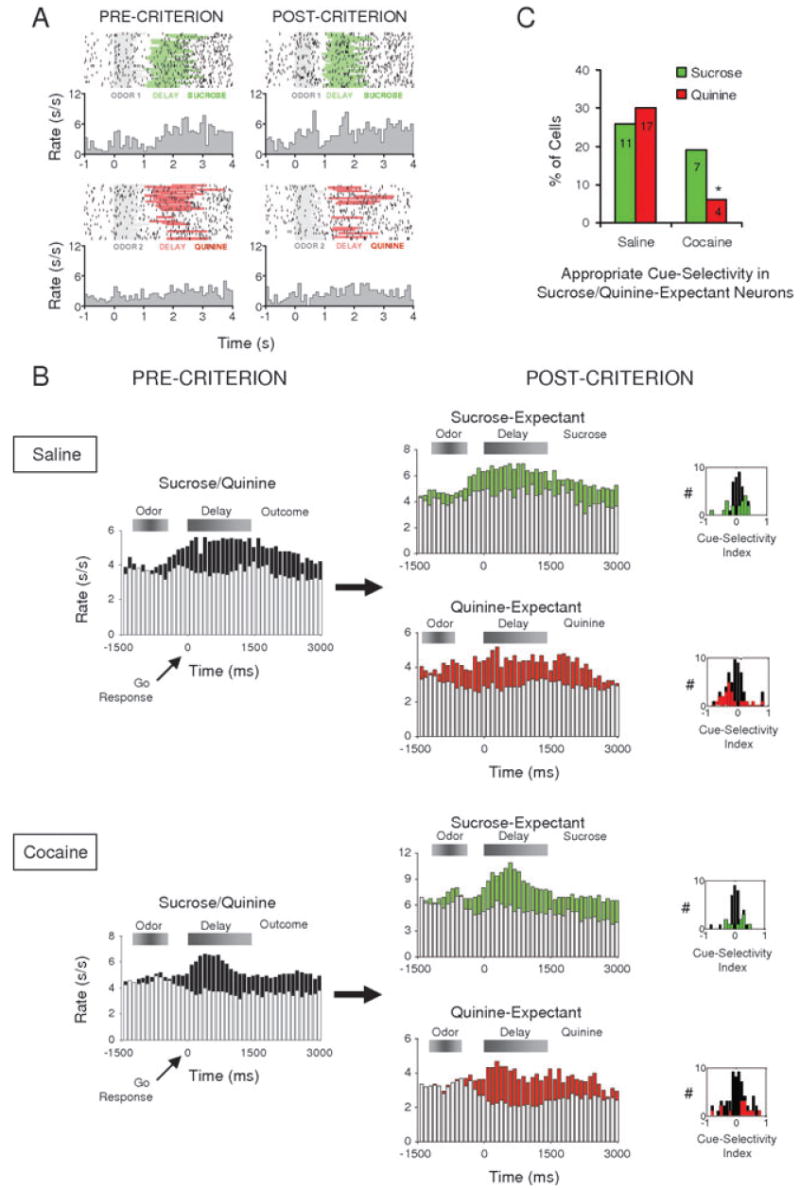
Cue-selectivity in outcome-expectant OFC neurons in saline- and cocaine-treated rats. (A) Single-unit with outcome-expectant activity recorded in a saline-treated rat. In the pre-criterion trials, this neuron fires selectively during a delay in anticipation of sucrose (green shading), as compared with quinine (red shading). In the post-criterion trials, the neuron becomes selective for the sucrose-predicting odor cue (grey shading, top panel), while still firing selectively in immediate anticipation of the sucrose. Raster displays show neural activity on individual trials, synchronized to odor onset, and each histogram shows average activity in spikes/s in 100-ms bins. (B) Population responses for outcome-expectant neurons. Shown are average firing rates, in spikes/s in 100-ms bins, on trials with the neurons' preferred outcomes (green bars, sucrose trials; red bars, quinine trials; black bars, preferred outcome trials) and non-preferred outcomes (white bars), synchronized to the response at the fluid well. Shaded boxes above the histograms indicate the approximate timing of odor sampling and the delay period. In saline-treated rats, both sucrose- and quinine-expectant neurons developed higher firing to the cue that predicted the neurons' preferred outcomes. By contrast, in cocaine-treated rats, only the sucrose-expectant neurons showed this correlate; the quinine-expectant population failed to become cue-selective after learning. An index of cue-selectivity, shown for each neuron in the population in insets next to each histogram, also demonstrates this difference. This index will be positive for neurons that fire more to the sucrose-predicting cue and negative for neurons that fire more to the quinine-predicting cue; green/red bars indicate scores for single-units that were significantly cue-selective by anova. The quinine-expectant population in cocaine-treated rats was unique in that these neurons were as likely to become selective for the odor that predicted sucrose as for the odor that predicted quinine. Note that because the histograms show neural activity synchronized on the behavioral response, only data from go trials are shown; however, statistical analyses of cue-selectivity shown in the insets considered activity on all trials, irrespective of whether a response was made. (C) Percentage of sucrose- (green) and quinine-expectant (red) single-units that developed significantly selective activity for the odor cue predicting sucrose and quinine, respectively. Cocaine-treated rats had significantly fewer neurons with these correlates overall, largely due to the near complete failure of quinine-expectant neurons to become selective for the quinine-predicting odor cue. (*, significant difference at P < 0.05 or better)