


Fig. 1.
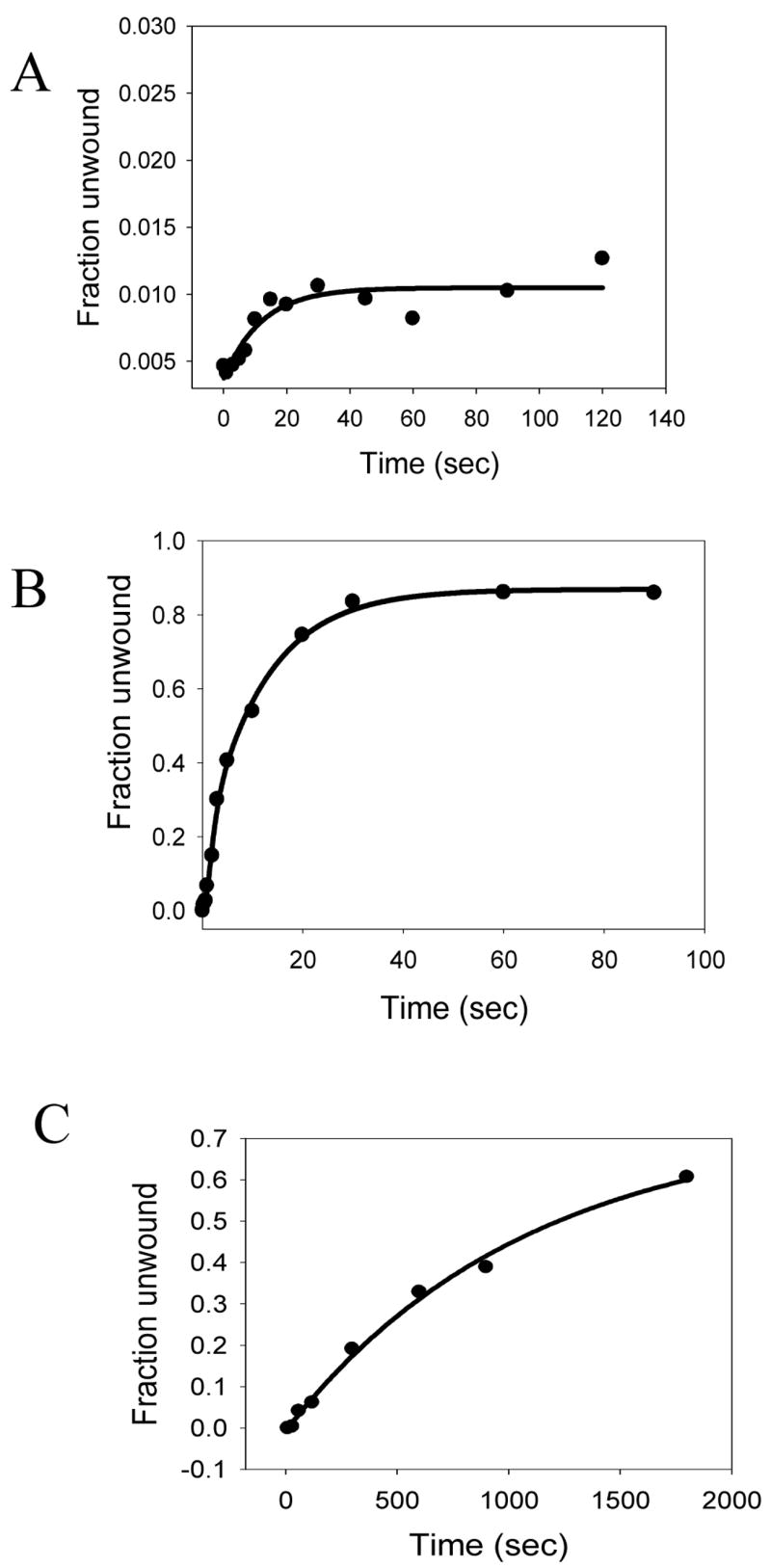
HCV NS3h has a low intrinsic processivity of DNA unwinding. (A) Unwinding kinetics of a 40bp forked DNA substrate (Table I, 3) under single turnover conditions. NS3h (200nM) was incubated with 5 nM ss/dsNA substrate in buffer in one syringe, and mixed with equal volume of 10 mM ATP, 1μM PolyU and 400nM DNA trap in the same buffer from the other syringe, for the times indicated. The unwinding reaction was stopped by the addition of a 1.5 fold volume of quenching solution. The reactions were carried out in a rapid quenched-flow instrument. NS3h unwinds less than 1% of the total DNA. (B) Unwinding kinetics of the 18bp forked DNA substrate (Table I, 6) under of single turnover conditions. Reactions were performed as explained above, but a 18bp forked DNA substrate was used instead of the 40bp forked DNA. NS3h unwinds about 80% of the 18bp substrate with a rate of 3.7 bp/s. (C) Unwinding kinetics of the 40bp forked DNA substrate under multiple turnover conditions. Unwinding reactions were carried out by incubating 200nM of NS3h with 5 nM ss/dsNA substrate in buffer in one syringe, and mixing with equal volume 10 mM ATP but no trap, in the same buffer from the other syringe for the times indicated. NS3h unwinds about 60% of the substrate at a rate of 0.4 bp/s.