


Figure 3. Concentration-response data for activation of human PXR, zebrafish PXR, and human VDR.
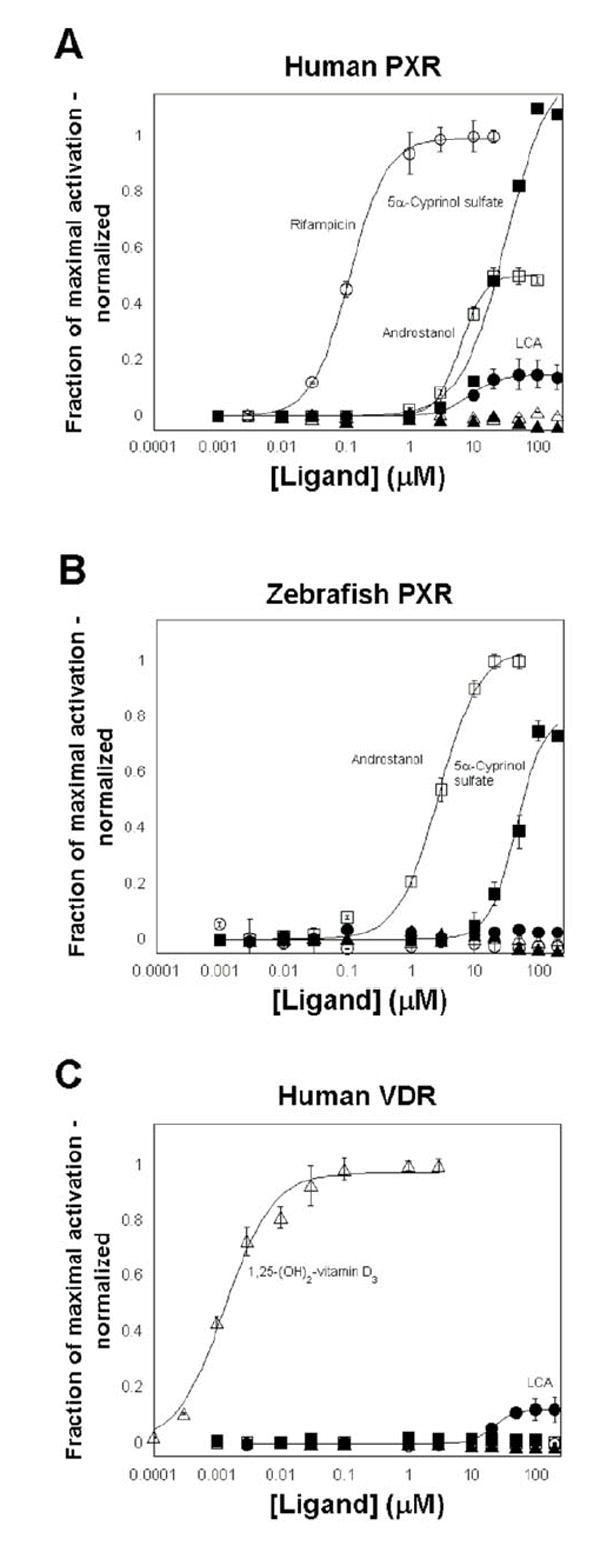
The ordinate represents activation of the PXR or VDR, relative to vehicle control, and normalized to the maximal activator (rifampicin for human PXR, 5α-androstan-3α-ol for zebrafish PXR, and 1,25-(OH)2-vitamin D3 for human VDR; see Supplementary Table Ia). The drugs tested were rifampicin (○), lithocholic acid (LCA, ●), androstanol (□), 5α-cyprinol sulfate (■), 5α-cyprinol (▲), and 1,25-(OH)2-vitamin D3 (Δ). (A) Human PXR is activated efficaciously by rifampicin, androstanol, and 5α-cyprinol sulfate. Micromolar concentrations of lithocholic acid activated human PXR but with low efficacy relative to rifampicin (approximately ε =0.15). Human PXR was not activated by 1,25-(OH)2-vitamin D3 or unconjugated cyprinol. (B) Zebrafish PXR is activated efficaciously by micromolar concentrations of androstanol and 5α-cyprinol sulfate but is not activated by lithocholic acid, unconjugated cyprinol, rifampicin, or 1,25-(OH)2-vitamin D3. (C) Human VDR is activated by nanomolar concentrations of 1,25-(OH)2-vitamin D3 and with low efficacy by micromolar concentrations of lithocholic acid. Human VDR is not activated by androstanol, rifampicin, cyprinol sulfate, or unconjugated cyprinol. In (A) and (B), full-length receptors for human PXR and VDR were used, with the reporter plasmid being CYP3A4-PXRE-Luc. In (C), a GAL4-LBD fusion was used for zebrafish PXR, with the reporter plasmid being tk-UAS-Luc.