



Abstract
Mammalian odorant receptors (ORs) are crucial for establishing the functional organization of the olfactory system but the mechanisms controlling their expression remain largely unexplained. Here we utilized a transgenic approach to explore OR-gene regulation. We determined that although olfactory sensory neurons (OSNs) are capable of supporting expression of multiple functional ORs, several levels of control ensure that each neuron normally expresses only a single odorant receptor. Surprisingly, this regulation extends beyond endogenous-ORs even preventing expression of transgenes consisting of OR-coding sequences driven by synthetic promoters. Thus, part of the intrinsic feedback system must rely on elements present in the OR-coding sequence. Notably, by expressing the same transgenic-ORs precociously in immature neurons, we have overcome this suppression and established a generic method to express any OR in ∼90% of OSNs. These results provide important insights into the hierarchy of OR-gene expression and the vital role of the OR-coding sequence in this regulation.
Introduction
The mammalian sense of smell relies on the detection of odorants by a very large family of G protein coupled receptors (GPCRs) which, in mice, are encoded by approximately 1,300 different genes (Buck and Axel, 1991; Zhang et al., 2007). These odorant receptors (ORs) are expressed by olfactory sensory neurons (OSNs) residing deep within the nasal cavities in the main olfactory epithelium (MOE). A key feature of the mammalian olfactory system is that each OSN expresses just one of the 2,600 potential OR-alleles (Chess et al., 1994; Malnic et al., 1999). This establishes the odorant selectivity of the neuron and marks its identity with that of a single specific OR protein. ORs also play an instructive role in the central projection of OSNs (Ressler et al., 1994; Vassar et al., 1994; Mombaerts et al., 1996; Wang et al., 1998) and the generation of a topographic map of odorant response properties in the olfactory bulb (Malnic et al., 1999; Belluscio and Katz, 2001). Thus, precise control of OR gene expression is fundamental for the assembly and operation of the mammalian olfactory system.
How does an OSN select a single OR allele from this large gene family for expression? Over the past few years two important principles have emerged. First, short DNA sequences upstream of the OR-receptor transcriptional start site have been demonstrated to have the capacity to drive the expression of ORs and reporter genes in OSNs in patterns that resemble those of endogenous ORs (Qasba and Reed, 1998; Vassalli et al., 2002). Second, OR gene expression prevents activation of other endogenous OR-genes by utilizing an OR-protein dependent feedback mechanism (Serizawa et al., 2003; Lewcock and Reed, 2004; Shykind et al., 2004). Recently, it was proposed that a putative transactivating element (H) may be involved in initiating expression of a single OR (Lomvardas et al., 2006). In this model, the unique complex containing the H-element would also serve as a target for feedback mechanisms that recognize the expression of a functional OR-protein thus preventing activation of additional OR-alleles (Serizawa et al., 2003; Lewcock and Reed, 2004; Shykind et al., 2004). However, more recent evidence demonstrates that the H-region is not essential for expression of most ORs but rather functions in cis, much like the locus control region (LCR) of the globin gene cluster, controlling the expression of a local group of OR genes (Serizawa et al., 2000; Serizawa et al., 2003; Fuss et al., 2007). Consequently, it was proposed that there may be many such LCR-like elements in the genome (Serizawa et al., 2004; Fuss et al., 2007). While these studies provide useful information to help explain how a single OR might be chosen, many aspects of odorant receptor gene regulation still remain unclear. Here, we have used a new approach to broadly express single ORs in many OSNs and have uncovered the presence of several layers of regulation involved in OR-gene suppression.
Results
Receptor-promoter interactions limit OR-expression
We have been interested in mechanisms governing OR-gene expression and initially explored the use of broadly expressed OSN genes as a potential tactic to target expression of one olfactory receptor to many sensory neurons. Surprisingly, placing the OR-coding sequence of several different ORs under the control of two different promoters, OMP and Gγ8, that efficiently drive expression of non-OR reporter genes in the olfactory system never resulted in transgenic OR expression in OSNs (Fig. 1A). These two promoters were chosen because they are active at different developmental stages of the OSN life cycle. OMP is a marker for mature olfactory sensory neurons (Rogers et al., 1987), whereas Gγ8, a heterotrimeric G-protein subunit, is expressed predominantly in immature OSNs, including some without dendritic or axonal projections (Ryba and Tirindelli, 1995). Importantly, such immature neurons do not express detectable levels of ORs (Cheng and Reed, 2007) and thus, the observed suppression of Gγ8-OR transgenes is independent of expression of endogenous odorant receptors.
Figure 1. Strategies used to investigate OR expression.
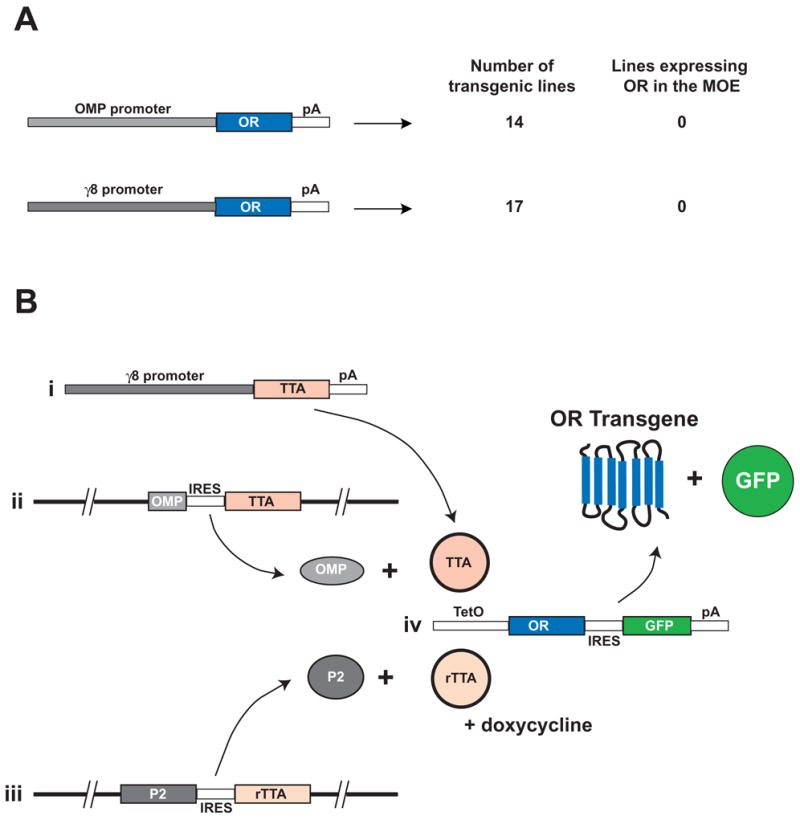
(A) Transgenic lines were generated using OMP and Gγ8 promoters directly upstream of three different OR coding sequences. Surprisingly, none of these 31 lines expressed detectable transgenic-mRNA in the MOE. (B) In an alternative approach, OR expression in OSNs was driven indirectly from olfactory promoters using a tetracycline-transactivator based system. We generated transgenic lines where the Gγ8 promoter drives expression of TTA in immature OSNs (i) and used two knockin lines: one driving TTA under the control of the OMP promoter in most mature OSNs (ii) and the other designed to express rTTA in a subset of mature OSNs that also express the P2 receptor (iii). These tetracycline transactivator lines were crossed with multiple lines of TetO-OR mice (iv) to express transgenic OR and bicistronically encoded GFP (or LacZ) in OSNs.
How does the inhibition of an OR transgene expression work, and could it also be part of the normal process controlling endogenous OR expression? We reasoned that perhaps the proximity of an odorant receptor coding sequence to conserved elements of a general olfactory promoter (i.e. present in the OMP and Gγ8 genes; Wang and Reed, 1993) might provide a signal for transgene silencing. Therefore, we developed an alternative strategy whereby OR-coding sequences were placed downstream of a synthetic TetO-promoter and crossed these transgenes into animals expressing tetracycline transactivators (TTA) to induce OR expression in the MOE (see Fig. 1B). To help track OR-transgene expression, we generated mice carrying bicistronic constructs consisting of TetO-OR-IRES-GFP or TetO-OR-IRES-lacZ using a number of different ORs (e.g. M72, M71, P2, P3, MOR28 and rat-I7 and I9).
In one set of studies, we made use of OMP-IRES-TTA knock-in mice (OMP-TTA, Yu et al., 2004) to express TTA in all mature olfactory neurons. We have now examined 37 different TetO-OR transgenic lines crossed into this background and in 36 of these lines observed broad but still limited expression of the transgenes in the MOE (Fig. 2A-D). Transgene expression was restricted to only 10–30% of OSNs (Fig. 2A-D) with substantial variation in total number of transgene-expressing neurons between different individual mice of the same genotype. Thus, separating the olfactory promoter from the OR coding sequence can partially overcome the suppression of OR transgene expression. However, the number and distribution of OSNs expressing the TetO-OR transgenes still did not approach the extent and uniformity that we observed for OMP-GFP, Potter et al., 2001, see Fig. 2E). To explore this issue further, we examined the expression of TetO-OR transgenes in the vomeronasal organ (VNO), which also expresses OMP. Remarkably, the vast majority of the VNO sensory neurons express the TetO-OR transgenes (Fig. 2F), closely mimicking the native expression of OMP. Thus, TetO-OR-transgenes are selectively silenced in the majority of OSNs.
Figure 2. TetO-OR transgenes driven by OMP-TTA are broadly expressed in the MOE.
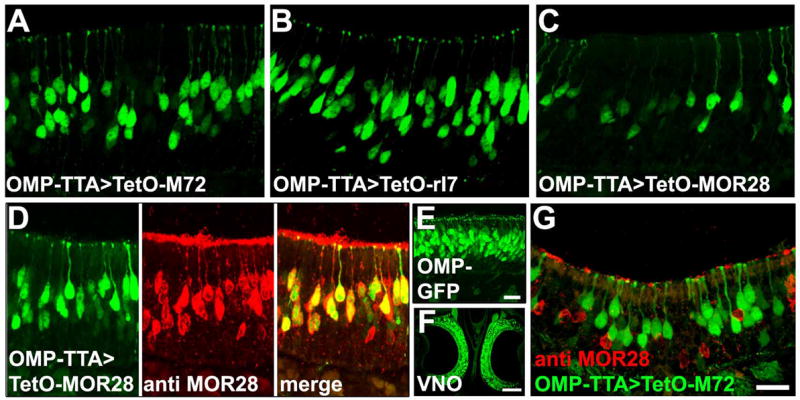
3-week old mice carrying the OMP-TTA knockin express TetO-OR-IRES-GFP transgenes but only in subsets of sensory neurons of the MOE (A-D). GFP fluorescence (A-D, G) and immunohistochemistry (D) demonstrate expression of a TetO-M72 (A, G), TetO-rI7 (B) and two TetO-MOR28 lines (C, D) in 10–30% of OSNs; note that as expected the cells expressing GFP are immunoreactive for the co-expressed transgenic OR (D). OMP is expressed in a much larger number of OSNs as indicated by an OMP-GFP knockin (E). In contrast to their limited expression in the MOE most TetO-OR transgenes are expressed in the majority of VNO sensory neurons (with 5 of 6 lines showing expression in >80% of neurons) as indicated for a TetO-M72 line (F). Expression of transgenic and endogenous ORs are mutually exclusive in OSNs (G) as indicated by the lack of cellular overlap between GFP fluorescence (TetO-M72, green) and endogenous MOR28 (immunofluorescence, red). Scale bars, MOE = 20 μm, VNO = 100 μm.
Reciprocal silencing of transgenic and endogenous olfactory receptors
Normally an OSN only expresses a single olfactory receptor (Chess et al., 1994; Malnic et al., 1999). Therefore, we wondered whether endogenous OR genes could be expressed in those cells where the OMP-driven OR transgene is on. To address this issue, we used double labeling techniques to determine whether endogenous and transgenic ORs are co-expressed. We followed transgene expression using GFP fluorescence and carried out immunohistochemistry to examine expression of MOR28, an OR that is expressed in a particularly large subset of OSNs (∼10% of OSNs in the ventral MOE: Tsuboi et al., 1999; Serizawa et al., 2000; Barnea et al., 2004). Fig. 2G demonstrates that transgenic-OR positive neurons never co-express the endogenous receptor MOR28, and conversely OSNs that express MOR28 do not express the transgene. Thus, expression of transgenic ORs driven by TTA indirectly from the OMP promoter is sufficient to prevent endogenous OR gene expression. Perhaps more remarkably, these data also show that expression of endogenous ORs can prevent expression of TTA-driven OR transgenes. Since the TetO-OR transgenes consist of just the OR coding sequence linked to a synthetic expression cassette, such two-way suppression would require that the highly variable OR coding sequences (Buck and Axel, 1991; Zhang et al., 2007) contain elements that are sufficient on the one hand to be silenced, and on the other to silence endogenous OR expression.
If endogenous receptor expression provides the signals necessary to silence expression of the OMP-driven OR transgene, how does the transgene ever escape such suppression? We reasoned that stochastic differences in the timing of endogenous OR and OMP gene expression might allow transgenic-OR expression to precede accumulation of endogenous receptor protein in a subset of OSNs. Thus, we hypothesized that precocious expression of TTA early in OSN development should increase the number of transgene-expressing cells, while delayed expression should further restrict the population of cells containing transgenic OR.
To test this hypothesis, we crossed our TetO-OR transgenes into backgrounds expressing TTA under the control of promoters that target TTA-expression to populations of olfactory neurons at different developmental stages. To restrict TTA expression to OSNs already expressing an endogenous OR, we made use of mice expressing a bicistronic P2-IRES-rTTA allele (P2-rTTA, Gogos et al., 2000). In these animals, the rTTA is encoded by the same transcript as the endogenously expressed olfactory receptor P2, thus ensuring their co-expression. Mice carrying the P2-rTTA knockin and TetO-OR transgenes were weaned at 3 weeks of age and rTTA activity was induced by feeding animals a high concentration doxycycline diet for an additional 3 weeks. In situ hybridization confirmed expression of rTTA in a P2-like pattern (Fig. 3A). However, these same animals had only an extremely small number of transgenic-OR positive cells. Counts from 4 different mice totaled just 7, 10, 12 and 64 reporter positive cells in the whole MOE, corresponding with expression of the TetO-OR-IRES-GFP transgenes in less than 2% of the P2-IRES-rTTA positive OSNs. Interestingly, the few cells expressing the OR-transgene were all found at the base of the olfactory epithelium, right at the site where immature OSNs are located (Fig. 3B). Together, these data demonstrate that the TetO-OR transgenes are silenced in the vast majority of cells expressing endogenous receptor but suggest that there is a period early in the development of the OSN where both endogenous (i.e. P2-IRES-rTTA) and transgenic receptor (TetO-OR-IRES-GFP) mRNA can be co-expressed. Presumably this reflects the time required to accumulate sufficient receptor protein expression to enable the presence of one OR to silence other OR-genes.
Figure 3. Suppression of TetO-OR transgenes in cells expressing endogenous ORs.
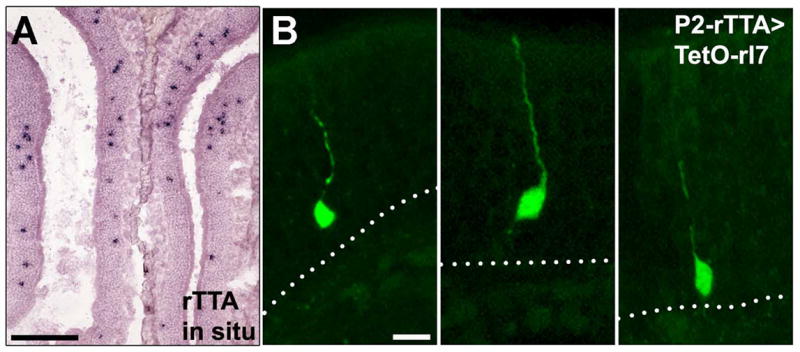
In situ hybridization using an rTTA probe demonstrates that 6 week old mice carrying the P2-rTTA knockin and TetO-rI7 transgene express rTTA in an OR like pattern after doxycycline treatment (A). In contrast, GFP-fluorescence revealed that very few, basally-localized, OSNs express the TetO-rI7 transgene (B, see text for more detail). Broken lines indicate the base of the MOE; scale bars, A: 200 μm; B: 10 μm.
To explore whether there is a permissive time window for transgenic OR expression that precedes endogenous OR expression, we carried out the complementary experiment, whereby TetO-OR transgenes are now expressed in immature OSNs. We achieved this by generating transgenic mice where the Gγ8 promoter drives expression of the tetracycline transactivator. Gγ8 is robustly expressed in OSNs of young animals, but as animals age, Gγ8 expression is limited to the regenerating olfactory neural population (Ryba and Tirindelli, 1995). Three independent Gγ8-TTA lines were generated, and two of these expressed TTA in at least 50% of the Gγ8 positive OSNs (compare Fig. 4A and B). The Gγ8-TTA mice were crossed with the various TetO-OR transgenic animals to determine whether the OR-transgenes could be broadly expressed and not subjected to suppression as seen when driven by the late-expressing drivers. Indeed, Fig. 4 demonstrates that the OR transgenes are now broadly expressed. Therefore it appears that precocious OR-transgene expression does overcome the endogenous OR-dependent suppression observed in OMP-TTA and P2-rTTA animals.
Figure 4. Precocious expression of TetO-OR using Gγ8-TTA overcomes suppression of the TetO-transgene.
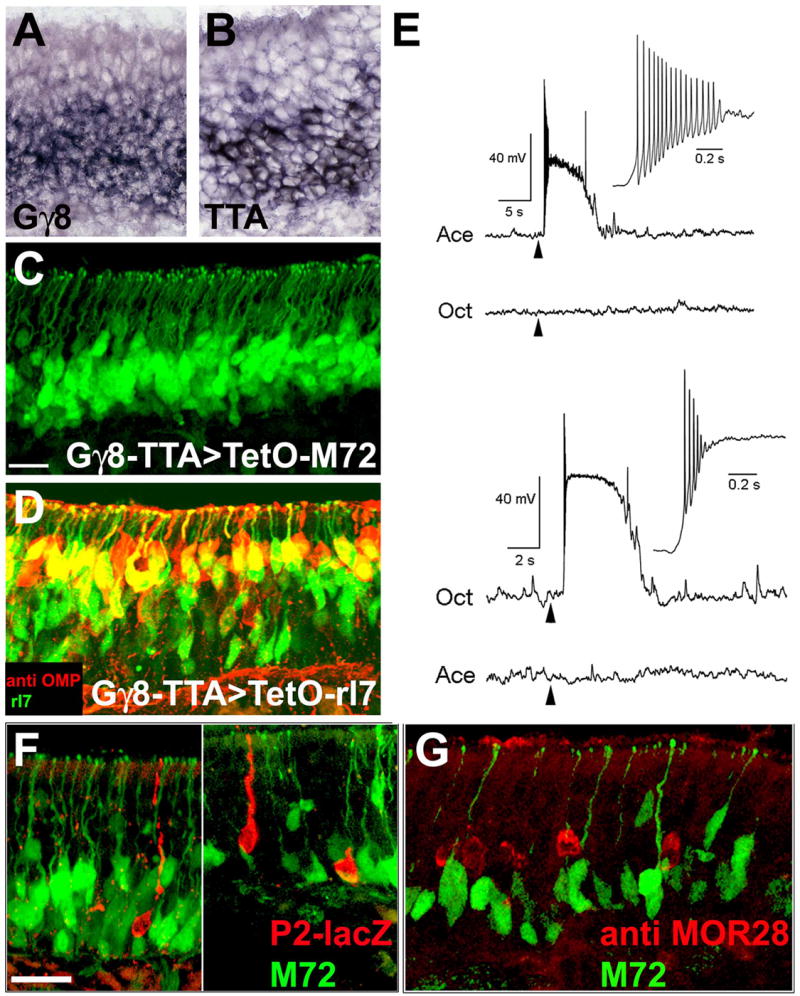
In situ hybridization of the MOE of 1–2 week old mice with Gγ8 (A) and TTA (B) probes indicate that TTA is expressed in a large subset (>50%) of Gγ8 positive neurons in Gγ8-TTA animals. GFP fluorescence demonstrates that in 2–3 week-old double transgenic mice (carrying Gγ8-TTA and TetO-OR transgenes) many OSNs express TetO-M72 (C) and TetO-rI7 (D). GFP positive OSNs (C-D) extend dendrites to the surface of the MOE with the more apically located neurons co-expressing OMP (red immunofluorescence, D). Electrophysiological recordings from OSNs expressing the M72-transgene or rI7-transgene of 1–2 week old mice (E) demonstrate that transgenic receptors are functional and confer selective responses to acetophenone (ACE-M72, n=24 cells) and octanal (OCT-rI7, n=7 cells). Arrowheads mark onset of odor pulses that selectively induced rapid depolarization of OSNs triggering trains of action potentials (inset). (F) Representative confocal images of the MOE from 3-week old mice carrying both Gγ8-TTA and TetO-OR transgenes as well as a P2-lacZ knockin construct to mark cells expressing the endogenous P2-receptor show that cells expressing transgenic ORs (GFP-fluorescence) do not co-express the endogenous receptor P2 (red, β-galactosidase-immunofluorescence). Similarly, there was no overlap between transgenic (green, GFP) and the endogenous OR, MOR28 (red, immunofluorescence) in Gγ8-TTA, TetO-M72 double-transgenic animals (G). Note that the different levels of GFP-fluorescence reflect regional differences in Gγ8-TTA expression, with higher expression in dorsal regions (F, left panel) compared to ventral regions where MOR28 is predominantly expressed (G). Scale bar, 20 μm.
Are the Gγ8 driven ORs functional and capable of suppressing endogenous receptor expression? To test for function we relied on expression of two receptors, rI7 and M72, whose activating ligands (octanal and acetophenone, respectively) have been identified (Zhao et al., 1998; Bozza et al., 2002). Fig. 4E shows that transgenic rI7 expressing neurons respond to octanal but not acetophenone while M72 positive OSNs respond to acetophenone but not octanal. To examine the suppressing potential of these transgenic ORs, we investigated whether endogenous MOR28 or P2 (using a P2-IRES-tau-lacZ reporter animal (Mombaerts et al., 1996) are ever co-expressed with Gγ8-TTA driven OR-transgenes. Fig. 4G demonstrates that transgenic OR positive cells never co-express endogenous MOR28. In addition, we have examined several thousand-P2-positive cells (Fig. 4F) from more than 30 mice and have never observed even a single P2-positive OSN that co-expresses the transgene.
Generation of mice expressing a single OR in the majority of OSNs
We have shown that by separating the olfactory promoter from the OR-coding sequence and expressing the OR precociously using the Gγ8-promoter we could overcome suppression of OR-transgenes in OSNs. However, because Gγ8 is predominantly active in developing rather than mature OSNs, the expression of transgenic ORs indirectly under its control is transient, and by 6 weeks of age OR-transgene expression is limited to the small population of regenerating neurons (Fig. 5A). We reasoned that if indeed the first OR that is expressed establishes the cell identity and inhibits expression of other ORs, then mice carrying both Gγ8-TTA and OMP-TTA should ensure activation and continued expression of the transgenic OR throughout the life of an OSN. This approach should result in transgene expression in a much larger population of mature OSNs than we observed with the OMP-TTA driver alone (Fig. 5B) and in principle, should also completely prevent endogenous OR expression. Indeed, 6-week old mice carrying both OMP-TTA and Gγ8-TTA now express TTA-driven transgenic ORs in almost all OSNs (Fig. 5 C, D). Moreover, as predicted, OSNs expressing the transgenic receptor do not co-express endogenous ORs (MOR28 and P2), which are now restricted to an extremely small population of OSNs (Fig. 5E and data not shown). Together these results provide a strong validation of our proposal that the first OR to be expressed silences other ORs. In addition, we have shown that by initiating OR expression in immature OSNs and maintaining it in mature neurons, it is now possible to drive expression of any TetO-OR transgene in essentially all OSNs.
Figure 5. Expression of transgenic receptor in most OSNs.
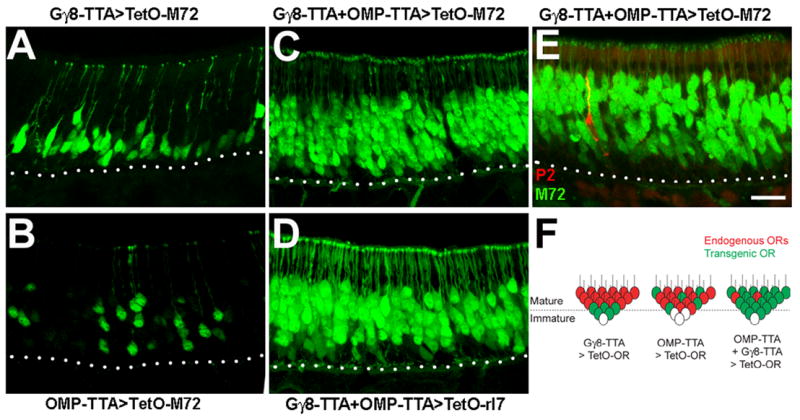
(A) MOE from a 6 week old Gγ8-TTA, TetO-M72 double transgenic animal showing transgene expression (GFP, green) in significantly fewer OSNs than in younger mice (see Fig. 4). Note these GFP-positive cells show a markedly basal localization that corresponds with Gγ8-expression in immature OSNs. However, the expression pattern of TetO-M72 driven by OMP-TTA in 6 week old mice (B) remains similar to that observed in 3 week old animals (Fig. 2) i.e. restricted to 10–30% of OSNs. Remarkably, in combination Gγ8-TTA and OMP-TTA are capable of driving TetO-OR transgene expression in virtually all OSNs as shown for 6-week old mice expressing TetO-M72 (C, E) and TetO-rI7 (D). Such mice retain a very small number of OSNs expressing endogenous receptors as indicated by staining for a P2-lacZ reporter (red, E). Dotted lines indicate the base of the MOE; scale bar, 20 μm (A-E). (F) Diagram summarizing these results depicts expression of endogenous receptors (red) and TetO-OR transgenes driven by Gγ8-TTA and/or OMP-TTA (green) in non-overlapping subsets of OSNs. When TTA expression is driven by Gγ8 (left lane), only a small subset of relatively immature neurons express the OR-transgene reflecting the limited expression of Gγ8 in 6 week old mice. Indirect expression of OR-transgenes using OMP-TTA (middle) results in endogenous receptor mediated silencing of the OR-transgene in the majority of OSNs. In contrast, by combining OMP-TTA and Gγ8-TTA (right lane), precocious expression of the transgene under the control of Gγ8-TTA is maintained in mature neurons under the control of OMP-TTA silencing expression of endogenous ORs in the vast majority of OSNs.
Olfactory receptor sequence but not function is required for OR-silencing
Next, we sought to determine whether non-odorant receptor GPCR-transgenes are also subject to OR dependent feedback inhibition in OSNs, or if this is a property of functional ORs. First, we crossed OMP-TTA mice with either TetO-hT2R16 (a human taste receptor GPCR, Mueller et al., 2005) or TetO-RASSL (a modified opioid receptor, Redfern et al., 2000) and observed that these GPCRs are expressed in the vast majority of OMP-expressing OSNs (data not shown) demonstrating that the OSN suppression of ORs is not extended to GPCRs in general, but is highly selective for ORs. Is a functional OR required to suppress the expression of other OR transcripts? To investigate this, we generated odorant receptors containing a mutation at the highly conserved DRY sequence, a motif located at the cytoplasmic face of helix-3 and essential for activating G-proteins and downstream signaling pathways (Acharya and Karnik, 1996). Notably, our data showed that the expression of a mutated TetO-M72ALE transgene, where DRY has been changed to ALE (Fig. 6B) is indistinguishable from that of the fully functional TetO-OR allele (Figs. 2 and 4). Indeed, expression of the M72ALE transgene both suppresses and is suppressable by endogenous ORs (Fig. 6B). Independent experiments by (Imai et al., 2006) using a different mutation of the DRY sequence are consistent with our data and also indicate that mutated ORs suppress activation of other endogenous OR genes.
Figure 6. GPCR function is not required for OR suppression and OSNs are competent to express two functional receptors.
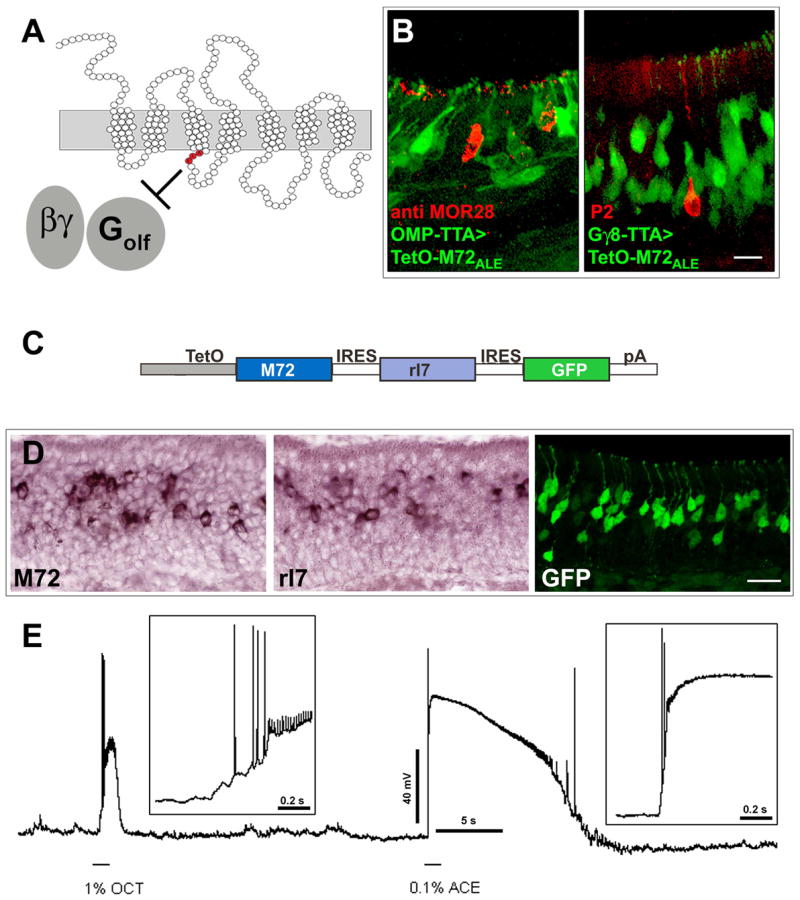
(A) Diagram indicates that mutation of the highly conserved “DRY” sequence of M72 to “ALE” (red residues) prevents G-protein coupling (Acharya and Karnik, 1996). However, this mutation has no influence on the mutually exclusive expression of the transgenic (TetO-M72ALE) and endogenous receptors driven by OMP-TTA (B, left panel) or Gγ8-TTA (B, right panel). Shown are TetO-M72ALE expression (green) with endogenous MOR28 immunofluorescence (B, left panel, red) and β-galactosidase immunostaining in 3 week old mice also carrying a P2-lacZ allele (B, right panel, red). The transgene used to co-express two odorant receptors in an OSN is schematically shown (C). In situ hybridization and GFP fluorescence (D) indicate that both ORs (M72 and rI7) and GFP are expressed in the MOE of 3 week old mice when driven by OMP-TTA. Moreover, functional recordings (E) from GFP-labeled OSNs (1-2 week old animals) demonstrate that these neurons co-express M72 and rI7 and respond to both octanal (OCT) and acetophenone (ACE); insets show that both odorants trigger action potentials (n=17 cells). Scale bar, 10 μm (B), 20 μm (D).
Expression of multiple functional olfactory receptors in an OSN
The expression of a single OR in a mammalian OSN involves a number of layers of regulation (e.g. selection, promoter dependent inhibition and OR-dependent silencing) that combine to prevent multiple different OR genes from being co-expressed. Can such a complex system be over-ridden to allow expression of multiple functional ORs within a single OSN? To address this issue we sought to express M72 and rI7 (two receptors that are known to respond to different odorants, see Fig. 4E) in a single neuron. Thus we could use electrophysiological recordings to unequivocally determine whether a given OSN did indeed express two functional ORs. Our approach involved generating mice carrying a single construct expressing these two ORs from the same regulatory sequence, TetO-M72-IRES-rI7-IRES-GFP (TetO-M72-rI7, see Fig. 6C). When TetO-M72-rI7 was crossed to OMP-TTA (or Gγ8-TTA) the transgene was expressed in a subset of OSNs (just like other TetO-OR transgenes) that now contained mRNA for both transgenic receptors (e.g. see Fig. 6D). More importantly, single cell recordings demonstrated that GFP-labeled neurons responded robustly both to octanal and acetophenone (Fig. 6E). Thus, while mammalian OSNs are tightly regulated to transcribe only a single OR allele, they are quite capable of translating, processing, and utilizing two different odorant receptors.
Discussion
A mammalian olfactory neuron expresses a single olfactory receptor, yet it has over 2500 potential OR alleles to choose from. How this process is orchestrated is a central question in cellular and molecular neurobiology. Recent studies in mice have uncovered two important features of OR-gene control. First, a conserved DNA sequence upstream of the MOR28 gene, the H-element, has been shown to work in cis to activate any one (but only one at a time) of a handful of downstream OR-genes (Serizawa et al., 2000; Serizawa et al., 2003; Fuss et al., 2007). Remarkably, in the nucleus of an OSN, this same element associates in a chromosomal complex with the actively expressed OR-allele, even if the OR is from a different genomic location. These results led Lomvardas and coworkers to propose that the H-elements may also act in trans to select the expression of a single OR per neuron (Lomvardas et al., 2006). Second, several studies examined the expression of OR-pseudogenes with various mutations that all prevented translation of a full length odorant receptor (Serizawa et al., 2003; Lewcock and Reed, 2004; Feinstein et al., 2004). Notably, this type of OR-pseudogene was often co-expressed with a functional OR-gene in an OSN. Complementary experiments that directly examined the stability of receptor choice demonstrated that OR-switching normally occurs albeit at a low frequency in immature OSNs but is dramatically enhanced whenever an OSN selects a non-translatable OR-mutant (Shykind et al., 2004). Thus it was suggested (Serizawa et al., 2003; Lewcock and Reed, 2004; Shykind et al., 2004) that the odorant receptor-protein is required to initiate a regulatory feedback process that ensures each OSN expresses a single functional OR-allele rather than an OR-pseudogene (a significant problem for mice and humans, where approx. 20% and 70% of OR-genes are non-functional, Zhang et al., 2007).
In this study, we sought to examine the regulatory hierarchy of OR-gene expression by experimentally dissociating the process of gene selection from feedback inhibition. By using heterologous promoters to express transgenic ORs in the MOE, we demonstrated that although an OSN can be forced to functionally express two different ORs, multiple layers of control operate to ensure that normally just one OR is expressed in each olfactory neuron.
Together, our results revealed several layers of regulation in the hierarchy that controls odorant receptor choice. First, we showed that transgenic ORs driven from a synthetic TetO-promoter are capable of suppressing selection and/or expression of endogenous OR-genes. This finding is consistent with the OR-mediated feedback inhibition described previously (Serizawa et al., 2003; Lewcock and Reed, 2004; Shykind et al., 2004). What signals are important for this type of suppression? While the mechanisms underlying this process have not been defined, it was recognized that OR and immunoglobulin gene-regulation share features including monoallelic gene expression and feedback inhibition (Serizawa et al., 2003; Lewcock and Reed, 2004; Shykind et al., 2004). In the immune system, developing B-lymphocytes require a functional pre-B cell receptor that initiates a tyrosine kinase cascade, which transmits the signal to prevent further gene rearrangement and ensures monoallelic expression (Nemazee, 2000). Therefore it was anticipated that signaling through an odorant receptor might play an important role in maintaining the monoallelic expression of a functional OR in each OSN (Serizawa et al., 2003; Lewcock and Reed, 2004; Shykind et al., 2004). Interestingly, our data demonstrate that suppression of endogenous receptors still occurs even with an OR-transgene, TetO-M72ALE that contains mutations making it incapable of activating a G protein pathway (see also Imai et al., 2006). In combination, these findings imply that although an OSN needs to be able to detect expression of a full-length OR-protein, signaling through the olfactory signal transduction pathway is not necessary for the feedback inhibition.
Second, we demonstrated that while it has not been experimentally feasible to drive OR expression using general olfactory promoters in engineered mice, this suppression can be overcome by separating the promoter from the OR coding sequence; this is most dramatically illustrated when comparing Gγ8 directly driving an OR transgene versus Gγ8 driving TTA, which in turn drives expression of a TetO-OR transgene. Third, and perhaps most surprisingly, expression of an endogenous OR prevents expression of transgenic ORs even if driven by completely unrelated regulatory sequences, like those of the bacterial tetracycline system. Indeed, although TTA is found in the vast majority of the OSNs in OMP-TTA knock-in mice, TetO driven ORs are only expressed in a fraction of these cells. This means that the short (∼1kb) and highly variable OR coding sequences themselves (Buck and Axel, 1991; Zhang et al., 2007) are sufficient to mark a transgene as an OR locus and make them one target for feedback inhibition. However, our data do not rule out the existence of other targets e.g. at the level of gene-selection as recently postulated (Lomvardas et al., 2006; Serizawa et al., 2006). Finally, we showed that precocious expression of a transgenic OR ensures suppression of endogenous receptors thus suggesting a “first-takes-all / early-bird-gets-the-worm” paradigm.
Mammalian odorant receptors are recognized to have at least three quite different functions in OSNs: (a) determining the odorant selectivity (sensory tuning) of the neurons (Zhao et al., 1998), (b) playing an instructive role in targeting their axonal connections in the olfactory bulb (Ressler et al., 1994; Vassar et al., 1994; Mombaerts et al., 1996; Wang et al., 1998), and (c) functioning as the trigger for feedback inhibition (Serizawa et al., 2003; Lewcock and Reed, 2004; Shykind et al., 2004). Our results have provided fascinating new insight into the control of OR-gene expression and raise a number of challenging questions, for example, how does an OSN determine whether it is expressing an OR gene? What is the nature of the feedback mechanism that ensures continued expression of this one OR while keeping all other OR genes silent even when driven by a synthetic promoter? And what features of an OR coding sequence does an OSN recognize to implement this complex regulation? The approach described here that reliably allows expression of any receptor throughout the entire epithelium should help address some of these issues and thereby aid dissection of the mechanisms regulating the expression of OR genes.
Experimental Procedures
Mice
All transgenic lines were produced by pronuclear injection of zygotes from FVB/N mice. The Gγ8-TTA construct consisted of −2561 to +3 (the location of the Gγ8 ATG) fused to TTA (tet-off). TetO-ORs (TetO-OR-IRES-reporter) utilized full length OR receptor sequences in a standard TetO expression vector (Gogos et al., 2000). Three lines of Gγ8-TTA transgenic mice were obtained, all with variation in TTA mRNA expression. We selected the line with the highest number of TTA-positive OSNs where approx. 60–80% of Gγ8-expressing cells (variation reflecting mouse to mouse differences) are positive for TTA. Direct Gγ8-OR constructs utilized the same Gγ8-upstream sequence; OMP-OR constructs used a previously described promoter region (Walters et al., 1996). More than 80 independent TetO-OR-IRES-reporter lines were generated containing ten different OR genes and either a GFP or LacZ reporter. PCR mediated mutagenesis was used to introduce the DRY to ALE mutation in both the M72 and rI7 receptors to generate TetO-M72ALE and TetO-rI7ALE transgenes (both of which produced equivalent results when expressed in OSNs). For doxycycline treatment to induce rTTA (tet-on) activation, mice were weaned at 3 weeks and were then fed a diet (Bioserv) containing 6g/kg doxycycline for 3 weeks at which point olfactory epithelia were harvested for analysis. Knock-in mice: OMP-TTA, P2-rTTA (P2-IRES-rTTA), OMP-GFP (OMP-IRES-GFP), and P2-LacZ (P2-IRES-Tau-LacZ) mice have been described previously (Mombaerts et al., 1996; Gogos et al., 2000; Potter et al., 2001; Bozza et al., 2002) and were generous gifts from Joseph Gogos and Peter Mombaerts. For all experiments, the transgenes were hemizygous and knock-in backgrounds heterozygous.
Histology and Fluorescence Imaging
In situ hybridization and immunhistochemistry were carried out as described previously (Belluscio et al., 2002; Zhao et al., 2003). Antibodies against β-galactosidase and OMP were from MP Biochemicals and Wako Chemicals USA, Inc. and were used at 1:500 and 1:5000 dilutions respectively. Anti-MOR28 antibody was generously provided by Richard Axel and was used at a 1:6000 dilution (Barnea et al., 2004). Cy3-labaeled secondary antibodies (used at 1:500 dilutions) were from Jackson Immuno-Research. Confocal images (1 μm optical sections) were collected using a Zeiss LSM-510-Meta confocal (Carl Zeiss Inc.). Fluorophores used were GFP, excitation 488, emission 507; and Cy3, excitation 550, emission 570.
Functional Recordings
Electrophysiological recordings on olfactory sensory neurons were carried out as described previously (Ma et al., 1999). Briefly, GFP-positive cells of ∼ 2 week old animals were identified by fluorescence and DIC optics (Olympus BX51WI) and recordings were targeted to dendritic knobs using perforated-patch configuration. Amphotericin B was included in the patch pipette solution at a final concentration of 240 μg / ml.
Acknowledgments
We would like to thank Youmei Wu for early work characterizing the Gγ8-promoter, Andrew Cho, and the NIDCR Transgenic Facility for help generating the transgenic mice used in this study, M. Ma and X. Grosmaitre for assistance with electrophysiological recordings, and Joseph Gogos, Richard Axel, Gilad Barnea and Peter Mombaerts for providing various genetically modified mice and antibodies. We are particularly grateful to Charles Zuker for his very insightful suggestions and also to members of our labs for their help and critical review of the manuscript. This research was supported by the Intramural Research Program of the NIH, NIDCR and NINDS.
Footnotes
Publisher's Disclaimer: This is a PDF file of an unedited manuscript that has been accepted for publication. As a service to our customers we are providing this early version of the manuscript. The manuscript will undergo copyediting, typesetting, and review of the resulting proof before it is published in its final citable form. Please note that during the production process errors may be discovered which could affect the content, and all legal disclaimers that apply to the journal pertain.
References
- Acharya S, Karnik SS. Modulation of GDP release from transducin by the conserved Glu134-Arg135 sequence in rhodopsin. J Biol Chem. 1996;271:25406–25411. doi: 10.1074/jbc.271.41.25406. [DOI] [PubMed] [Google Scholar]
- Barnea G, O’Donnell S, Mancia F, Sun X, Nemes A, Mendelsohn M, Axel R. Odorant receptors on axon termini in the brain. Science. 2004;304:1468. doi: 10.1126/science.1096146. [DOI] [PubMed] [Google Scholar]
- Belluscio L, Katz LC. Symmetry, stereotypy, and topography of odorant representations in mouse olfactory bulbs. J Neurosci. 2001;21:2113–2122. doi: 10.1523/JNEUROSCI.21-06-02113.2001. [DOI] [PMC free article] [PubMed] [Google Scholar]
- Belluscio L, Lodovichi C, Feinstein P, Mombaerts P, Katz LC. Odorant receptors instruct functional circuitry in the mouse olfactory bulb. Nature. 2002;419:296–300. doi: 10.1038/nature01001. [DOI] [PubMed] [Google Scholar]
- Bozza T, Feinstein P, Zheng C, Mombaerts P. Odorant receptor expression defines functional units in the mouse olfactory system. J Neurosci. 2002;22:3033–3043. doi: 10.1523/JNEUROSCI.22-08-03033.2002. [DOI] [PMC free article] [PubMed] [Google Scholar]
- Buck L, Axel R. A novel multigene family may encode odorant receptors: a molecular basis for odor recognition. Cell. 1991;65:175–187. doi: 10.1016/0092-8674(91)90418-x. [DOI] [PubMed] [Google Scholar]
- Cheng LE, Reed RR. Zfp423/OAZ participates in a developmental switch during olfactory neurogenesis. Neuron. 2007;54:547–557. doi: 10.1016/j.neuron.2007.04.029. [DOI] [PMC free article] [PubMed] [Google Scholar]
- Chess A, Simon I, Cedar H, Axel R. Allelic inactivation regulates olfactory receptor gene expression. Cell. 1994;78:823–834. doi: 10.1016/s0092-8674(94)90562-2. [DOI] [PubMed] [Google Scholar]
- Feinstein P, Bozza T, Rodriguez I, Vassalli A, Mombaerts P. Axon guidance of mouse olfactory sensory neurons by odorant receptors and the beta2 adrenergic receptor. Cell. 2004;117:833–846. doi: 10.1016/j.cell.2004.05.013. [DOI] [PubMed] [Google Scholar]
- Fuss SH, Omura M, Mombaerts P. Local and cis effects of the H element on expression of odorant receptor genes in mouse. Cell. 2007;130:373–384. doi: 10.1016/j.cell.2007.06.023. [DOI] [PubMed] [Google Scholar]
- Gogos JA, Osborne J, Nemes A, Mendelsohn M, Axel R. Genetic ablation and restoration of the olfactory topographic map. Cell. 2000;103:609–620. doi: 10.1016/s0092-8674(00)00164-1. [DOI] [PubMed] [Google Scholar]
- Imai T, Suzuki M, Sakano H. Odorant receptor-derived cAMP signals direct axonal targeting. Science. 2006;314:657–661. doi: 10.1126/science.1131794. [DOI] [PubMed] [Google Scholar]
- Lewcock JW, Reed RR. A feedback mechanism regulates monoallelic odorant receptor expression. Proc Natl Acad Sci U S A. 2004;101:1069–1074. doi: 10.1073/pnas.0307986100. [DOI] [PMC free article] [PubMed] [Google Scholar]
- Lomvardas S, Barnea G, Pisapia DJ, Mendelsohn M, Kirkland J, Axel R. Interchromosomal interactions and olfactory receptor choice. Cell. 2006;126:403–413. doi: 10.1016/j.cell.2006.06.035. [DOI] [PubMed] [Google Scholar]
- Ma M, Chen WR, Shepherd GM. Electrophysiological characterization of rat and mouse olfactory receptor neurons from an intact epithelial preparation. J Neurosci Methods. 1999;92:31–40. doi: 10.1016/s0165-0270(99)00089-8. [DOI] [PubMed] [Google Scholar]
- Malnic B, Hirono J, Sato T, Buck LB. Combinatorial receptor codes for odors. Cell. 1999;96:713–723. doi: 10.1016/s0092-8674(00)80581-4. [DOI] [PubMed] [Google Scholar]
- Mombaerts P, Wang F, Dulac C, Chao SK, Nemes A, Mendelsohn M, Edmondson J, Axel R. Visualizing an olfactory sensory map. Cell. 1996;87:675–686. doi: 10.1016/s0092-8674(00)81387-2. [DOI] [PubMed] [Google Scholar]
- Mueller KL, Hoon MA, Erlenbach I, Chandrashekar J, Zuker CS, Ryba NJP. The receptors and coding logic for bitter taste. Nature. 2005;434:225–229. doi: 10.1038/nature03352. [DOI] [PubMed] [Google Scholar]
- Nemazee D. Receptor selection in B and T lymphocytes. Annu Rev Immunol. 2000;18:19–51. doi: 10.1146/annurev.immunol.18.1.19. [DOI] [PMC free article] [PubMed] [Google Scholar]
- Potter SM, Zheng C, Koos DS, Feinstein P, Fraser SE, Mombaerts P. Structure and emergence of specific olfactory glomeruli in the mouse. J Neurosci. 2001;21:9713–9723. doi: 10.1523/JNEUROSCI.21-24-09713.2001. [DOI] [PMC free article] [PubMed] [Google Scholar]
- Qasba P, Reed RR. Tissue and zonal-specific expression of an olfactory receptor transgene. J Neurosci. 1998;18:227–236. doi: 10.1523/JNEUROSCI.18-01-00227.1998. [DOI] [PMC free article] [PubMed] [Google Scholar]
- Redfern CH, Degtyarev MY, Kwa AT, Salomonis N, Cotte N, Nanevicz T, Fidelman N, Desai K, Vranizan K, Lee EK, et al. Conditional expression of a Gi-coupled receptor causes ventricular conduction delay and a lethal cardiomyopathy. Proc Natl Acad Sci U S A. 2000;97:4826–4831. doi: 10.1073/pnas.97.9.4826. [DOI] [PMC free article] [PubMed] [Google Scholar]
- Ressler KJ, Sullivan SL, Buck LB. Information coding in the olfactory system: evidence for a stereotyped and highly organized epitope map in the olfactory bulb. Cell. 1994;79:1245–1255. doi: 10.1016/0092-8674(94)90015-9. [DOI] [PubMed] [Google Scholar]
- Rogers KE, Dasgupta P, Gubler U, Grillo M, Khew-Goodall YS, Margolis FL. Molecular cloning and sequencing of a cDNA for olfactory marker protein. Proc Natl Acad Sci U S A. 1987;84:1704–1708. doi: 10.1073/pnas.84.6.1704. [DOI] [PMC free article] [PubMed] [Google Scholar]
- Ryba NJP, Tirindelli R. A novel GTP-binding protein gamma-subunit, G gamma 8, is expressed during neurogenesis in the olfactory and vomeronasal neuroepithelia. J Biol Chem. 1995;270:6757–6767. doi: 10.1074/jbc.270.12.6757. [DOI] [PubMed] [Google Scholar]
- Serizawa S, Ishii T, Nakatani H, Tsuboi A, Nagawa F, Asano M, Sudo K, Sakagami J, Sakano H, Ijiri T, et al. Mutually exclusive expression of odorant receptor transgenes. Nat Neurosci. 2000;3:687–693. doi: 10.1038/76641. [DOI] [PubMed] [Google Scholar]
- Serizawa S, Miyamichi K, Nakatani H, Suzuki M, Saito M, Yoshihara Y, Sakano H. Negative feedback regulation ensures the one receptor-one olfactory neuron rule in mouse. Science. 2003;302:2088–2094. doi: 10.1126/science.1089122. [DOI] [PubMed] [Google Scholar]
- Serizawa S, Miyamichi K, Sakano H. One neuron-one receptor rule in the mouse olfactory system. Trends Genet. 2004;20:648–653. doi: 10.1016/j.tig.2004.09.006. [DOI] [PubMed] [Google Scholar]
- Serizawa S, Miyamichi K, Takeuchi H, Yamagishi Y, Suzuki M, Sakano H. A neuronal identity code for the odorant receptor-specific and activity-dependent axon sorting. Cell. 2006;127:1057–1069. doi: 10.1016/j.cell.2006.10.031. [DOI] [PubMed] [Google Scholar]
- Shykind BM, Rohani SC, O’Donnell S, Nemes A, Mendelsohn M, Sun Y, Axel R, Barnea G. Gene switching and the stability of odorant receptor gene choice. Cell. 2004;117:801–815. doi: 10.1016/j.cell.2004.05.015. [DOI] [PubMed] [Google Scholar]
- Tsuboi A, Yoshihara S, Yamazaki N, Kasai H, Asai-Tsuboi H, Komatsu M, Serizawa S, Ishii T, Matsuda Y, Nagawa F, Sakano H. Olfactory neurons expressing closely linked and homologous odorant receptor genes tend to project their axons to neighboring glomeruli on the olfactory bulb. J Neurosci. 1999;19:8409–8418. doi: 10.1523/JNEUROSCI.19-19-08409.1999. [DOI] [PMC free article] [PubMed] [Google Scholar]
- Vassalli A, Rothman A, Feinstein P, Zapotocky M, Mombaerts P. Minigenes impart odorant receptor-specific axon guidance in the olfactory bulb. Neuron. 2002;35:681–696. doi: 10.1016/s0896-6273(02)00793-6. [DOI] [PubMed] [Google Scholar]
- Vassar R, Chao SK, Sitcheran R, Nunez JM, Vosshall LB, Axel R. Topographic organization of sensory projections to the olfactory bulb. Cell. 1994;79:981–991. doi: 10.1016/0092-8674(94)90029-9. [DOI] [PubMed] [Google Scholar]
- Walters E, Grillo M, Tarozzo G, Stein-Izsak C, Corbin J, Bocchiaro C, Margolis FL. Proximal regions of the olfactory marker protein gene promoter direct olfactory neuron-specific expression in transgenic mice. J Neurosci Res. 1996;43:146–160. doi: 10.1002/(SICI)1097-4547(19960115)43:2<146::AID-JNR3>3.0.CO;2-G. [DOI] [PubMed] [Google Scholar]
- Wang F, Nemes A, Mendelsohn M, Axel R. Odorant receptors govern the formation of a precise topographic map. Cell. 1998;93:47–60. doi: 10.1016/s0092-8674(00)81145-9. [DOI] [PubMed] [Google Scholar]
- Wang MM, Reed RR. Molecular cloning of the olfactory neuronal transcription factor Olf-1 by genetic selection in yeast. Nature. 1993;364:121–126. doi: 10.1038/364121a0. [DOI] [PubMed] [Google Scholar]
- Yu CR, Power J, Barnea G, O’Donnell S, Brown HE, Osborne J, Axel R, Gogos JA. Spontaneous neural activity is required for the establishment and maintenance of the olfactory sensory map. Neuron. 2004;42:553–566. doi: 10.1016/s0896-6273(04)00224-7. [DOI] [PubMed] [Google Scholar]
- Zhang X, Zhang X, Firestein S. Comparative genomics of odorant and pheromone receptor genes in rodents. Genomics. 2007;89:441–450. doi: 10.1016/j.ygeno.2007.01.002. [DOI] [PMC free article] [PubMed] [Google Scholar]
- Zhao GQ, Zhang Y, Hoon MA, Chandrashekar J, Erlenbach I, Ryba NJP, Zuker CS. The receptors for mammalian sweet and umami taste. Cell. 2003;115:255–266. doi: 10.1016/s0092-8674(03)00844-4. [DOI] [PubMed] [Google Scholar]
- Zhao H, Ivic L, Otaki JM, Hashimoto M, Mikoshiba K, Firestein S. Functional expression of a mammalian odorant receptor. Science. 1998;279:237–242. doi: 10.1126/science.279.5348.237. [DOI] [PubMed] [Google Scholar]