


Figure 1.
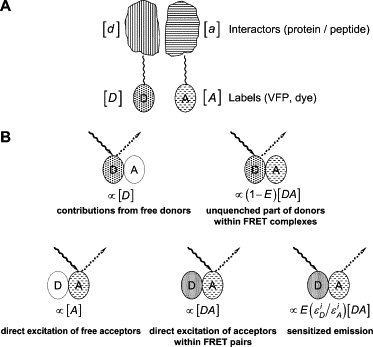
Conventions and fluorescence properties of interacting molecules. (A) We consider interactors d and a, which can be present either as separate molecules at abundances [d] and [a], respectively, or else as complexes at [da]. They are labeled with chromophores D (for donor) and A (for acceptor). Since labeling may not be complete and since fluorophores—even when present—may not be functional (either because of bleaching or incomplete folding), we distinguish between d and D (and a and A) and call [D] the abundance of those donor fluorophores, which are intact and coupled to a monomeric interactor of type d. Likewise, we call [A] and [DA] the abundances of intact fluorophores of monomeric type a and of complexes, da, respectively. Note that, in the latter case, both fluorophores have to be intact for da to qualify as DA. The relationship between [a], [d], and [da] on the one hand and [A], [D], and [DA] on the other, is given by Eqs. 28–30. We assume that the dimerization is not influenced by the labeling state of the interactors. (B) The upper row shows the fluorophore configurations leading to fluorescence with donor emission characteristics. These are the contributions to δi of Eq. 14. The left side shows the emission from free donor D, which can be either a monomeric, correctly labeled molecule of type d (see above), or a dimer with an intact fluorophore D and a nonfluorescent (or nonexisting) label on a. The lower row shows the three contributions to fluorescence (Eq. 15) with emission spectrum of the acceptor.