


Figure 2.
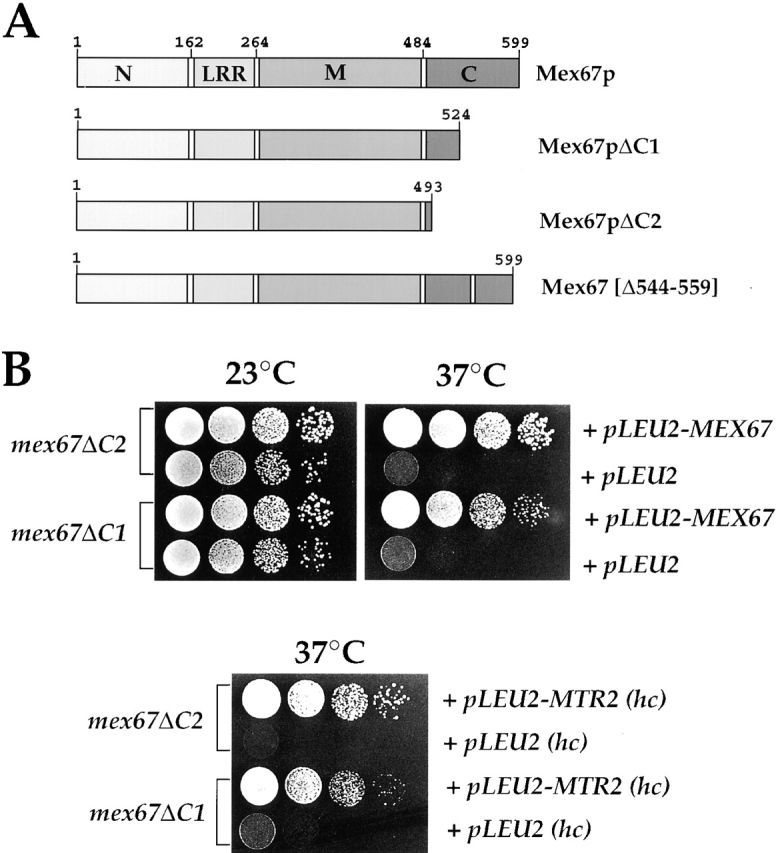
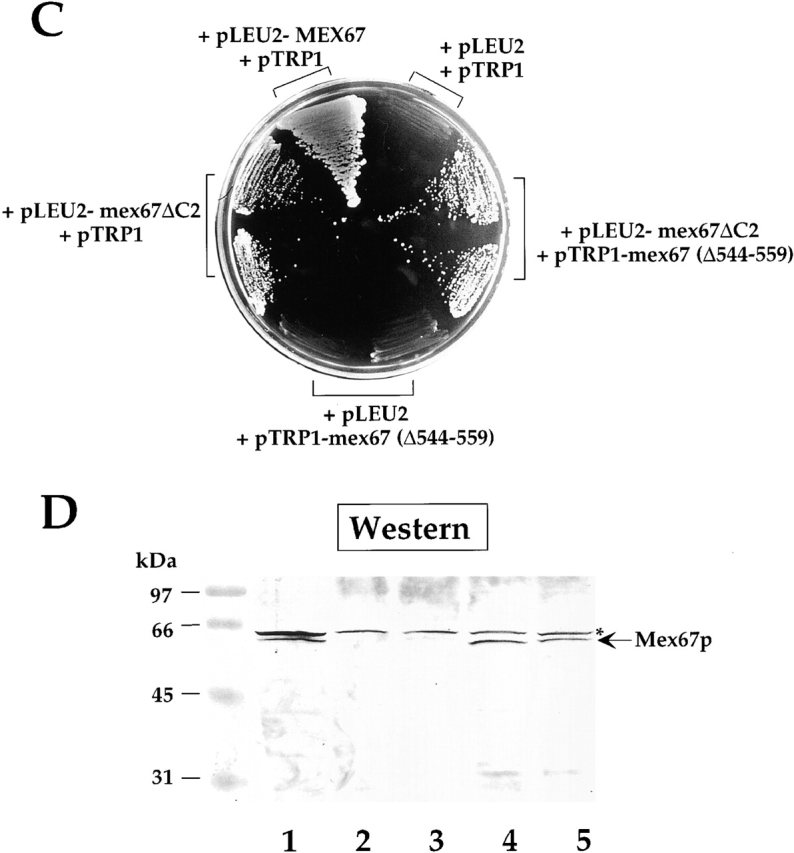
The C domain of Mex67p is not essential for cell growth. A, Domain organization of Mex67p and amino acid truncations/point mutations in the C domain. B, Growth of the mex67ΔC1 and mex67ΔC2 thermosensitive mutants at 23 and 37°C. The same amount of cells was diluted in 10−1 steps, spotted onto YPD plates, and grown for 3 d at the indicated temperatures. The mutants were transformed with empty, MEX67, or MTR2 containing plasmids (pLEU2, either single or hc plasmid). C, The mex67(Δ544–559) allele is not dominant-lethal. The MEX67 shuffle strain (mex67::HIS3, pURA3-MEX67) was transformed with the pLEU2 and pTRP1 plasmids coding for the indicated gene constructs. Transformants were then streaked onto 5-FOA plates (+uracil, −leucine, −tryptophane) and grown for 5 d at 30°C. The nonviable mex67(Δ544–559) allele has been described recently (Segref et al. 1997). D, Western blot analysis of whole cell yeast lysates expressing mex67ΔC2 deletion constructs using anti-Mex67p antibodies. 1, full-length Mex67p; 2, mex67ΔC2 and mex67(Δ544–559) (low-copy); 3, mex67ΔC2 and mex67(L[552]>P) (low copy); 4, mex67ΔC2 and mex67(Δ544–559) (hc); 5, mex67ΔC2 and mex67(L[552]>P) (hc). The band marked by an asterisk is a protein cross-reacting with the anti-Mex67p immune serum. A molecular weight marker standard is also shown.